Fencing shared or communal garden spaces
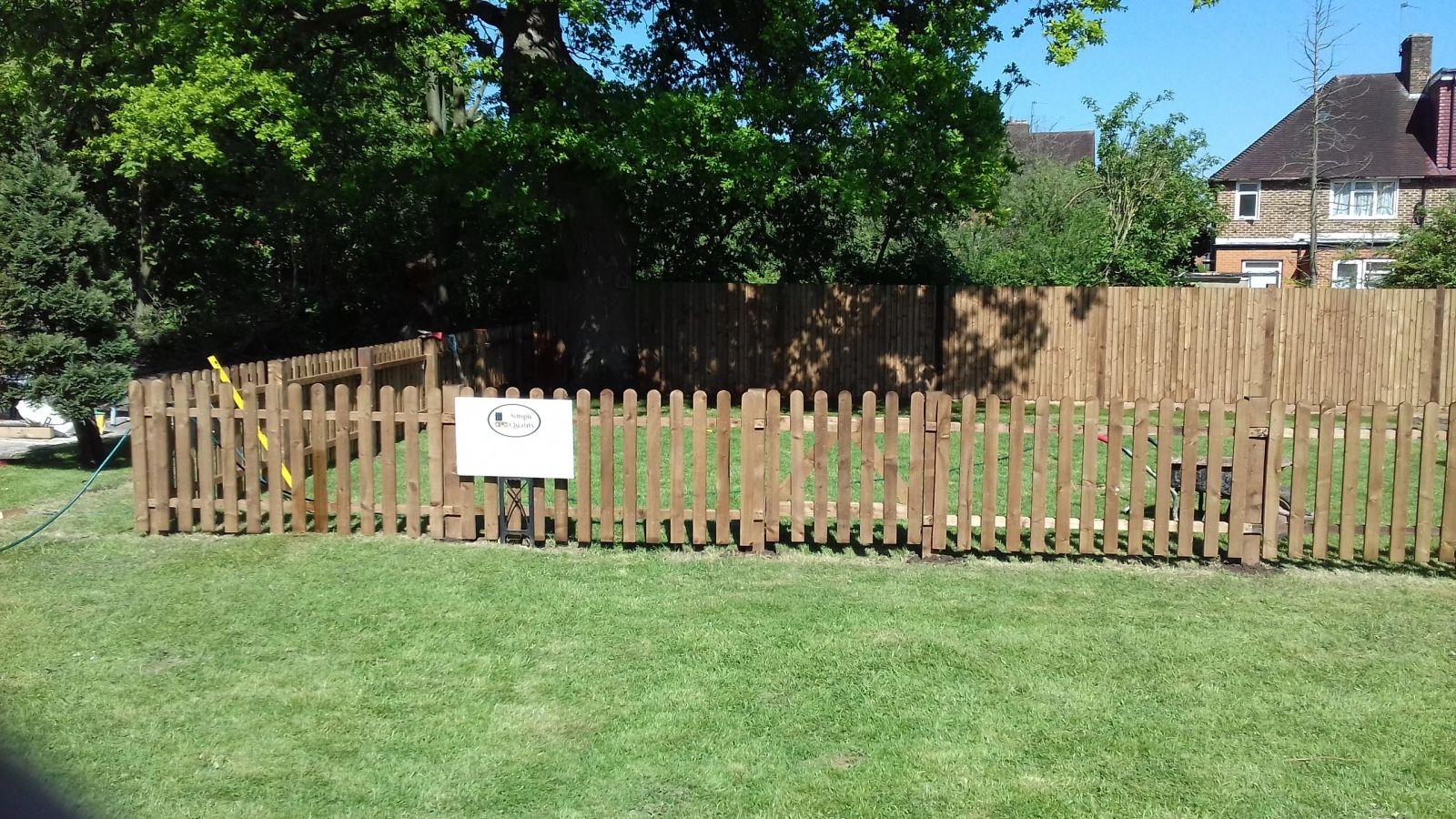
Communal gardens shared by several properties usually need any new fencing agreed by the group or managing body rather than one resident acting unilaterally, since a partition can change how the whole space is used.
Where a communal garden includes mature planting or trees under a collective management plan, new fence lines need checking against that plan rather than just against the ground itself.
Access routes for maintenance vehicles or refuse collection through a communal garden also need to stay clear when planning new subdivisions with fencing.
Corner plots and highway sightlines
A boundary fronting a road used by vehicles is limited to 1m under permitted development, but corner plots have a second constraint: the highway authority's visibility splay, which can require even lower boundary treatment near a junction so drivers can see pedestrians and oncoming traffic.
These splays are measured as a triangle from a set point back along both roads and are sometimes fixed by a planning condition on the original build rather than by the general permitted development rules.
A solid fence built to the letter of the 1m rule can still be a highway safety problem on a tight corner, so it's worth checking the local plan or asking planning before finalising height on a corner boundary.
Pre-commencement conditions affecting acoustic works
Where a wider development has planning conditions requiring noise mitigation before other works begin, an acoustic boundary fence can be caught by a pre-commencement condition that has to be discharged with the local authority before installation starts.
Checking whether any such condition applies before ordering materials avoids installing a barrier that then has to be altered to satisfy a condition that wasn't accounted for at the outset.
Stainless steel grades near salted roads
Grade 304 stainless steel resists general corrosion well but can develop surface pitting when regularly exposed to chloride from de-icing salt spray thrown up by passing traffic.
Grade 316 stainless includes molybdenum, which significantly improves resistance to chloride pitting, and is the more appropriate specification for fixings and fittings on roadside fencing subject to winter gritting.
The cost difference between the two grades is usually small relative to the fitting itself, so specifying 316 near a heavily gritted road is generally worth it for the extended service life alone.
Post top crown-cutting for water shedding
A crown cut, a shallow diagonal saw cut across the top of a fence post, sheds rainwater to one side rather than letting it pool flat on the post's exposed end grain.
It's a lower-cost alternative to fitting a separate post cap and can be combined with an end-grain preservative treatment applied to the freshly cut surface for extra protection.
A flat-topped post left uncapped and uncut is the most exposed detail on an otherwise well-treated post, since the end grain there absorbs water directly with nothing to divert it.
Using profile boards at corners
Profile boards — a horizontal board fixed between two pegs set back from the actual corner — let a string line be set, removed and reinstated at the exact same point throughout a job without disturbing the corner itself.
They're most useful where a run turns through an angle, since the intersecting lines from two boards mark the true corner point independently of any post already dug.
Leaving the boards in place until the last post is set and checked avoids the common error of the line creeping slightly as pegs get knocked or the string is re-tied.
Stain, oil and paint finishes compared
A stain sits mostly on the surface with some absorption, giving colour and some UV protection while still letting the timber's grain show through, and it typically needs reapplying every couple of years on an exposed fence.
An oil penetrates further into the timber and feeds it rather than just coating it, which suits open-grained hardwood decking and cladding, but it wears off through foot traffic and weathering faster than a stain on a vertical surface.
Paint gives the most complete colour coverage and hides the timber grain entirely, but it also traps moisture behind an intact film if the substrate isn't fully dry, and a failed paint film is harder to recover from than a faded stain, which just needs cleaning and recoating.
Sheltered courtyard microclimates and reduced wear
A small enclosed courtyard garden surrounded by walls or buildings on most sides creates a sheltered microclimate with reduced wind and often reduced direct rain exposure, which can extend the practical life of a timber finish well beyond the general guideline interval.
The trade-off is often reduced airflow and higher humidity in the enclosed space, which can favour algae or mould growth even though the timber itself isn't taking direct weather.
Recommending a maintenance interval based on general exposure alone can be too cautious for a sheltered courtyard or too relaxed for a damp, poorly-ventilated one, so it's worth judging each enclosed garden on its own conditions.
Cleat fixing at pale-to-rail junctions
Pales are commonly bolted to rails through a cleat rather than welded, because a bolted cleat can be replaced individually if a pale is damaged, whereas a welded joint means cutting into the rail to make a repair.
Cleats are punched to match the pale profile so the fixing sits flush rather than proud, and a mismatched cleat left loose is one of the more common defects found on an older palisade run at survey stage.