Backfilling technique around a set post
Backfilling isn't just tipping soil or concrete into the gap around a post — compacting it in stages as it's added, rather than filling the hole in one go, avoids leaving voids that let the post shift later.
Where soil rather than concrete is used as backfill on a lighter garden fence, layering and firming it every 100-150mm gives a noticeably more stable result than one loose fill tamped only at the top.
Overfilling and mounding backfill above ground level around the post, rather than finishing flush or slightly domed for drainage, is a common shortcut that leaves a lip where water collects against the post face.
Timber grading for a mass-and-seal build
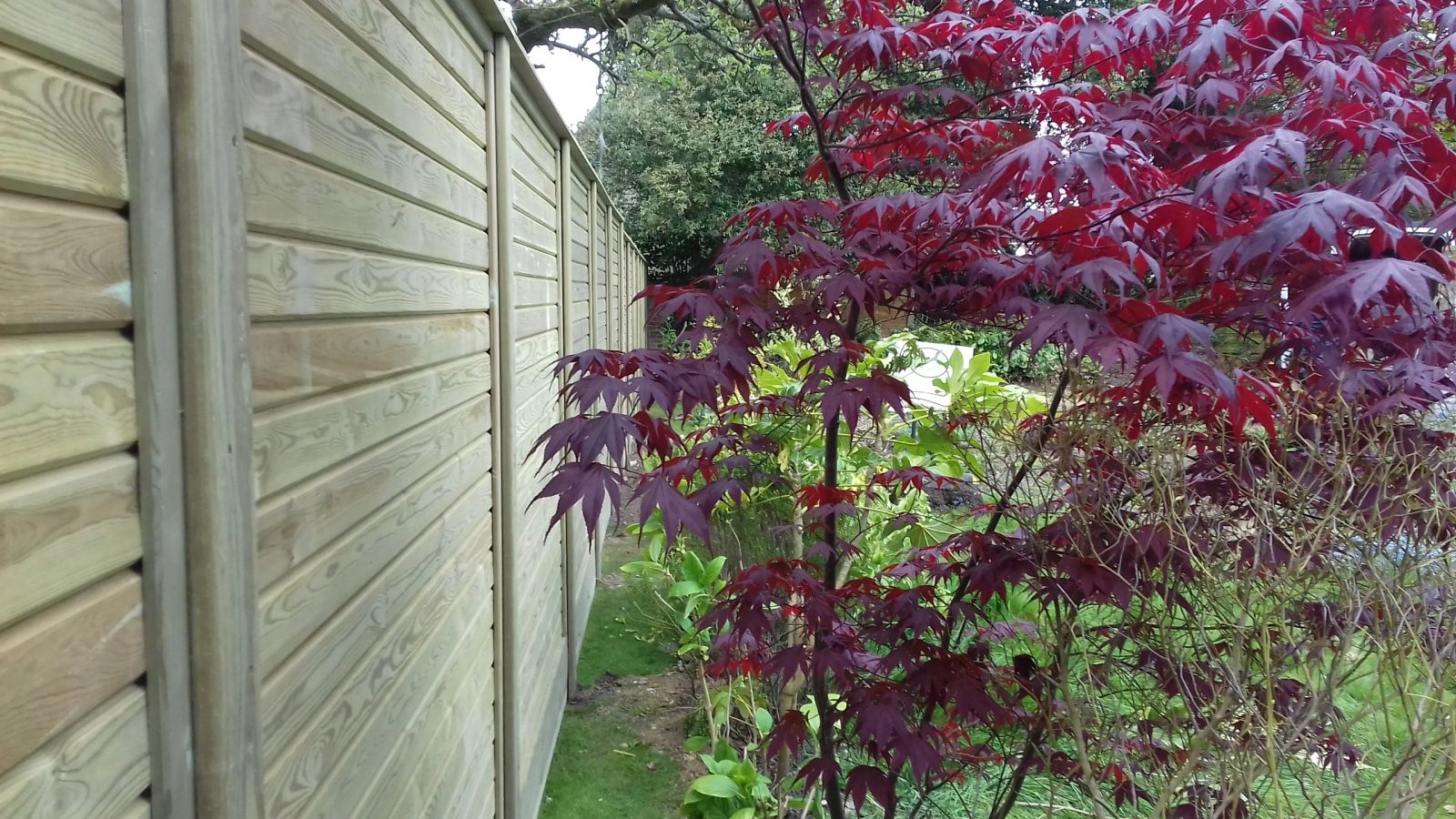
Denser timber contributes more mass to the mass-and-seal principle than a lighter, faster-grown section of the same nominal thickness, so board selection matters more on an acoustic job than on a standard fence.
Both skins are fully pressure-treated before assembly, since the infill cavity between them is harder to inspect or re-treat once the fence is built.
Staining and finishing heavy timber
A dense acoustic timber skin takes stain or preservative in the same way as any timber fence, but the thicker section and the sealed cavity behind it mean both faces need proper coverage since the inner face is harder to reach for future maintenance.
Finishing before final assembly, where the design allows, ensures the inner skin gets a proper coat rather than being left untreated once the infill and outer skin are in place.
Boundary work near underpinning or subsidence repairs
A property that's had underpinning or subsidence repair work sometimes has ground disturbance extending into the garden near the boundary, which can affect where a new fence line can safely be dug without disturbing settled ground.
Where underpinning is recent, it's worth checking with whoever carried out the structural work before digging post holes nearby, since the settlement process can continue for some time after the visible repair is finished.
Cracking in an existing boundary wall running close to a subsidence-affected building is sometimes an early symptom worth reporting rather than just repairing cosmetically.
Fencing alongside a shared access driveway
A driveway shared by two or more properties usually carries a right of way that limits how close a new fence can come to the actual running surface, regardless of who legally owns the land beneath it.
Width needs checking against the widest vehicle that regularly uses the shared drive, not just a car, since delivery vans and refuse vehicles are a common reason an otherwise reasonable-looking fence line turns out too tight.
Gates across a shared driveway need agreement from all parties with a right of way over it, and usually a means of access — a code, a key, or simply leaving it unlocked — for everyone who needs to use the route.
Outbuildings casting permanent shade onto a fence run
A shed, greenhouse or garage built close to a boundary casts a fixed shadow over part of the adjoining fence run for some or all of the day, creating the same slower-drying conditions as a north-facing aspect regardless of the fence's actual orientation.
This localised shading is easy to overlook when assessing a whole boundary's exposure, since the rest of the run a few metres away may be in full sun.
It's worth treating the shaded section as its own microclimate for treatment and inspection purposes rather than assuming uniform conditions along the full length.
Questions to ask any fencing contractor
Worth asking directly: who owns the boundary being worked on, what happens if buried obstructions are found, and whether waste removal and disposal are included in the price rather than charged separately afterwards.
It's also reasonable to ask what post-setting method will be used for the specific ground conditions on site, since a contractor who hasn't looked at soil type before quoting depth and concrete volume is guessing rather than specifying.
Asking how a contractor handles a shared boundary with a neighbour who hasn't been consulted is a good test of whether they've thought through the ownership question at all, rather than just the fence itself.
Trellis toppers for extra height and privacy
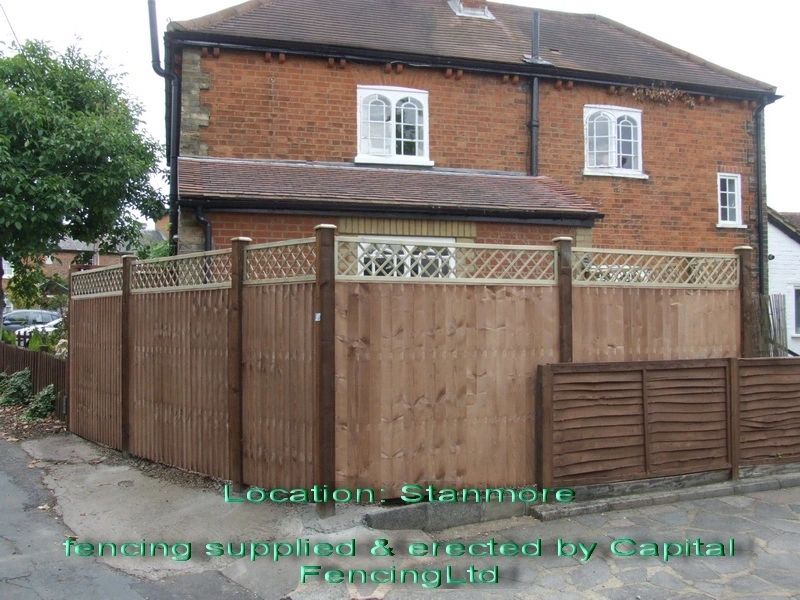
Adding a trellis topper to an existing or new fence is a common way to gain extra height for climbing plants or additional privacy without exceeding permitted development limits for a solid boundary.
Because trellis is inherently more open than solid panel, it doesn't usually count the same way toward the 2m height rule in every case, but it's still worth checking with the local authority since interpretations vary.
A trellis topper needs its own bracing where it's more than a token height, since a tall panel of trellis catching wind behaves more like a sail than most people expect.
Strainer posts and wire tensioning loads
A strainer, or straining post, anchors the end of a tensioned wire or mesh run and needs to resist a sustained pulling load along the line of the fence, which is a materially different stress to the mostly lateral wind load an intermediate post experiences.
Strainer posts are typically set deeper, in a larger concrete footing, or braced with a diagonal strut back to a second post, specifically to resist this sustained pull rather than an occasional gust.
Under-specifying a strainer post relative to the wire tension applied is a common cause of an entire fence run gradually leaning inward from one end, since the strainer post itself moves rather than the wire actually loosening.