Scribing a gravel board to uneven ground
Ground level rarely runs perfectly straight between two posts, so a gravel board cut square often leaves a gap under one end and digs into the ground at the other unless it's scribed to follow the actual contour.
Scribing means holding the board in position, marking the ground profile onto its face, and cutting along that line so the board's bottom edge follows the undulation rather than an assumed flat datum.
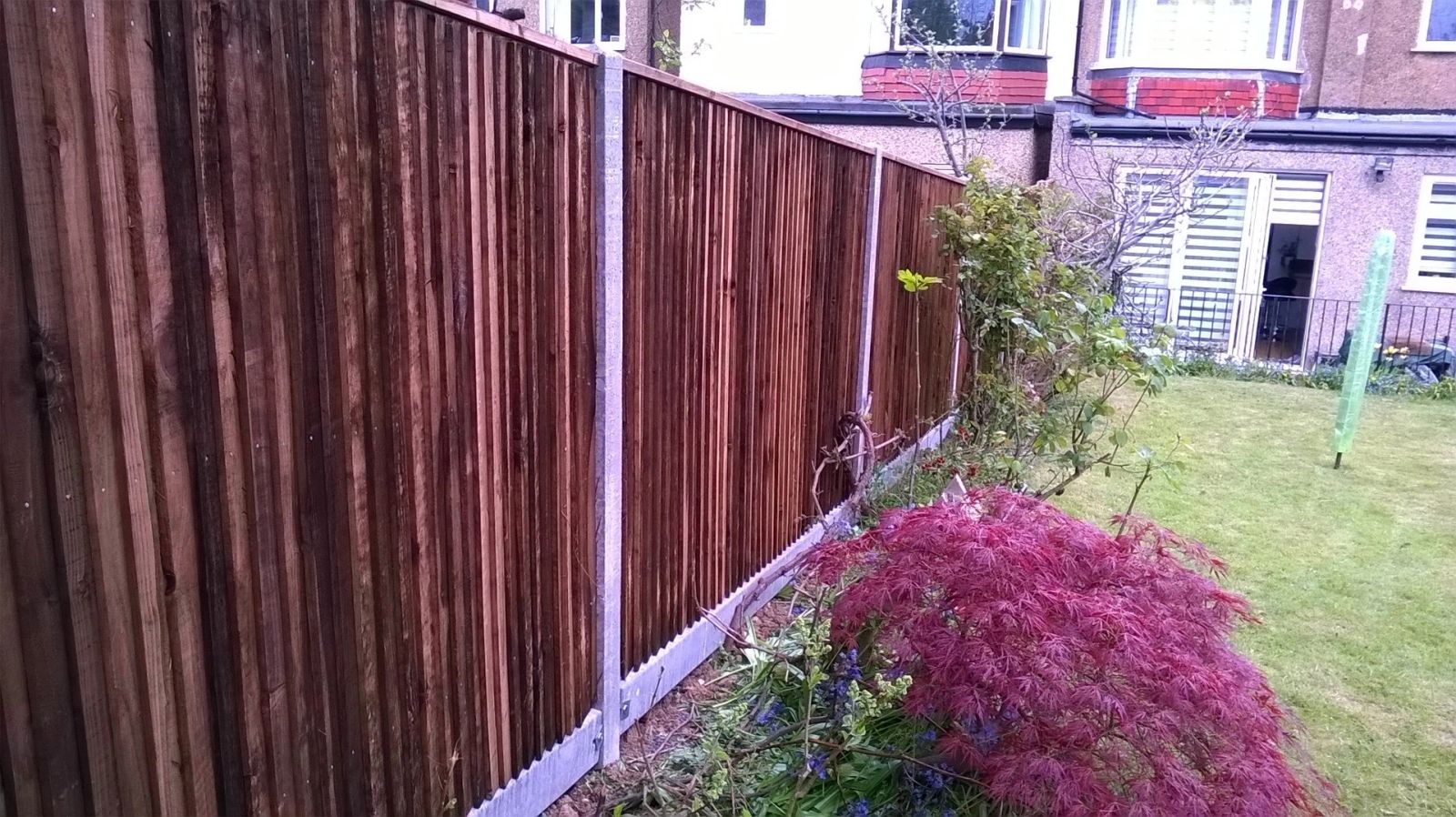
On concrete gravel boards this isn't possible after casting, so uneven ground either needs the board bedded on a shaped mortar bed or a timber board used instead where the ground profile is particularly irregular.
Timber grades and treatment
Pressure-treated softwood is graded by the treatment's intended service life — timber rated for ground contact (Use Class 4) should always be used for posts, while a lighter Use Class 3 treatment is normally sufficient for panels and boards that don't touch soil.
Tanalised or vacuum-pressure-treated stock takes preservative deeper into the timber than a surface-dipped batch, which matters most at cut ends, where the untreated core is exposed and should always be re-treated on site.
Hardwoods like oak or iroko don't need chemical preservative to the same degree but cost more upfront and behave differently as they season, so the choice is really about budget and maintenance appetite rather than one being simply 'better'.
Shared private water sources crossing a boundary
Some older rural properties share a private water supply, such as a well or borehole, with pipework running across one or more boundaries under a recorded easement.
Fencing work that might disturb this kind of shared supply pipe needs particular care, since interrupting it can affect a neighbour's water supply entirely, not just a garden feature.
Checking the title for any recorded private water supply arrangement is worth doing on older rural properties before any boundary groundworks proceed.
Working near a live road or railway boundary
An acoustic fence often sits right against a busy road or a railway cutting, so work is planned to keep materials and tools clear of the carriageway or track side at all times, with extra care taken on any section within reach of passing traffic.
On a school-boundary job, timing around drop-off and pick-up avoids disruption on both sides of the fence.
Estate management schemes and shared rules
Some developments, particularly newer estates, are subject to an estate management scheme or a management company with its own rules covering boundary treatments, materials and even colours.
These schemes usually run alongside normal planning law rather than instead of it, so a fence can need to satisfy both the council and the estate's own management company.
Annual estate charges often fund maintenance of shared boundary features, so it's worth checking what's already covered before commissioning separate work on a shared line.
Colour and finish effects on a solid acoustic face
A dark-finished solid acoustic panel absorbs more heat from direct sun than a lighter finish, which can accelerate timber movement and drying out on a south-facing run.
This is a durability consideration rather than an acoustic one, but it affects how often joints need checking on an exposed, sun-facing acoustic boundary.
Post section choice for heavy acoustic panels
A slender fence post sized for a standard lap panel will flex or fail under the sustained weight and wind loading of a dense acoustic panel, so post section is upsized specifically for the extra mass being carried.
A box-section steel post or a substantial concrete post gives the stiffness needed to hold a heavy panel true over years of wind loading, rather than allowing gradual lean that opens joints and lets sound through.
Panel orientation and sun exposure
A dense, dark-faced acoustic panel absorbs more solar heat through the day than an open fence, and on a south-facing run that can mean noticeably higher surface temperatures, which affects both comfort near the fence and the timber's long-term movement.
Lighter facing colours or a slight setback from a seating area reduce this effect, and it's worth considering alongside the purely acoustic decisions when planning a south-facing solid boundary.
Perimeter security at a GP surgery or health centre
A GP surgery boundary balances public accessibility during opening hours against protecting drug storage, equipment and the building itself outside them, so a low decorative frontage often gives way to a more solid, higher fence around plant areas, bin stores and rear access at the same site.
Step-free, wide gate openings are needed anywhere patients using wheelchairs or mobility aids pass through the boundary, which can constrain gate hardware choices compared with a purely commercial yard.