Weather windows for concrete and timber work
Concrete shouldn't be mixed or poured in a hard frost, since freezing water in the mix before it cures weakens the finished base permanently rather than just delaying the cure.
Heavy or prolonged rain during digging can turn a clean-sided post hole into a collapsing, waterlogged trench within an hour on clay or silty ground, which is why digging is often timed around a forecast dry spell rather than started regardless.
Staining or oiling timber needs a dry surface and typically a minimum air temperature to cure properly, so that stage of a job is usually scheduled separately from the wetter groundwork rather than done back-to-back on the same visit.
Small wind turbine noise
A small domestic or agricultural wind turbine produces both an aerodynamic swish from the blades and a mechanical hum from the generator, with the aerodynamic component varying with wind speed rather than staying constant.
Because the noise source sits well above ground level, a ground-mounted barrier does little to break the line of sight to it, and the practical response is usually about siting and orientation of the turbine itself rather than boundary screening.
Stepping panel height on a sloping acoustic boundary
Where the ground falls along a boundary that needs consistent acoustic screening, stepping the panel height with the slope keeps the top of the run at a consistent level relative to the noise source, rather than following the ground and creating a dip in coverage partway along.
A raked top edge, following the slope directly, can leave a section of the run lower relative to the source than intended, opening a partial sightline exactly where the ground falls away.
Vegetation growing through or over a shared fence
Plants growing from one garden through, over or against a shared fence — a spreading shrub, an overhanging branch, a self-seeded sapling in the fence line itself — sit in a grey area between garden maintenance and boundary structure that isn't always covered by a simple 'good neighbour' agreement.
A sapling that germinates directly against a post and is left to grow can eventually distort or crack the post as its trunk thickens, which is a slow-motion structural problem rather than a purely cosmetic one.
Flagging seedlings growing in or immediately against a fence line at an early stage, before root or trunk growth causes structural distortion, avoids a much larger repair later.
Boundary fencing between church grounds and an adjoining graveyard
Church grounds fencing often has to distinguish between an actively used graveyard area, where ground disturbance for post holes needs careful checking against known burial plots, and a wider grounds boundary where standard fixing methods apply without restriction.
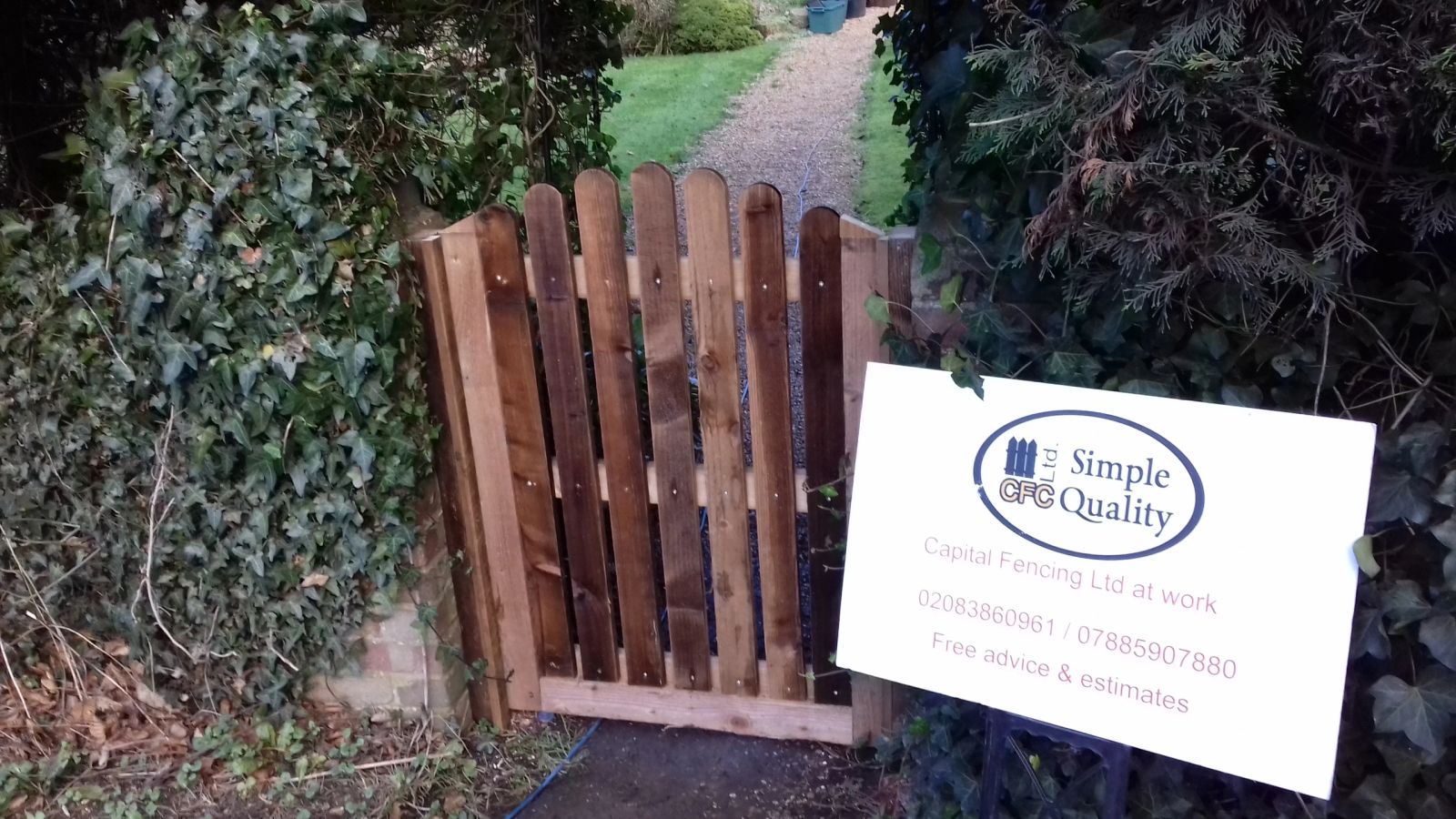
A lychgate or similar traditional entrance feature is frequently retained as the visual and ceremonial entry point even where a plainer security fence is added around the rest of the boundary for practical reasons.
Soakaways near a fence line
A soakaway needs to sit at least 5m from a building under current guidance, and positioning one close to a boundary risks saturating the neighbour's ground as well as your own client's.
Digging a new post hole into or immediately alongside an existing soakaway compromises its performance and can undermine a post set on top of what's really just loose rubble fill.
Where a soakaway's exact position isn't recorded, a slow-draining or consistently damp patch along the fence line is often the only visible clue before digging starts.
Western red cedar characteristics
Western red cedar contains natural oils and extractives that give it decay and insect resistance without chemical treatment, which is why it's often left untreated and allowed to silver naturally over time rather than stained.
It's considerably lighter and softer than most fencing softwoods, which makes it easier to work but also more prone to surface denting and scuffing during handling and fitting.
Because it's naturally durable rather than pressure-treated, cedar doesn't carry the green or brown tint of treated softwood, and any colour change over its life comes from UV exposure rather than a fading dye.
What a basic noise assessment covers
A basic noise assessment for a fencing job typically identifies the dominant source, its approximate direction and height, and the times it's most active, rather than producing a full technical acoustic report.
That level of assessment is usually enough to size and position a domestic barrier sensibly, while a more detailed instrumented survey is a separate undertaking usually reserved for planning applications or formal noise complaints.
Keeping post positions clear of drainage gulleys and channels
A surface drainage channel or gulley running near the boundary needs to stay clear and functioning, so a post landing directly over or immediately beside one can block flow or make future clearing of the channel awkward.
Where the fence line has to cross a channel, spanning it with a slightly wider gap under the gravel board, rather than boxing the channel in completely, keeps it accessible for clearing leaves and debris.
It's worth running water through the channel before finishing the job, where practical, to confirm the new fence hasn't inadvertently altered how it drains.