Boundary ownership when a fence needs repair
A failing fence is a common trigger for a dormant boundary dispute, since neither neighbour has had reason to check who's actually responsible until something needs fixing. Where ownership isn't clear from the deeds, we recommend confirming it and notifying the neighbour in writing before repair work starts.
On a shared rear boundary between terraced gardens this is worth doing even for a straightforward panel swap.
Guide roller side play on sliding gates
A guide roller keeps the top of a sliding gate steady as it travels, controlling side-to-side play rather than carrying the gate's weight, and excess play here shows up as the gate rocking or leaning as it moves rather than dragging.
Adjusting or replacing a worn guide roller is usually a smaller job than addressing the main track or bottom rollers, but it's often overlooked because the fault looks similar from a distance.
Post-hole spoil disposal
Digging out an old post footing produces broken concrete and soil that has to be removed from site rather than left in the garden, and old concrete in particular is heavier and bulkier than the volume of the original hole suggests.
Spoil disposal is factored into a repair from the outset, particularly on a job replacing several posts where the total volume of waste concrete adds up quickly.
Controlling dust and debris close to a neighbour
Angle grinding a metal fixing or breaking out an old concrete footing throws dust and fine debris further than expected, which matters on a repair close to a neighbour's washing line, patio furniture or parked car.
Sheeting off the immediate work area and clearing debris before leaving site each day is worth doing even on a short repair, since a small job that leaves a mess behind causes disproportionate friction with a neighbour compared with the size of the work itself.
Using a scaffold tower or podium for repairs on a tall or high-level run
A repair above roughly head height, such as capping or bracing on a tall acoustic fence or a boundary on sloping ground, needs a proper working platform rather than a stepladder, both for safety and to allow two hands free for fixing.
On a tall run this can mean the access equipment takes longer to set up and move along the fence than the repair itself, which is worth factoring into how a job like this is planned and priced.
Choosing a self-closing mechanism for pool or drive gates
A spring-loaded hinge, hydraulic closer, or gravity-hinge design (where the hinge itself is angled so the gate swings closed under its own weight) each achieve self-closing in a different way, with different maintenance needs and different feel in use.
Gravity hinges are mechanically simple and low-maintenance but rely on the gate post and hinge post staying accurately set, since any settling changes the closing behaviour.
Hydraulic or spring closers give a more consistent, adjustable close but are an additional mechanical component that itself needs occasional servicing or replacement over the gate's life.
Measuring height from natural ground level
Permitted development height limits are measured from the natural ground level on the lower side of the boundary, not from any raised bed, deck or hardstanding that's been added since, which matters wherever one side of a plot has been built up.
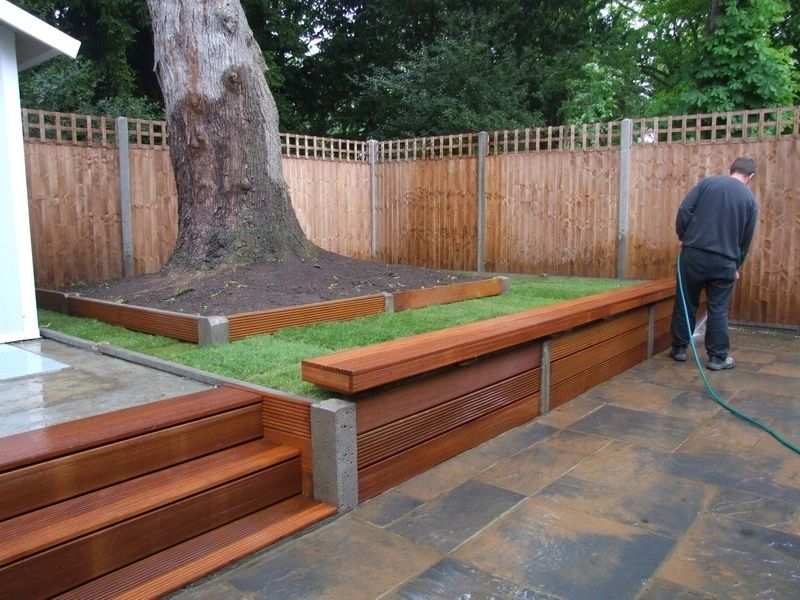
On a level change between neighbouring gardens, the higher ground effectively gives that side a taller fence relative to the lower garden even though the fence itself is a uniform height along its top rail.
Councils measuring a disputed fence will normally use the original survey level or historic photos where the ground has since been altered, so changing levels doesn't retrospectively legalise an over-height fence.
Bin and bike access considerations
A gate used regularly to move bins or bikes through needs enough clear width and a low enough threshold that wheels don't catch, which is a different design priority to a gate that's mostly left closed.
Where this is the main use of a side gate, we factor it into leaf width and threshold detail at repair or replacement time rather than defaulting to a standard pedestrian gate size.
Post splitting from over-driven fixings
Driving a nail or coach screw too close to a timber post's edge, particularly near the end grain, concentrates stress in a narrow section of fibres and can split the post along the grain rather than simply seating the fixing.
Pre-drilling a pilot hole for larger fixings, especially near board or post ends, relieves that concentrated stress by giving the fixing a path that doesn't have to force the surrounding fibres apart.
Species with straighter, more even grain generally resist this kind of splitting better than timber with interlocked or knotty grain near the fixing point, where existing weaknesses in the fibre structure make a split more likely to propagate.
Narrow access and carrying materials by hand
Where there's no side access wide enough for a barrow, materials have to be hand-carried through the house or over a boundary, which changes both the time a job takes and the choice of components — shorter, lighter sections are far easier to move this way than long concrete gravel boards.
Protecting internal flooring and doorways during a through-house carry is worth agreeing before the first delivery arrives, since a scuffed hallway wall is one of the most common complaints on this kind of access.
On some terraces the only alternative is craning or lifting material over a roof or side wall, which needs its own access and safety plan rather than being treated as a simple manual carry.
Preparing a weathered gate surface before refinishing
A timber gate that's greyed and roughened from UV and weather exposure needs its surface sanded back to sound wood before a new stain or paint is applied, since coating over a degraded surface fails much sooner than one applied to properly prepared timber.
Loose or flaking old paint in particular needs removing fully rather than painting over, as trapped moisture behind a failed coating accelerates rot underneath.