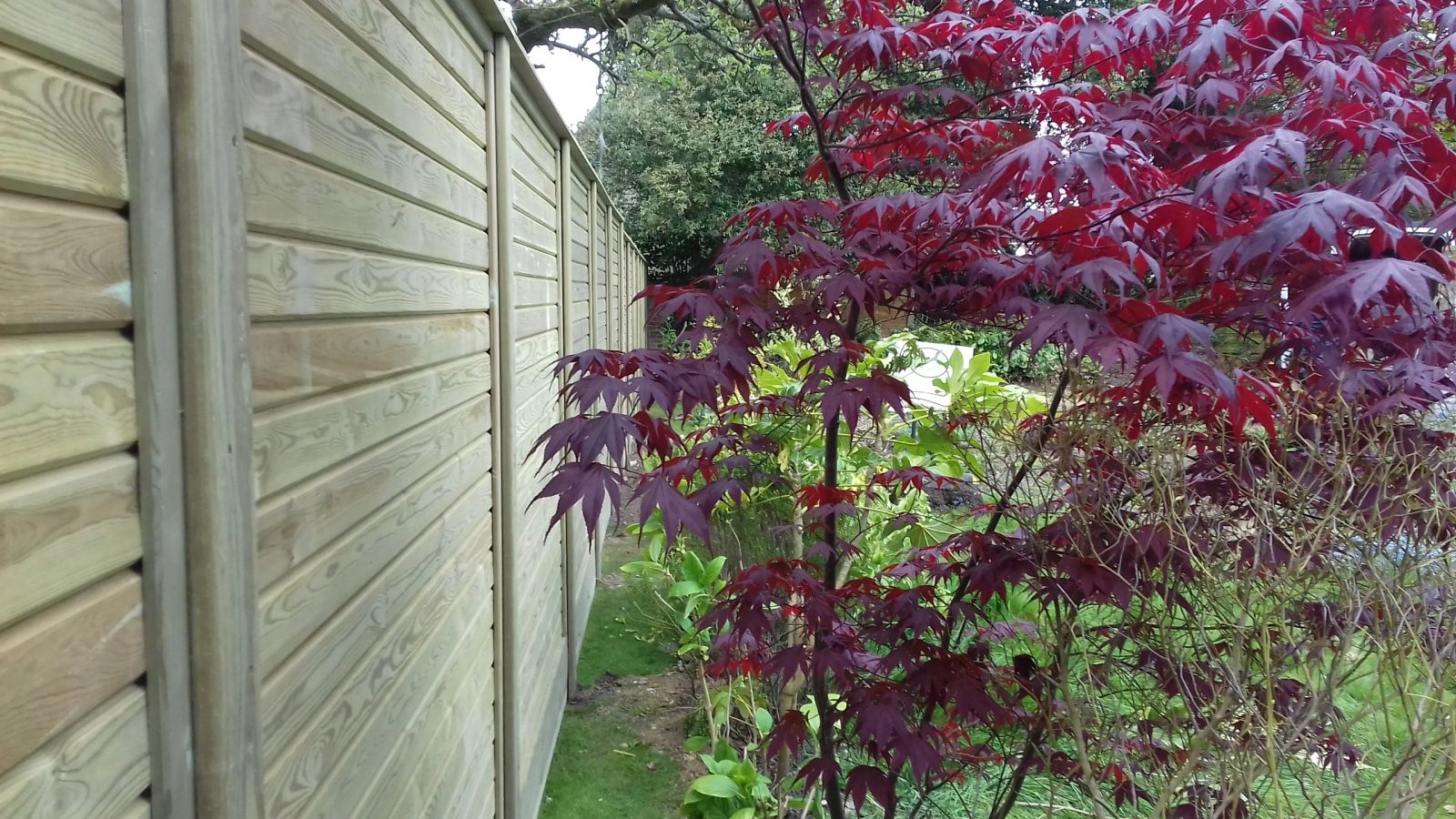
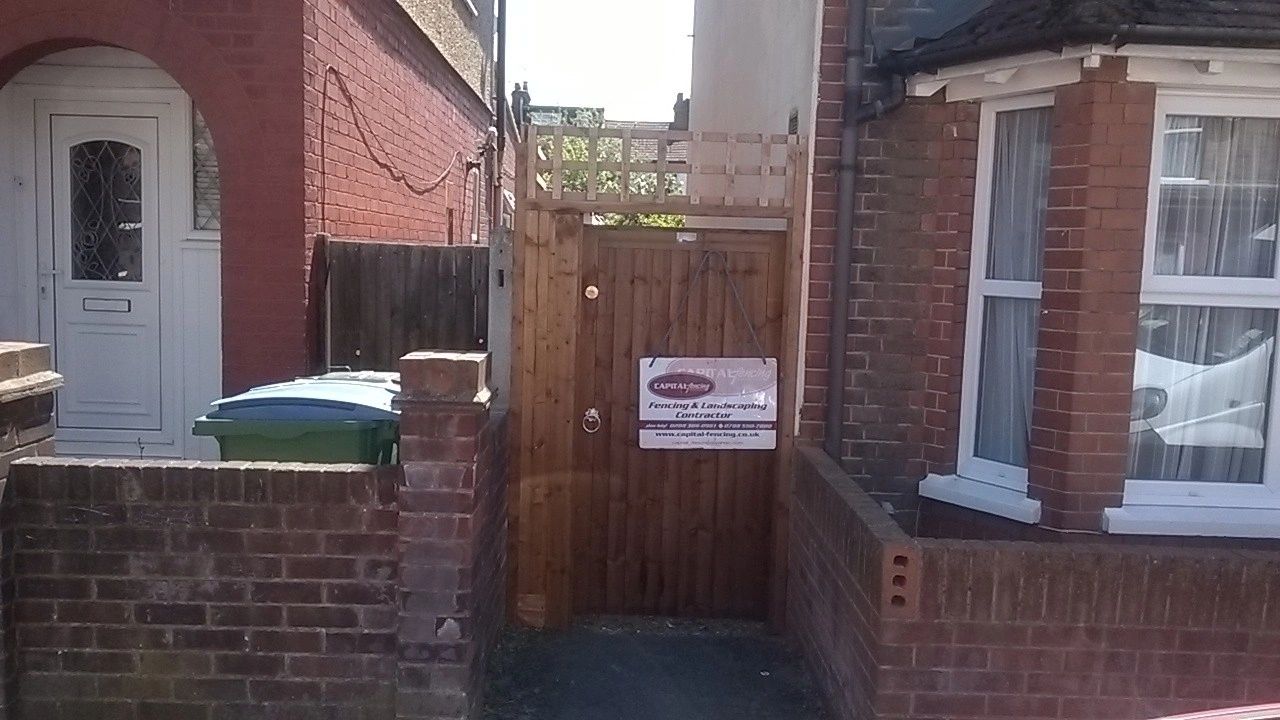
Removing an old boundary before the new one goes in
Old fencing, damaged palisade or rusted mesh is cleared and taken off site as part of the job rather than left for the client to deal with, and any concrete post stumps are broken out where the new line needs a fresh, sound base rather than being built around old debris.
Where a section is genuinely sound we'll say so and reuse it rather than clearing it needlessly.
Recommended inspection intervals for gate hardware
Checking hinge fixings, latch alignment and post plumb roughly twice a year, typically before and after the worst of winter weather, catches most developing faults while they're still a simple adjustment rather than a full repair.
A gate in heavy daily use, such as a bin store or communal alley gate, benefits from more frequent checks than a garden gate opened only occasionally.
Bearer support on adjustable pedestals
Adjustable plastic pedestals supporting deck bearers let each support point be levelled individually, which is useful over an uneven concrete base, a sloped patio, or ground that isn't practical to excavate level.
Pedestal spacing still needs to follow the same span logic as timber joists, since an adjustable base doesn't change how far the bearer above it can safely span before it needs another support point.
Pedestals also raise the whole deck slightly, which is worth checking against a threshold or step height at the house before committing to the system.
Stainless steel grades near salted roads
Grade 304 stainless steel resists general corrosion well but can develop surface pitting when regularly exposed to chloride from de-icing salt spray thrown up by passing traffic.
Grade 316 stainless includes molybdenum, which significantly improves resistance to chloride pitting, and is the more appropriate specification for fixings and fittings on roadside fencing subject to winter gritting.
The cost difference between the two grades is usually small relative to the fitting itself, so specifying 316 near a heavily gritted road is generally worth it for the extended service life alone.
Industrial units and compounds
Industrial estate boundaries are frequently specified as high-security palisade or welded mesh rather than timber, both for perimeter security and because timber degrades faster next to hardstanding and vehicle movement.
A shared service road between units means access for fencing plant has to be coordinated with other tenants using the same route, and any material laydown area needs agreeing so it doesn't block emergency access.
Compound gates wide enough for HGV access are a different specification challenge from a domestic driveway gate, needing heavier hinges, a track or wheel to carry the weight, and clear signage where they open across a shared road.
Timing the work seasonally
Fencing and decking can be installed year-round, but ground conditions change the practicalities: concrete cures more slowly in cold weather and shouldn't be poured in a hard frost, while waterlogged winter ground makes post holes collapse before they can be set.
Late spring and summer give the most predictable digging conditions and the fastest concrete cure times, which is also when demand is highest and lead times stretch out.
Autumn and early winter bookings, ground conditions allowing, are often the quickest to schedule and let a new timber fence weather in before the following summer.
Good practice notifying a neighbour before work starts
There's no general legal requirement to notify a neighbour before replacing a fence that sits entirely on your own land, but doing so avoids most of the friction that boundary work can otherwise cause.
A short conversation or note covering timing, likely noise, and any need for brief access to their side goes a long way toward a smooth job.
Where the new fence will differ noticeably in height, style or colour from what's there now, flagging that in advance tends to head off objections that only surface once the work is finished.
Referee whistles and sports ground noise
A whistle used on a sports pitch is a short, sharp, high-frequency sound designed specifically to carry over background noise, which makes it one of the harder everyday sounds for a garden barrier to meaningfully reduce.
For a plot backing onto a playing field, expectations are set around softening the general crowd and match noise rather than isolated whistle blasts, which by design cut through most barriers to some degree.
The distance-doubling rule of thumb
As a rough rule, doubling the distance from a point noise source reduces the sound level by a noticeable, broadly consistent amount in open ground, which is why moving a seating area further from a boundary can help almost as much as adding barrier height.
This rule applies most cleanly to a single point source in open space and becomes less reliable near reflective surfaces or with a source spread along a line, like a road, rather than concentrated at one point.
Salt and de-icing near a pavement
A front boundary fence close to a pavement or road gritted in winter is exposed to salt spray and run-off that a rear-garden fence never sees, and that salt accelerates corrosion in untreated steel fixings and speeds up timber degradation at ground level.
Galvanised or stainless fixings resist this better than standard bright steel, and are worth specifying as standard on any boundary within a few metres of a regularly gritted surface.
Salt-laden ground also tends to stay damp for longer after a thaw, extending the period a post base is sitting in wet conditions each winter.
Visibility splays for vehicle gates onto a road
A driveway gate opening directly onto a road needs to be positioned or set back so that a driver waiting to exit can see approaching traffic clearly, and a solid gate that opens outward across the pavement can obstruct pedestrians as well as sightlines if not set back far enough.
This is a site layout consideration that needs addressing at the design stage, since it's much harder to correct once posts are concreted in a fixed position.