Wheel load rating on wheeled gates
A wheel fitted to the leading edge of a heavy gate to support its weight as it swings needs a load rating matched to the gate's actual weight, since an undersized wheel flat-spots or seizes under a load it wasn't specified for.
This is separate from a sliding gate's running wheels — a support wheel on a swing gate only touches down near full opening or closing, rather than carrying the gate along its whole travel.
Prevailing wind direction and driven rain exposure
In much of southern England the prevailing wind and driven rain come predominantly from the south-west, so a south-west-facing fence face typically weathers, silvers and needs re-coating faster than the opposite face of the same run.
This uneven exposure is worth explaining to clients who are puzzled that one side of a boundary looks noticeably more weathered than the other despite being installed on the same day from the same materials.
Where a client wants a more even appearance over time, orienting board overlap so the leading edge faces the prevailing weather sheds rain more effectively than the reverse arrangement.
Balustrade heights on raised decking
A raised deck with a drop of 600mm or more generally needs a balustrade for safety, with 900mm to 1100mm commonly used as the guide height depending on the drop and whether the household includes young children.
Baluster spacing should follow the same principle as fence gap safety — generally kept under 100mm — to avoid a child being able to squeeze through or get a head trapped between uprights.
Handrail fixings need to resist a lateral push load, not just support their own weight, so posts anchored into the deck frame itself rather than just screwed to a fascia board are the more reliable detail on any deck with a meaningful drop.
Talking to neighbours before you start
A shared boundary fence, even one that's entirely your responsibility to maintain, sits next to someone else's garden — giving a neighbour advance notice of the height, style and timing of the work heads off most disputes before they start.
Where a fence straddles the boundary line exactly, both parties technically have an interest in it, and a quick written note agreeing who's paying for what avoids a much longer argument later if it needs replacing again.
This isn't a formal Party Wall Act process — that applies to structures like walls between buildings — but the same basic courtesy of clear, written communication before work starts applies just as well to garden boundaries.
Wind load: solid panels versus slatted screens
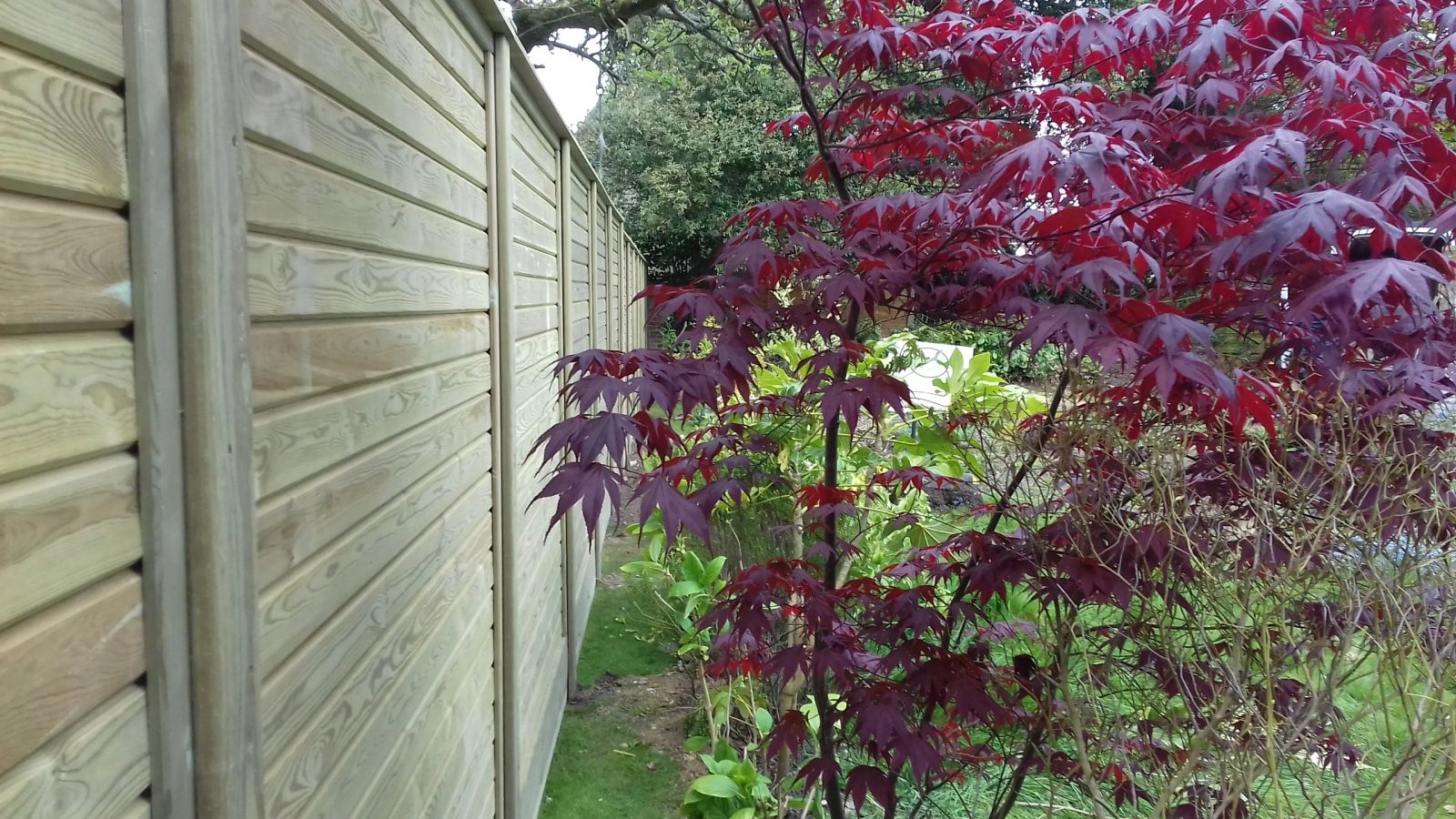
A solid close-boarded panel presents its whole face to the wind, so on an exposed run the load transferred into the post is far higher than the same height in a slatted or louvred screen with even small gaps between boards.
Manufacturers' span tables for solid panels assume a sheltered suburban garden; on an open plot the safe bay width between posts often needs reducing rather than relying on the standard 1.8m centre.
Where the client wants privacy rather than a windbreak, a slatted design with a close-boarded section lower down still cuts load noticeably while keeping most of the screening effect.
Working around pets and children on site
An open trench, a stack of loose posts or a partially removed fence panel is an obvious hazard for a young child or an excitable dog, and on an occupied family garden it's worth agreeing at survey stage how pets will be kept away from the working area each day.
A garden with no boundary at all for part of a working day — because the old fence has come down and the new one isn't up yet — needs a temporary barrier or a clear arrangement for keeping animals indoors until the run is complete.
Leaving tools, concrete mix or offcuts accessible overnight on a site with children present is worth avoiding even where the work itself is finished for the day.
Keeping mortice depth consistent across a run of timber posts
Hand-cut mortices in timber posts can vary slightly in depth from post to post if they're cut freehand rather than to a fixed jig or depth stop, which then shows up as a rail sitting at a slightly different height at each junction.
A simple depth stop clamped to the chisel or drill bit, checked against the first mortice cut, keeps every subsequent one consistent without needing to measure each one individually from scratch.
Checking a sample rail against several mortices before committing to cutting the whole run confirms the depth is right before the error, if there is one, has been repeated across every post.
Aligning hinges before final gate fixing
Hinges fixed slightly out of vertical alignment with each other make a gate bind or swing shut under its own weight rather than staying wherever it's left, even if each hinge individually looks correctly fitted.
Propping the gate at the intended finished height and checking the gap is even top and bottom before final fixing catches most alignment problems while they're still easy to adjust.
Loosely fitting the top hinge first, checking swing and clearance, and only then fully fixing both hinges is a more forgiving sequence than fully fixing both at once and finding the gate doesn't swing cleanly.
Boundary fencing for HMOs and multi-occupancy buildings
Houses in multiple occupation often have higher footfall through shared external areas than a single-family home, which points toward more durable gate hardware and fencing specified for frequent use rather than the lighter fittings suited to a quiet family garden.
Bin and cycle storage for several households sharing one plot needs more space and more robust screening than a single-household equivalent, and is worth planning at the same time as any boundary work.
Landlords managing several such properties often prefer a single consistent spec across their portfolio, both for cost predictability and so that future repairs use readily available standard parts.
A practical corrosion inspection schedule for steel fencing
A basic inspection walk checks ground-line rust on posts, coating breakdown at cut edges and weld points, and any bare metal exposed by a scrape or impact, since these are the points corrosion establishes itself first rather than spreading evenly across a whole panel.
Catching surface rust early with a localised repair coating is far cheaper than replacing a section once corrosion has perforated the steel, and an annual check is usually enough to catch problems at that early stage on a well-galvanised run.
Post anchor sockets versus set-in posts
A bolt-down or drive-in post anchor holds a timber post entirely above ground level, isolating the post's end grain from the direct soil and moisture contact it would face if simply set into a concreted hole.
Because the post itself never touches the ground, anchor-mounted posts largely avoid the ground-line rot that's the single most common failure point for concreted posts, though the anchor and its fixings become the new focus for corrosion.
Anchors do transfer more concentrated leverage into a smaller fixing area at the base than a post set deep in concrete, so they generally need a correspondingly larger or deeper concrete footing beneath them for the same wind load.