Security fencing around a builders' compound
A builders' compound holding plant, materials and fuel needs a higher standard of fencing than the general site hoarding, since compound contents are a specific theft target and are often left unattended overnight or over a weekend.
Anti-climb toppings, a single monitored access gate and lighting are more commonly justified on a compound than on the wider site perimeter, given the concentration of value inside a relatively small footprint.
Choosing a skip or a grab lorry for waste removal
A skip left on site suits a job generating waste steadily over several days and where there's a legal spot to place it, such as a driveway, but it needs a permit if it sits on the public highway.
A grab lorry collects loose spoil, rubble and old fencing directly without a skip being dropped and left, which suits a single big clearance visit and avoids occupying space on a narrow driveway or street for the whole job.
For a small domestic run, van-and-tip removal on the last day is often simpler than either option, and the right choice generally comes down to waste volume and how long the site can accommodate a static skip.
When deeds don't say who owns a boundary
It's common for older title deeds to be entirely silent on which side owns a given boundary, especially on properties built before detailed conveyancing plans became standard practice.
In that situation there's no single automatic rule that applies in every case, and long-standing practical evidence — who has always maintained the fence, existing physical features — can carry real weight.
Where ownership genuinely isn't clear, we'd always suggest raising it with the neighbour and, if needed, a conveyancing solicitor, rather than assuming a default answer.
Checking a drop bolt for bend before replacement
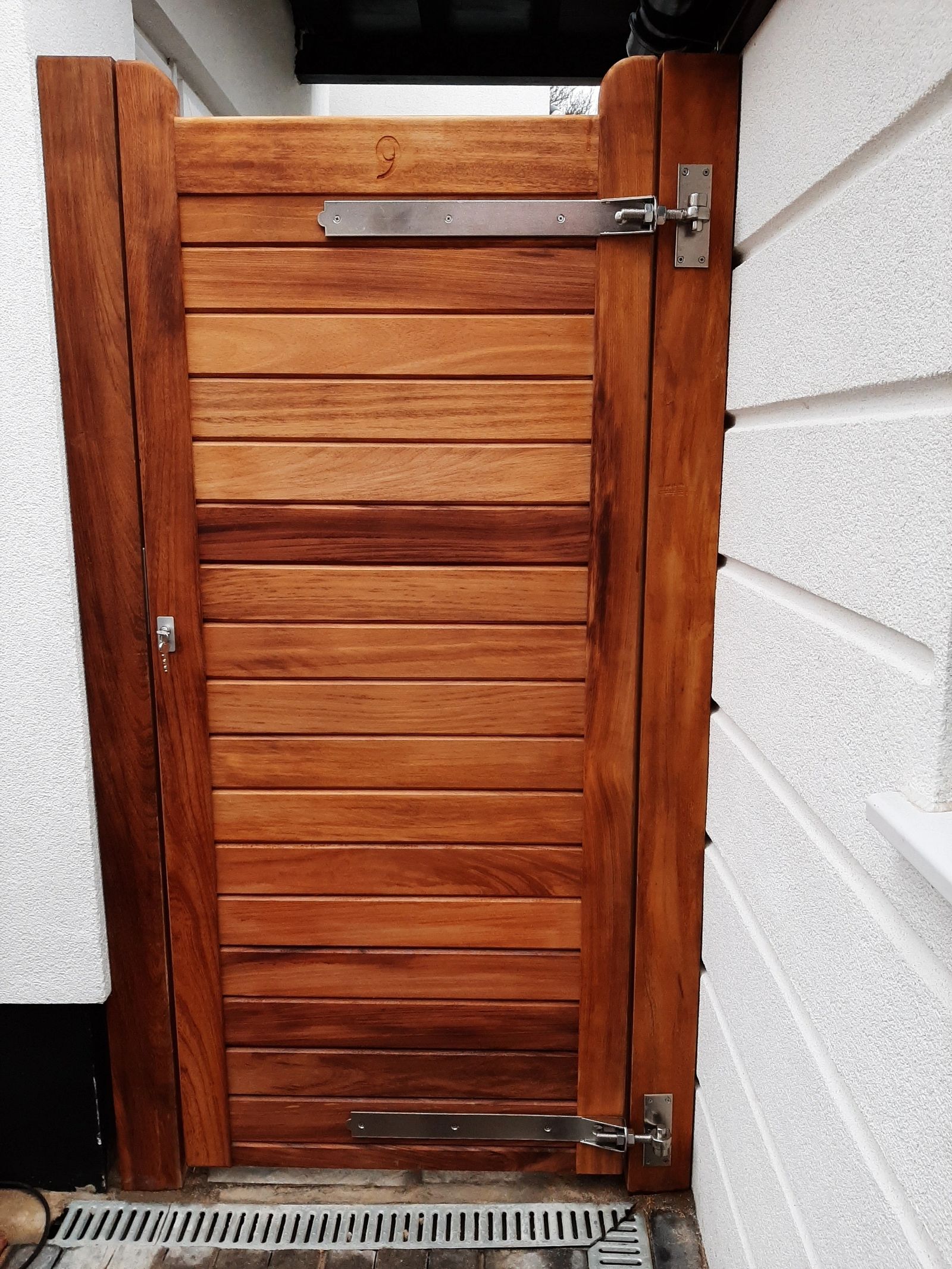
A drop bolt that no longer locates in its ground socket is often bent slightly from repeated contact rather than broken, and a bent bolt can sometimes be straightened rather than replaced if the bend is caught early.
Leaving a bent bolt in use accelerates wear on the socket edges as it forces its way in at an angle each time, which turns a simple bolt problem into a socket replacement too.
Planning permission over 2m and height applications
A fence over two metres generally needs planning permission unless a specific permitted development allowance applies, and that limit is especially relevant on an acoustic job where extra height is often what makes the barrier effective.
Where the required height for noise screening exceeds the permitted limit, a planning application addressing the acoustic justification is the usual route rather than building over height without consent.
Timber strength grading classes
Structural timber is graded into strength classes such as C16 or C24 based on visual inspection of defects like knots and slope of grain, or by machine stress grading that measures stiffness directly.
C24 timber has been graded to a higher strength and stiffness threshold than C16, and is specified where a structural calculation demands it, such as a longer unsupported gate post span, rather than chosen purely by appearance.
Fencing timber is rarely strength-graded in the same formal way as construction timber, which is one reason gate posts subject to real structural calculation sometimes specify a graded section rather than standard fencing stock.
Wheelbarrow routes and lawn protection
Moving concrete, gravel boards and spoil across a lawn on a wet day can leave rutting that lasts the rest of the season, particularly on clay soils that compact easily underfoot.
Boards or trackway laid along the barrow route spread the load and are a cheap precaution compared with reinstating a churned-up lawn afterwards.
Planning the route to cross the lawn at its narrowest point, or using a hard surface where one exists, reduces the area affected without slowing the job down.
Capping profile along the top edge
A capping rail along the top of an acoustic panel run protects the exposed end grain of the boards from rain, which otherwise draws moisture down into the panel core and shortens its working life.
A capping profile with a slight overhang and a drip groove on its underside sheds water clear of the face rather than letting it run down and re-wet the boards immediately below.
Clearing old gate hardware and frames
Old hinges, latches and, where a frame is beyond repair, the timber itself are removed and taken off site as part of the job, rather than left for the client to dispose of separately.
Where original ironmongery is salvageable and still serviceable, we reuse it rather than replacing parts that don't need it.
Overhead cables and clearance for gate operation
A gate installed beneath or near an overhead service cable needs its swing or opening path checked against that cable's height and any sag, particularly for a wider vehicle gate that might otherwise catch a low cable at its highest point of travel.
This is a straightforward site check to make before installation, since moving a gate's position after cables have been identified as a clearance problem is far more disruptive than checking beforehand.
Hedge disputes and the high hedge complaint route
A hedge over 2m tall made up mainly of evergreen or semi-evergreen species can be the subject of a formal 'high hedge' complaint to the local council under the Anti-social Behaviour Act 2003, but only after direct attempts to resolve it with the neighbour have failed and a fee is paid.
The council can then issue a remedial notice requiring the hedge to be reduced to a specified height, enforceable in the same way as a planning enforcement notice, though it typically won't require complete removal.
This process is separate from ordinary fence or boundary work and doesn't apply to deciduous hedges or single ornamental trees, which fall under general nuisance and tree law instead.