Permitted development height limits
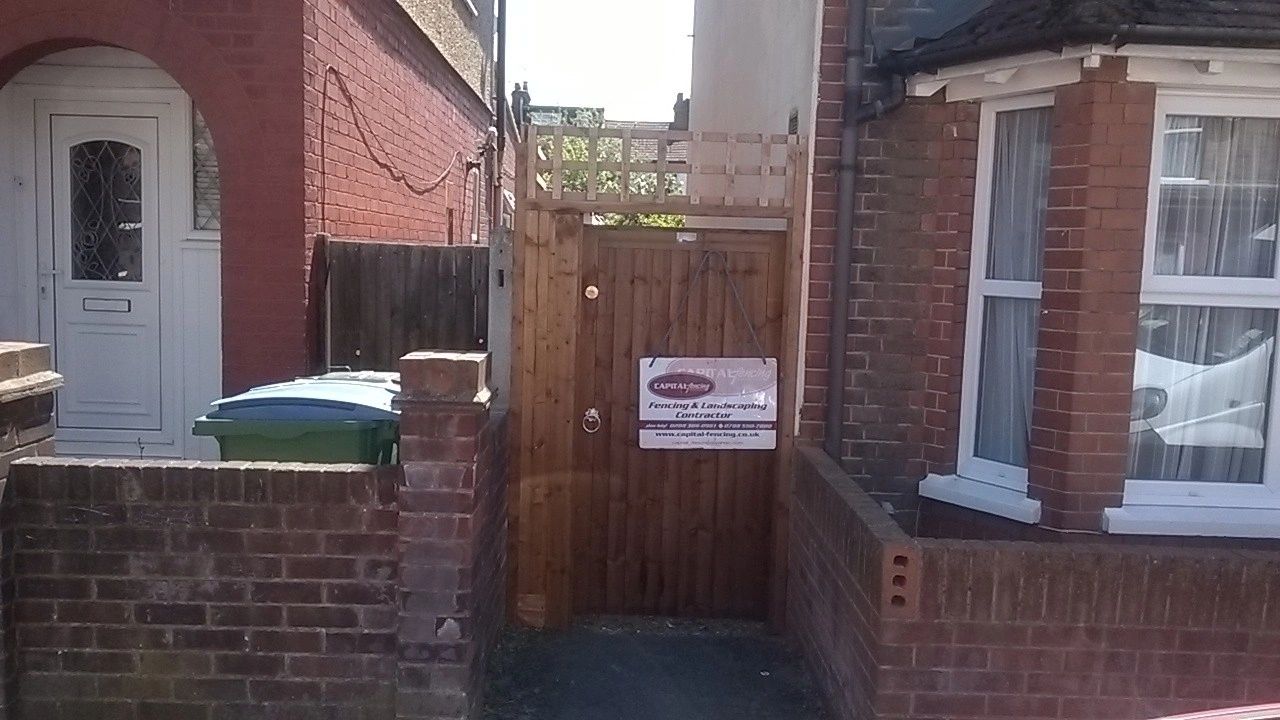
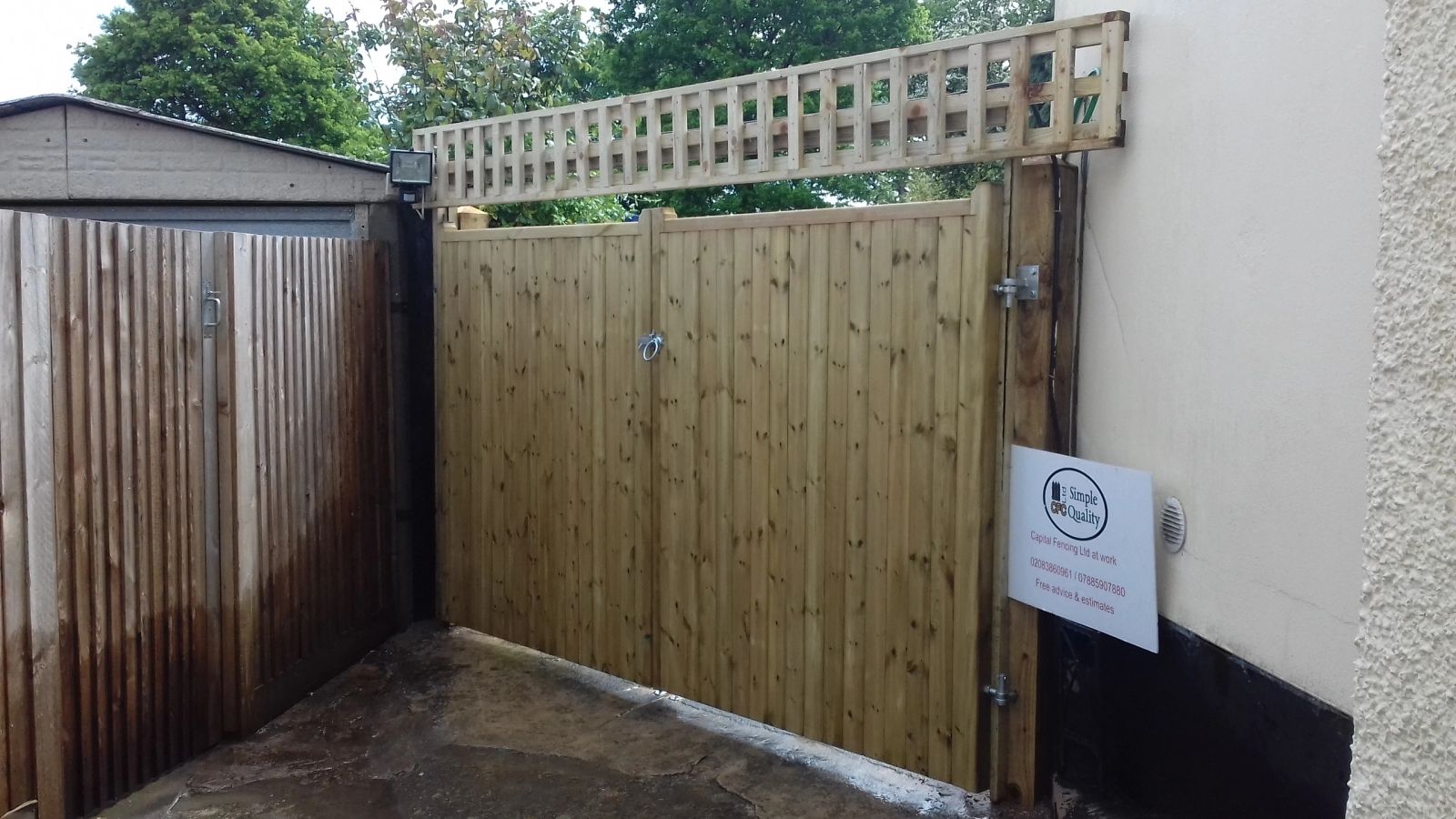
Height allowances differ between the front of a plot and the side or rear boundary, and drop further again near a highway where sightlines for road users have to be kept clear. We check the specific limit for the boundary in question rather than quoting a blanket height.
Conservation designation can reduce what's permitted even further, and a boundary next to a corner plot has its own separate sightline rule — both are checked against the site before a height is put on a quote.
Bin store gates and repeated daily wear
A gate fitted to a bin store gets opened and closed far more often than a garden gate used a few times a week, which accelerates hinge and latch wear well beyond what the timber or hardware size would normally suggest.
Specifying hardware rated for frequent use, rather than standard light-duty fittings, reduces how often these gates need attention once installed.
Fitting band-and-gudgeon hinges correctly
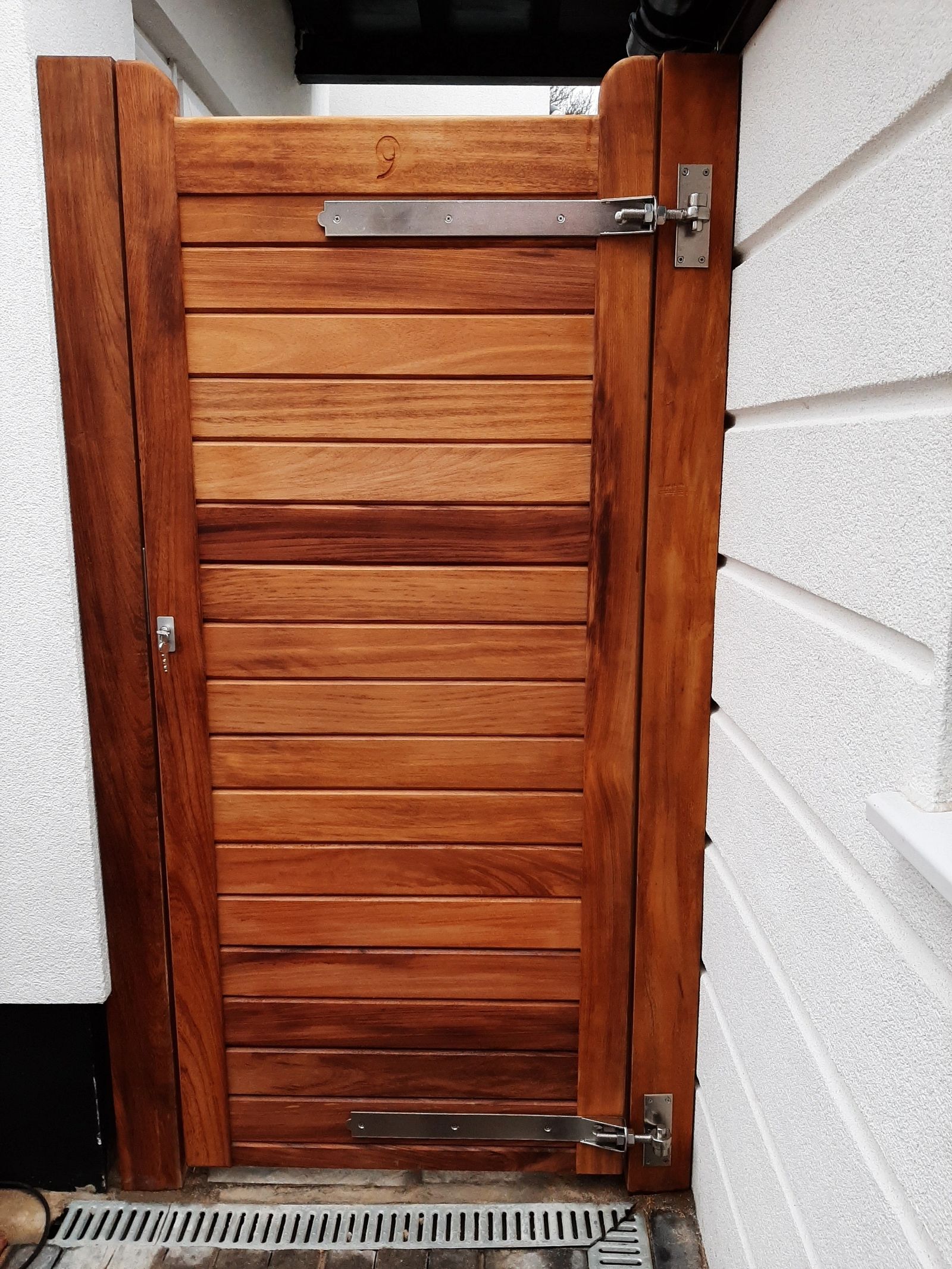
A band-and-gudgeon hinge splits into a band that's strapped across the gate and a gudgeon pin fixed to the post, and the two need to be perfectly vertical relative to each other or the gate will bind or swing awkwardly through its full arc.
Getting the gudgeon pins plumb and in line during fitting matters more with this hinge type than with a butt hinge, since there's no simple way to adjust alignment after fixing.
Gravel-board clearance over uneven ground
A gravel board sitting flush with the soil on one section of a run can end up buried a couple of inches by the time the ground rises further along an uneven boundary, trapping moisture against timber that was specified to sit clear of the soil.
Stepping the board height slightly at each post, rather than running one continuous level line, keeps a consistent clearance above grade along the whole run.
Concrete gravel boards tolerate this ground contact better than timber ones, which is one reason they're specified as standard on plots with visibly uneven levels.
Frost pockets in low-lying garden corners
Cold air sinks and pools in the lowest part of a sloped garden or a corner enclosed by walls and fencing on more than one side, creating a frost pocket that experiences more frequent and harder frosts than the rest of the same garden.
Concrete post bases and fixings in these pockets go through more freeze-thaw cycles each winter than elsewhere on the same boundary, which can accelerate the same frost-related cracking seen on shallow footings generally.
It's a detail worth noting on a site visit to a garden with an obvious dip or an enclosed low corner, since it may justify a deeper or more robust base spec for just that section.
Japanese knotweed and invasive plants on a boundary
Japanese knotweed and other invasive non-native plants listed under the Wildlife and Countryside Act don't have to be removed by law, but it's an offence to allow them to spread into the wild or onto neighbouring land, and their green waste can't simply go into a normal garden waste bin.
Knotweed growing along or across a boundary is a common source of dispute and even litigation between neighbours, since an untreated infestation on one side can spread roots several metres and undermine fence posts or hard surfaces.
Any excavation near known knotweed needs specialist handling and disposal at a licensed site, since disturbing the rhizome without proper containment is one of the most effective ways to spread it further.
Compression versus tension fixing of infill panels
Some panel systems clip into a compression-fit channel between posts, relying on the panel being cut to a precise size to stay in place under load; others are bolted under tension to the post face, which tolerates more variation in panel size but adds visible fixing points.
Compression-fit systems look cleaner but are harder to make tamper-resistant, since a panel that can be removed without tools for maintenance can usually also be removed without tools by someone else.
Fencing a retail service yard
A retail service yard behind a shop or unit typically holds delivery access, waste storage and sometimes gas or refrigeration plant, so its fencing needs to allow regular vehicle and trolley movement while still closing off the yard from the public shopping area.
A sliding gate is often preferred here over a swing gate because it doesn't intrude into a tight yard footprint shared with delivery vehicles manoeuvring at close quarters.
Board thickness and deflection
A thin board fixed across a wide unsupported span will visibly bow or deflect under its own weight or a light push long before it's anywhere near breaking, because deflection increases sharply as thickness decreases.
Doubling a board's thickness roughly increases its stiffness eightfold for the same span, which is why panel manufacturers specify a maximum bay width for a given board thickness rather than treating thickness as purely a durability choice.
On wider bays it's usually cheaper overall to add an intermediate rail or reduce the bay width than to over-specify board thickness across the whole run to compensate.
Screw pull-out values in timber
A screw's resistance to being pulled straight out of timber depends on thread depth, shank diameter and the density of the timber it's driven into, with denser hardwoods offering significantly higher pull-out resistance than softwoods for the same screw.
Coarse-thread screws designed for softwood construction generally have deeper, wider-spaced threads than fine-thread screws intended for hardwood or metal, since softwood's lower density needs more thread engagement to achieve comparable grip.
Pre-drilling a pilot hole reduces the risk of splitting dense or knotty timber but also slightly reduces ultimate pull-out resistance compared with a screw self-tapping fully into undrilled timber, which is a trade-off worth balancing against the specific timber and screw.
Sherardised nails and fixings
Sherardising coats small steel fixings in zinc through a low-temperature diffusion process using zinc dust rather than a molten bath, giving a matt grey, evenly distributed coating well suited to fasteners with fine threads.
Because the process doesn't build up excess zinc at edges and threads the way hot-dip galvanising can, sherardised nails and screws keep a cleaner, more precise fit than galvanised equivalents of the same size.
The coating is thinner than typical hot-dip galvanising, so sherardised fixings are generally specified for above-ground, moderate-exposure use rather than permanent ground contact.