Palisade pale profiles: D-section versus W-section
D-section pales have a rounded face that offers less finger and foot grip than a flat pale, while W-section pales fold the steel into a shallow trough shape that resists bending under a lever without adding weight.
W-section is the more common choice on a taller or higher-security run because the fold adds stiffness across the pale's width, whereas D-section is often reserved for lower, more decorative palisade work.
Painted versus stained finish maintenance
A painted gate hides the timber grain and needs a full film to stay intact, so any crack or chip in that film lets water in behind the coating and can accelerate local rot if left unaddressed.
A stained or oiled finish penetrates the timber rather than sitting as a film, so it wears more evenly and is easier to top up in patches without a full strip-back.
Sheltered courtyard microclimates and reduced wear
A small enclosed courtyard garden surrounded by walls or buildings on most sides creates a sheltered microclimate with reduced wind and often reduced direct rain exposure, which can extend the practical life of a timber finish well beyond the general guideline interval.
The trade-off is often reduced airflow and higher humidity in the enclosed space, which can favour algae or mould growth even though the timber itself isn't taking direct weather.
Recommending a maintenance interval based on general exposure alone can be too cautious for a sheltered courtyard or too relaxed for a damp, poorly-ventilated one, so it's worth judging each enclosed garden on its own conditions.
Building decking around an existing tree
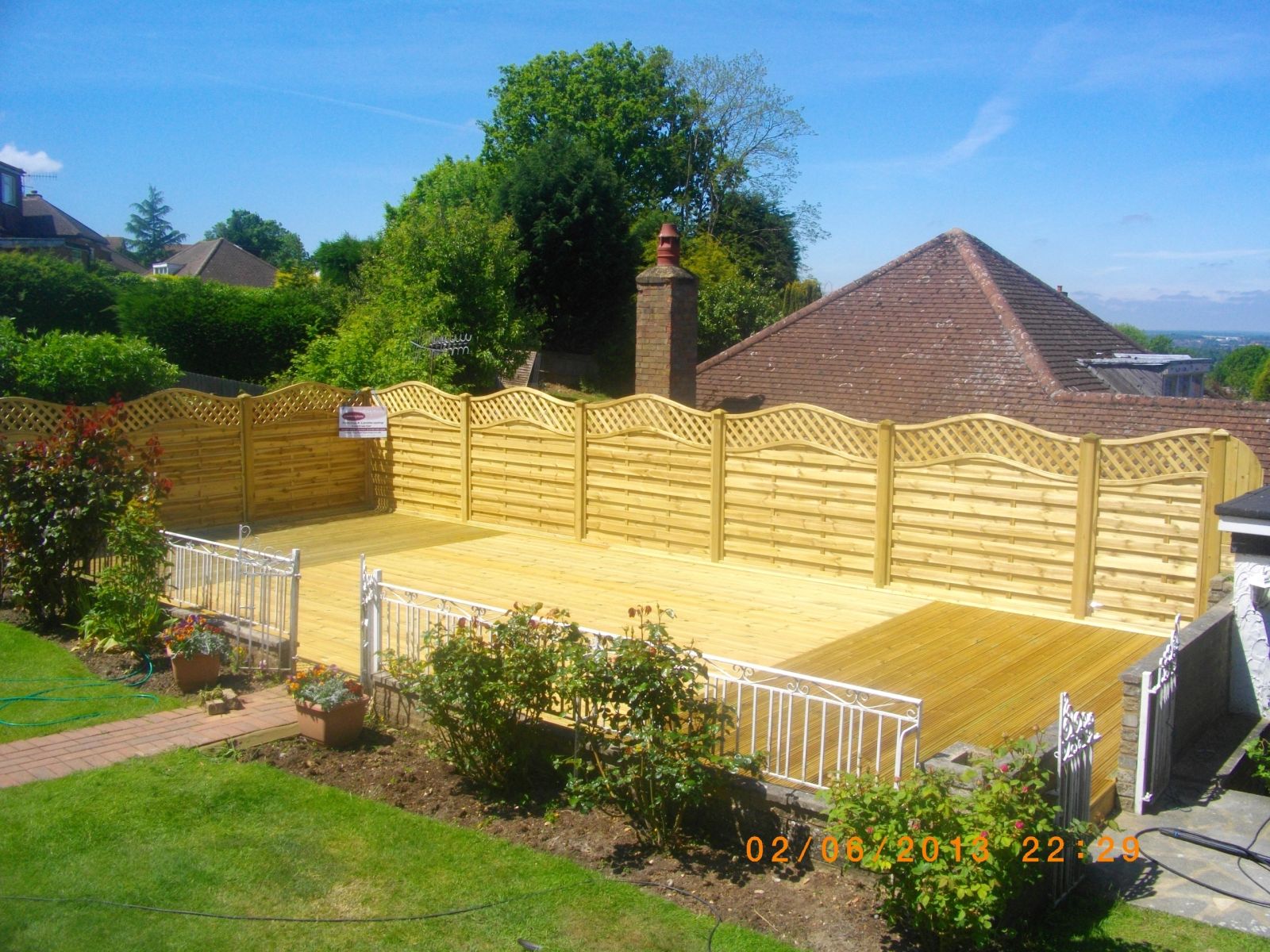
Decking built around a retained tree needs a gap between the boards and the trunk to allow for trunk growth over the coming years, since a tight-fitting frame will eventually be split or lifted as the tree thickens.
Foundations for the deck itself should avoid sitting directly over major roots, favouring a raised beam-and-post structure that spans over the root zone rather than ground-bearing pads dug into it.
Where the tree is protected by a Tree Preservation Order, any excavation for deck supports within its root protection area may need council notification before work starts.
Securing a rear alley boundary behind terraced housing
A rear alley boundary sees different pressure to a front garden fence, because it's typically unwatched, runs the full length of several properties, and is the route used to approach a back door or shed unseen from the street.
Consistent height and topping along the whole alley matters more here than on an individual plot, since a single weaker section among several stronger ones simply redirects the attempt rather than stopping it.
Powder coating and galvanising
Galvanising bonds a zinc coating to steel, usually by hot-dip, giving corrosion protection that works even if the surface is scratched because the surrounding zinc sacrifices itself to protect the exposed steel.
Powder coating is a decorative and additional protective layer baked onto the metal, giving a wide choice of colour and a harder finish than paint, but on its own over bare steel it doesn't offer the same self-healing protection as galvanising.
The durable combination for steel gates and railings is galvanising first, powder coating over the top, rather than powder coating alone, which is worth checking on a quote where both are mentioned separately.
Off-street parking and dropped kerbs
Converting a front garden to off-street parking usually requires a dropped kerb permit from the highway authority, and a boundary fence or gate across that new access has to be positioned clear of the visibility splay the dropped kerb creates.
Where a low front boundary already exists specifically to preserve sightlines onto the new parking, replacing it with a taller or solid fence can undo the safety benefit the dropped kerb approval was granted on.
It's worth checking whether the dropped kerb approval included any conditions on boundary treatment before ordering a new front fence or gate.
Signage requirements for an electrified deterrent topping
An electrified topping wire fitted above a security fence needs clear warning signage at regular intervals along the run, since an unmarked live topping exposes the site owner to liability that proper signage largely removes.
The pulse unit driving the topping is a low-current, high-voltage design intended to deter rather than injure, and it's kept separate from any perimeter earthing used for other electrical services on site.
Planning enforcement risk of over-height fences
A fence built above permitted development limits without consent is a breach of planning control, and councils generally have four years from substantial completion to take enforcement action against an operational breach like an over-height structure.
Enforcement typically starts with an informal request to reduce the height or apply retrospectively, escalating to a formal enforcement notice with an appeal right and, ultimately, prosecution for non-compliance if ignored.
A complaint from a neighbour is the most common trigger for enforcement action on garden boundaries, so an unauthorised over-height fence can sit unchallenged for years and then become an active case very quickly once someone reports it.
Mortice-and-tenon versus halving joints
A mortice-and-tenon frame joint has more glued and pegged surface area than a halving joint, which is simply two timbers notched and lapped over each other, so it resists racking better but is harder to repair once it's failed.
We identify which joint type a frame uses before quoting a repair, since a halving joint can often be re-fixed with new screws and adhesive where a failed mortice needs the whole corner remade.
Decking fixings visible versus hidden
Face-fixed decking is screwed directly down through the board top, which is simple, cheap and easy to replace a single board on, but leaves visible screw heads that can work slightly proud over time as the timber moves.
Hidden fixing clip systems fit into the board's grooved edge and screw down into the joist from the side, giving an unbroken top surface, but they generally cost more per board and make it harder to lift a single damaged board without disturbing its neighbours.
Composite boards are more often specified with hidden clip systems since the clean, screw-free look is part of the appeal that justifies the material's higher cost.