Sizing gates for specific vehicle types
A driveway gate wide enough for a family car may still be too narrow for a van, motorhome or trailer, which is worth checking against the actual vehicles a household owns or plans to own rather than a generic standard opening.
Turning circle matters as much as raw width on a tight driveway, since a gate that technically fits a vehicle's width can still be unusable if there isn't room to straighten up before passing through it.
For a household with mixed vehicle needs, a wider single gate or double gates with an off-centre split (one narrow, one wide leaf) can give flexibility that two equally-sized leaves don't.
Handling heavy gate posts and large timbers safely
A large hardwood or oversized gate post can be too heavy to lift and position safely by hand, particularly into a deep hole, so a simple lifting aid such as a sack truck, roller bars or a block and tackle reduces the risk of a manual handling injury.
Lowering a heavy post into a hole under control, rather than dropping the last stretch, also protects the hole's sides from collapsing under the impact just as it's being positioned.
Where a post genuinely needs mechanical assistance to move safely, planning that equipment into the job at the outset avoids improvising with inadequate lifting methods on the day.
Cat-proofing with angled overhangs
Cats are agile climbers rather than diggers, so containment relies on preventing a solid grip at the top of the fence rather than closing ground-level gaps, typically with an angled overhang or rotating roller bar fitted along the top.
These systems work by tipping the cat back into the garden as it reaches the top rather than physically blocking the climb, and need a consistent, unbroken run along the full boundary to be effective, since a single untreated gate or low section undoes the rest.
Overhang brackets add a small amount of extra load and a slight increase in overall height, both of which are worth checking against permitted development limits before fitting.
Creosote and its substitutes
Traditional creosote, a tar-oil wood preservative, gives strong protection against rot and insects but is now restricted to professional and agricultural use in the UK following changes in chemical regulation, and isn't available for general retail sale.
Modern water-based and oil-based substitute preservatives aim to replicate creosote's protective performance without the same handling and environmental restrictions, though some traditionalists consider the older tar-oil formulations more effective on long-term exposed structural timber.
Fencing sold as 'creosoted' to the public today is typically treated with one of these substitute formulations rather than genuine creosote, since supply of the original product to non-professional users has been curtailed.
Low bottom rails as a trip hazard
A gate's bottom rail set slightly proud of the finished ground or paving level can become a trip hazard, particularly at a frequently used pedestrian entrance, and this is worth checking as part of a repair rather than only assessing the gate's swing and hardware.
Adjusting the ground level either side or resetting the gate's hung height can resolve this without altering the gate's construction.
Windbreak netting as an interim exposure measure
On a newly exposed plot, such as after a neighbouring hedge or building is removed, temporary windbreak netting fixed to the existing fence can reduce load on the structure while a longer-term solution like replanting or upgrading the fence itself is arranged.
This is a genuinely useful stop-gap rather than a permanent fix, since netting left up long-term degrades in UV and adds its own wind resistance once it starts to fray and catch more air than when new.
It buys time to plan a proper specification change rather than leaving a suddenly-exposed fence to fail before a permanent upgrade can be arranged.
Mews and courtyard properties
Mews and courtyard developments typically share a single vehicle access route and sometimes a communal boundary treatment around the whole courtyard rather than individual garden fences.
Because the courtyard is often cobbled or block-paved right up to the building line, there's frequently no soil to dig a conventional post hole into, and fixings need to go into a paved base plate or bolted shoe instead of a concreted post.
Any alteration to a shared courtyard boundary usually needs the agreement of the other mews owners, since the fence is commonly held in joint ownership rather than allocated to one property.
Packing as a repair for an uneven panel gap
Packing uses timber shims between a post and a panel to correct a gap that's opened up as ground has settled unevenly beneath one end of a run, restoring a level top line without lifting or resetting every post along the bay.
It's a reasonable short-term fix for minor settlement, but packing over a gap caused by an actively failing post just delays a proper reset and the packing itself will need adjusting again as the post continues to move.
Stainless fixings in exposed positions
Stainless steel fixings resist corrosion better than galvanised equivalents and don't leave the dark rust streaks that a failing galvanised screw head can bleed into pale or oiled timber.
They're specified more selectively than as a blanket upgrade, typically on coastal or otherwise highly exposed sites, on hardwood where tannins react badly with ordinary galvanised steel, or on visible ironmongery where staining would be obvious.
Grade matters even within stainless — 304 is adequate for most exposed domestic fencing work, while a genuinely coastal or salt-exposed site is better served by the more corrosion-resistant 316 grade.
Transition detail from decking down to lawn or planting
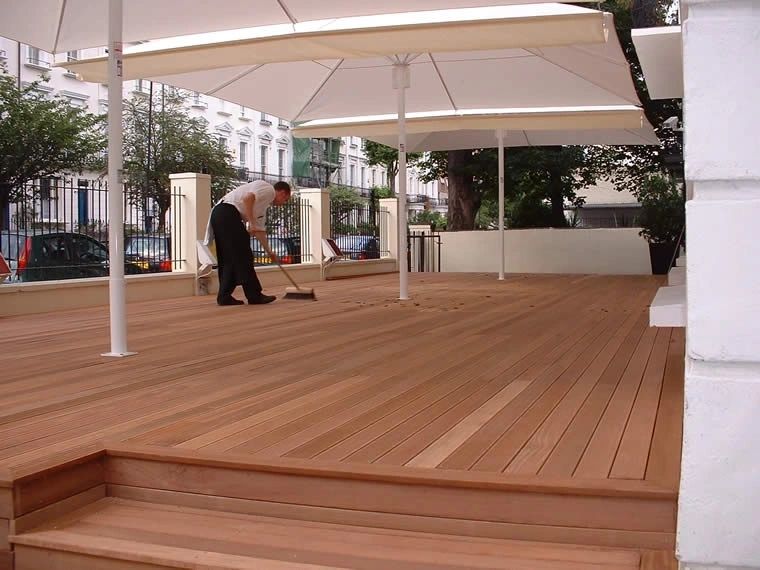
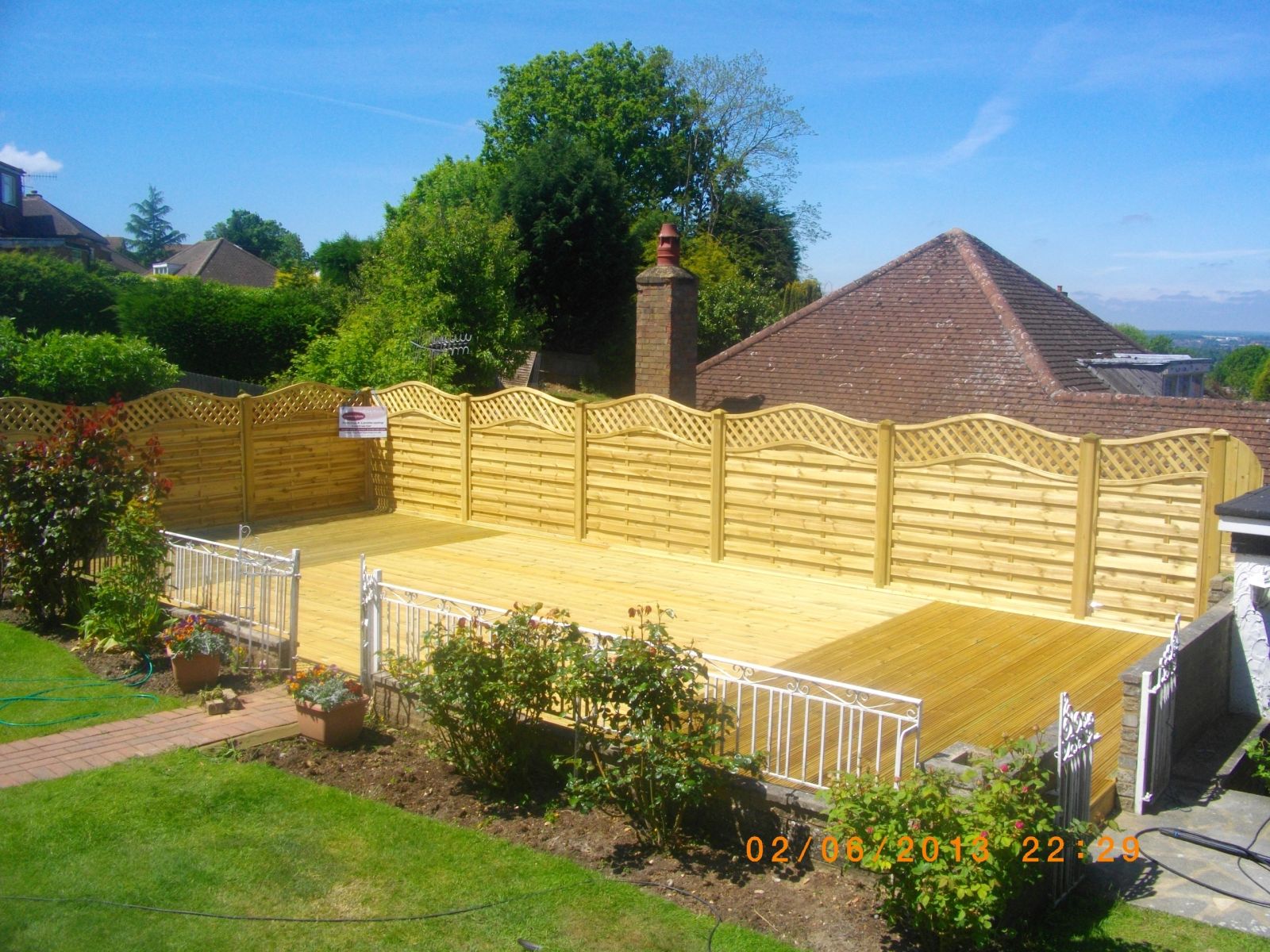
The edge where a deck meets an adjoining lawn or border needs a defined transition — a fascia board with a small step down, or a gravel or edging strip — rather than boards simply stopping at soil level, which otherwise leads to soil and organic matter migrating up against the deck edge.
That buildup against an unprotected deck edge holds moisture against the timber in exactly the way a raised bed built too close to a fence does, and is a common cause of localised rot along an otherwise sound deck perimeter.
A simple edging detail agreed at the design stage costs little compared with the deck itself but noticeably protects the vulnerable soil-contact edge.
Obstruction offences under the Highways Act
The Highways Act 1980 makes it an offence to obstruct a public highway, including the footway, without lawful authority, which is the underlying reason fencing, skips or materials on a pavement need proper authorisation.
This applies regardless of whether the obstruction is temporary for a delivery or intended as a permanent boundary feature encroaching onto highway land.
Where any part of planned boundary work might extend onto or over a public footway or verge, checking with the highway authority first avoids a straightforward enforcement issue later.