Digging near land drains
Older gardens, especially those on heavier clay, sometimes have unrecorded clay pipe or perforated plastic land drains laid to relieve waterlogging, and these rarely appear on any plan.
Hitting one with an auger usually shows up as a sudden drop in resistance followed by water pooling in the hole from a direction that doesn't match the water table generally on site.
A damaged land drain should be reconnected or rerouted rather than just backfilled over, since a broken run can redirect water against a post base for years afterwards.
Neighbourhood plan policies on boundary treatments
Some areas have an adopted neighbourhood plan alongside the wider local plan, which can include specific policies on boundary treatments, hedging, or street character that planning officers take into account.
These policies are most relevant when a planning application is genuinely needed, rather than affecting works that fall within standard permitted development rights.
Where a proposed boundary change does need permission, checking whether a neighbourhood plan applies locally can help anticipate what the council is likely to expect.
Wire supports for climbing plants on a fence
Climbers like clematis or trained fruit need their own tensioned wire or trellis support rather than relying on the fence panel itself, since the twisting and clinging growth habit can distort thin battens over time.
Vine eyes and straining wire fixed into posts, not into panel infill, spreads the load onto the structural timber rather than the part of the fence most likely to need replacing first.
Planning wire runs at the time a fence is built, rather than drilling into finished posts later, avoids weakening a post at exactly the point that already carries the most load.
Metal panel systems as an alternative on very exposed sites
On sites where timber panel failure from wind loading is a recurring problem despite heavier posts and shorter bays, a powder-coated steel or aluminium panel system offers a genuinely different approach, since the material doesn't flex, crack or delaminate the way a timber panel eventually does under repeated wind load.
These systems cost more than timber upfront and have a different aesthetic that not every client wants, but on a genuinely difficult exposed boundary they remove the recurring panel-replacement cycle entirely.
It's worth presenting as an option specifically where a client has already replaced timber panels on the same exposed run more than once, rather than as a default first suggestion.
Boundary questions in conveyancing enquiries
When a property is sold, standard conveyancing enquiries (the TA6 form) ask the seller to confirm boundary ownership and disclose any known disputes, including informal agreements about fence lines that were never registered.
An unrecorded verbal agreement about who maintains which boundary can cause problems at sale stage if it isn't consistent with the T-marks or general boundary on the title plan, since the buyer's solicitor will flag the discrepancy.
Keeping a simple written note or email trail of any boundary agreement reached with a neighbour, even an informal one, makes a later sale considerably smoother than relying on memory years afterwards.
How garden slope affects water shedding along a fence base
On a sloped garden, water naturally runs along the base of a fence line toward the lowest point, which means the downhill end of a run often sits in wetter ground than the uphill end even though both were built to the same specification.
This uneven exposure is a common reason why one end of an otherwise uniform fence needs gravel board replacement years before the rest.
A shallow cross-fall drainage channel or a slightly raised gravel board at the low point can intercept some of this flow before it pools against the timber.
Cracked concrete post repair limits
A hairline surface crack in a concrete post that hasn't reached the reinforcement can sometimes be left or sealed, but any crack that's opened enough to expose or move the internal reinforcing rod means the post has lost structural integrity.
We treat a reinforcement-deep crack as a replacement rather than a repair, since a patched crack in that condition tends to reopen under the next significant load.
Setting gate posts before the rest of a fence run
Gate posts carry more load and need tighter tolerances on spacing and plumb than intermediate fence posts, so they're normally set and checked first, with the rest of the run measured out relative to the confirmed gate opening rather than the other way round.
Where a gate is ordered to a bespoke size, its exact opening width has to be locked in before that section of the run is built, since a fence panel either side can absorb small adjustments far more easily than a made-to-measure gate can.
A gate post is also usually set with extra depth or a wider concrete base than a standard fence post, given the additional leverage a swinging gate applies, so it needs its own dig rather than being treated the same as its neighbours.
Temporary propping versus a permanent repair
A gate that's failed suddenly, such as a snapped hinge or a post knocked out of the ground, sometimes needs a temporary prop or fixing to secure the opening safely until a permanent repair can be carried out, particularly where the opening needs to remain secure overnight.
It's worth being clear with a client about which stage a repair is at, since a temporary fix isn't intended to be left in place long-term.
Sleeper edging and planters
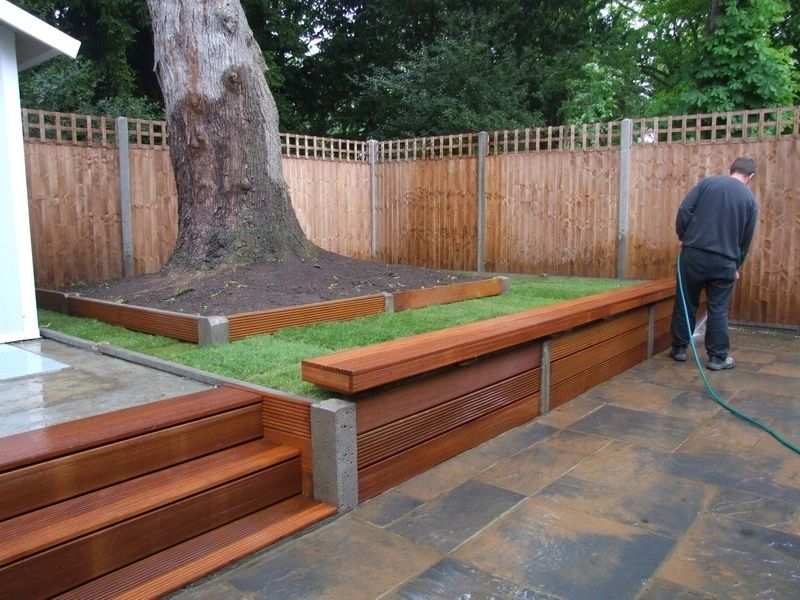
Softwood landscape sleepers are pressure-treated to a ground-contact use class and are generally cheaper and more consistent in size than reclaimed hardwood railway sleepers, which vary in condition and may carry historic residues such as creosote unsuitable for areas near planting or seating.
Sleepers used for raised beds or low retaining edges are usually stacked and pinned with long timber screws or steel rebar driven through pre-drilled holes rather than simply stacked loose, since an unpinned stack can shift as the ground behind it settles.
Where a sleeper structure is also expected to retain a meaningful depth of soil rather than just edge a bed, it moves into proper retaining-wall territory with its own drainage and structural considerations.
Redwood versus whitewood softwood
Redwood, more accurately European or Baltic redwood pine, has a denser structure and a naturally more durable heartwood than whitewood, which is typically spruce and has almost no natural decay resistance.
Both take preservative treatment reasonably well, but whitewood's tighter, harder-to-penetrate structure is one of the species that benefits most from incising before treatment.
In practice most fencing softwood sold as generic 'treated timber' doesn't distinguish clearly between the two, so the preservative treatment does more of the durability work than the species itself.