Setting realistic expectations for an acoustic fence
An acoustic fence noticeably softens noise rather than removing it, and the degree of improvement depends on the source, distance, height achievable and existing site conditions, not on the fence alone.
We discuss what a specific site can realistically achieve before quoting, rather than letting a general acoustic product description set an expectation the site can't deliver.
Hinge types found on garden gates
Band-and-gudgeon hinges, tee hinges, plain butt hinges and adjustable bolt-on hinges each suit a different gate weight and post material, and fitting the wrong type for the gate's weight is a common cause of early hinge failure.
A heavy timber gate needs a band-and-gudgeon or heavy-duty tee hinge rather than a light butt hinge sized for an internal door.
Refixing a concrete spur that has started to pull away
A spur bolted to a repaired post can work loose if its own footing wasn't set deep enough or wide enough to resist the same wind loading that failed the original post, showing up as a visible gap opening between spur and timber.
Refixing means re-tensioning or replacing the bolts and, where the footing itself has moved, breaking it out and repouring rather than simply pulling the spur back tight against a footing that's already failed.
Material delivery constraints on restricted-access sites
A property reached only by a narrow alley, a flight of steps, or a shared passage without vehicle access changes how gate materials are delivered and handled, since a full-size gate leaf, a bag of postmix or a length of steel box section may need carrying in by hand over some distance.
This constraint is worth identifying before materials are ordered, since it can affect what size or weight of gate is practical to specify for that particular access route.
Water ingress through a missing or damaged post cap
A post cap sheds rainwater off the exposed end grain at the top of a post, and once it's gone missing or cracked, that end grain absorbs water directly and rots from the top down rather than only from ground contact.
Refitting a cap is a cheap and quick repair on its own, but where a post has already been exposed for some time, it's worth checking how far rot has travelled down the post before assuming a new cap alone has solved the problem.
Safety standards for automated gates
Automated gates fall under machinery safety regulations, which means a force-limiting device or safety edge to stop the gate on contact with an obstruction, and photocells or other sensors to detect someone in the gate's path, aren't optional extras.
A risk assessment covering the specific installation — proximity to a public footpath, likely pedestrian use, manual override in a power cut — should be part of any automation job, not an afterthought once the gate's already built.
Annual servicing of the motor, safety sensors and mechanical stops keeps an automated gate compliant and catches wear before it becomes a safety issue rather than just an inconvenience.
Trellis toppers for extra height and privacy
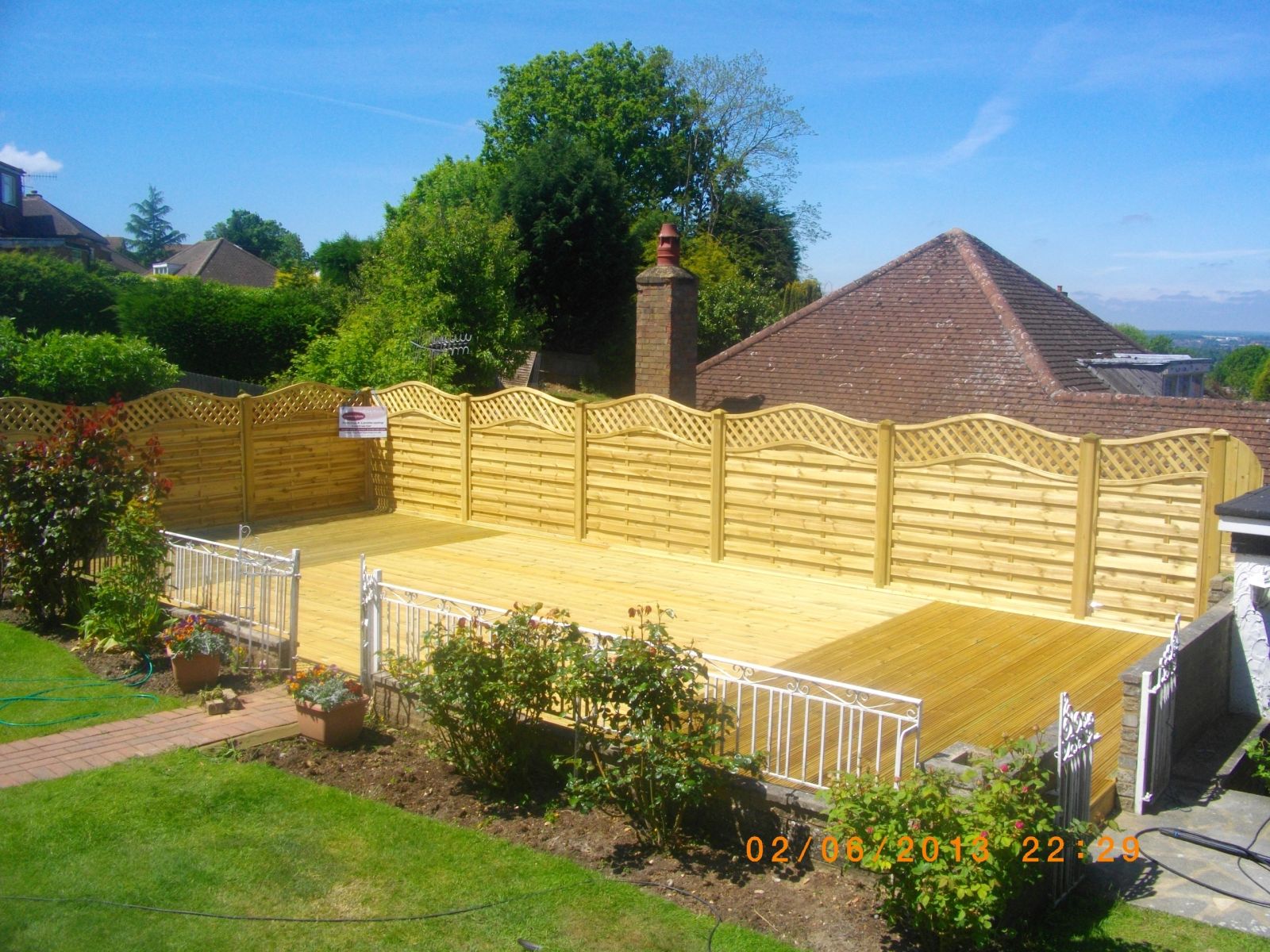
Adding a trellis topper to an existing or new fence is a common way to gain extra height for climbing plants or additional privacy without exceeding permitted development limits for a solid boundary.
Because trellis is inherently more open than solid panel, it doesn't usually count the same way toward the 2m height rule in every case, but it's still worth checking with the local authority since interpretations vary.
A trellis topper needs its own bracing where it's more than a token height, since a tall panel of trellis catching wind behaves more like a sail than most people expect.
Feather-edge versus overlap panel construction
Feather-edge fencing uses individual tapered boards nailed vertically to horizontal arris rails, built up on site board by board, which makes it easier to repair a single damaged board without disturbing the rest of the run.
Pre-made overlap or lap panels are faster to install since they arrive as a complete unit, but a single split board usually means replacing the whole panel rather than one board.
Feather-edge also tends to be the sturdier choice on an exposed or long run, since the individual boards and rail structure resist wind loading better than a thinner factory panel.
Mesh apertures and wire gauge
A mesh fence's aperture, the size of each gap between wires, and its wire gauge, the wire's diameter, together determine how much it restricts sightlines, resists intrusion and how heavy the finished panel is.
A smaller aperture with a heavier gauge wire gives better security and a more solid appearance, but adds weight and wind load that the supporting posts and foundations need to be sized for.
Wire gauge is often expressed in millimetres in current UK specifications rather than the older imperial standard wire gauge numbers, and mixing the two systems when comparing products can lead to ordering the wrong strength mesh.
Drilling into engineering brick or dense blockwork
Engineering brick and dense concrete block are far harder than ordinary facing brick, so standard masonry drill bits blunt quickly and a hammer-action drill with a carbide-tipped bit designed for dense material is needed to make progress without excessive heat.
Drilling slowly with intermittent withdrawal to clear dust keeps the bit cooler and the hole cleaner than forcing continuous pressure, which tends to glaze the hole and reduce the fixing's grip.
Where a wall is engineering brick specifically because it's load-bearing or below damp-proof course, it's worth checking that the fixing depth and pattern doesn't compromise the wall's structural role before drilling a run of holes into it.
Fitting band-and-gudgeon hinges correctly
A band-and-gudgeon hinge splits into a band that's strapped across the gate and a gudgeon pin fixed to the post, and the two need to be perfectly vertical relative to each other or the gate will bind or swing awkwardly through its full arc.
Getting the gudgeon pins plumb and in line during fitting matters more with this hinge type than with a butt hinge, since there's no simple way to adjust alignment after fixing.