Night-time noise sensitivity versus daytime
The same noise level is generally judged more intrusive at night than during the day, both because background noise is lower after dark and because sleep disturbance carries different consequences to daytime annoyance.
Where the main concern is night-time noise from a specific source, such as late deliveries or an all-night generator, the barrier design is weighted toward that source's night-time behaviour rather than its daytime average.
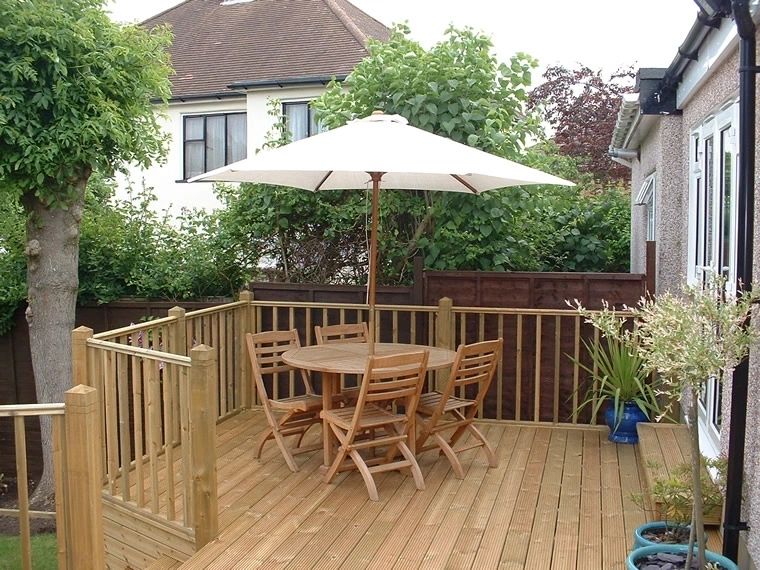
Deck boards against a shaded wall building up algae
A deck built hard against a shaded wall, fence, or dense planting on one side often shows a distinct band of algae growth along that edge well before the rest of the deck, since it dries far more slowly after rain.
This uneven wear pattern is normal rather than a sign of a substandard board, but it does mean that edge needs cleaning more often to keep slip resistance consistent across the whole deck.
Where possible, leaving even a narrow gap between the deck edge and an adjoining wall or dense hedge improves airflow along that edge and reduces how quickly algae establishes there.
Protecting galvanised coatings on fixings during a repair
Cutting, drilling or hammering a galvanised bracket or bolt during a repair can chip through the zinc coating and expose bare steel underneath, which then corrodes faster at exactly that damaged point than the surrounding coated surface.
Touching up any damaged area with a cold galvanising compound at the time of repair is a small step that meaningfully extends the life of the fixing, rather than leaving bare steel to start rusting immediately.
Terraced housing and rear access
Victorian and Edwardian terraces were rarely built with side access, which means materials for a rear garden fence often have to go through the house, over a shared side return, or down a narrow rear alley shared with several other properties.
That access constraint changes the practical choice of materials — full concrete gravel boards and long panels are harder to move through a narrow hallway than shorter timber sections carried in and built up on site.
It's also why timing matters on these jobs: a delivery that blocks a shared alley for half a day needs agreeing with neighbours in advance, not discovering on the morning of the job.
Distinguishing checking from structural splitting
Surface checking, fine drying cracks confined to the outer face of a timber section, is cosmetic and doesn't usually run deep enough to compromise a post or rail's strength.
A structural split runs further into or along the timber, sometimes right through a section, and can significantly reduce the effective load-bearing area at that point, particularly if it passes through a fixing or joint.
The practical test is depth and location: a shallow surface check away from any fixing is rarely a concern, while any split intersecting a bolt hole, mortice or bearing point is worth assessing before continued use.
Historic boundary stones and markers
Older rural and some urban boundaries occasionally retain historic boundary stones, iron markers or other physical features predating modern title plans, sometimes referenced directly in old deeds.
These features can carry real evidential weight in establishing a long-accepted boundary line, particularly where later documents are vague or contradictory.
Where such a marker exists, it's worth photographing and noting its position before any fencing work potentially disturbs or removes it.
Setting corner posts before intermediate posts
Corner and end posts are normally set first and their positions checked and finalised before any intermediate post along the run, since every other post's position is measured relative to those fixed points.
Setting intermediate posts first and corners last risks a corner ending up slightly off the true line established by the string, which then means either accepting a visible kink or redoing intermediate posts to correct it.
This sequence matters even more on a run with two changes of direction, where getting one corner wrong compounds the error along the whole of the next leg.
Japanese knotweed and invasive plants on a boundary
Japanese knotweed and other invasive non-native plants listed under the Wildlife and Countryside Act don't have to be removed by law, but it's an offence to allow them to spread into the wild or onto neighbouring land, and their green waste can't simply go into a normal garden waste bin.
Knotweed growing along or across a boundary is a common source of dispute and even litigation between neighbours, since an untreated infestation on one side can spread roots several metres and undermine fence posts or hard surfaces.
Any excavation near known knotweed needs specialist handling and disposal at a licensed site, since disturbing the rhizome without proper containment is one of the most effective ways to spread it further.
Sheltered courtyard microclimates and reduced wear
A small enclosed courtyard garden surrounded by walls or buildings on most sides creates a sheltered microclimate with reduced wind and often reduced direct rain exposure, which can extend the practical life of a timber finish well beyond the general guideline interval.
The trade-off is often reduced airflow and higher humidity in the enclosed space, which can favour algae or mould growth even though the timber itself isn't taking direct weather.
Recommending a maintenance interval based on general exposure alone can be too cautious for a sheltered courtyard or too relaxed for a damp, poorly-ventilated one, so it's worth judging each enclosed garden on its own conditions.
Powered auger versus hand-digging post holes
A petrol or hydraulic auger speeds up digging significantly on open, obstruction-free ground, but is the wrong tool near known services, tree roots or previous hardstanding, where it can't tell the difference between soil and something it shouldn't hit.
Access also decides the method — an auger needs room to manoeuvre and, for larger machines, a route wide enough to bring it onto site, which isn't always available on a narrow rear plot.
Hand-digging costs more in labour time but gives far more control in tight, obstructed or sensitive ground, which is why most quotes specify the method appropriate to the actual site rather than assuming the fastest option by default.
Why frost affects the timing of a post repair
Concrete poured around a post footing in freezing conditions can suffer frost damage before it's cured enough to resist it, leaving a weaker footing than the same mix poured in mild weather, so hard frosts are a reason to delay rather than push a repair through.
Ground that's frozen solid is also harder to dig cleanly, and posts reset into ground that later thaws unevenly can move again within the same season, so timing a repair around a settled mild spell reduces the risk of redoing it.