Galvanised versus stainless steel fixings on a coastal or corrosive site
Standard galvanised fixings perform well on most inland commercial sites, but a coastal, industrial or otherwise chemically aggressive environment accelerates corrosion at the fixing points well beyond what the same fence would experience on a typical inland yard.
Specifying stainless steel fixings instead of galvanised on an exposed site increases the outlay at installation but avoids a cycle of repeated fixing replacement that a standard galvanised specification would otherwise need in that environment.
Gaps at party walls and stepped brickwork
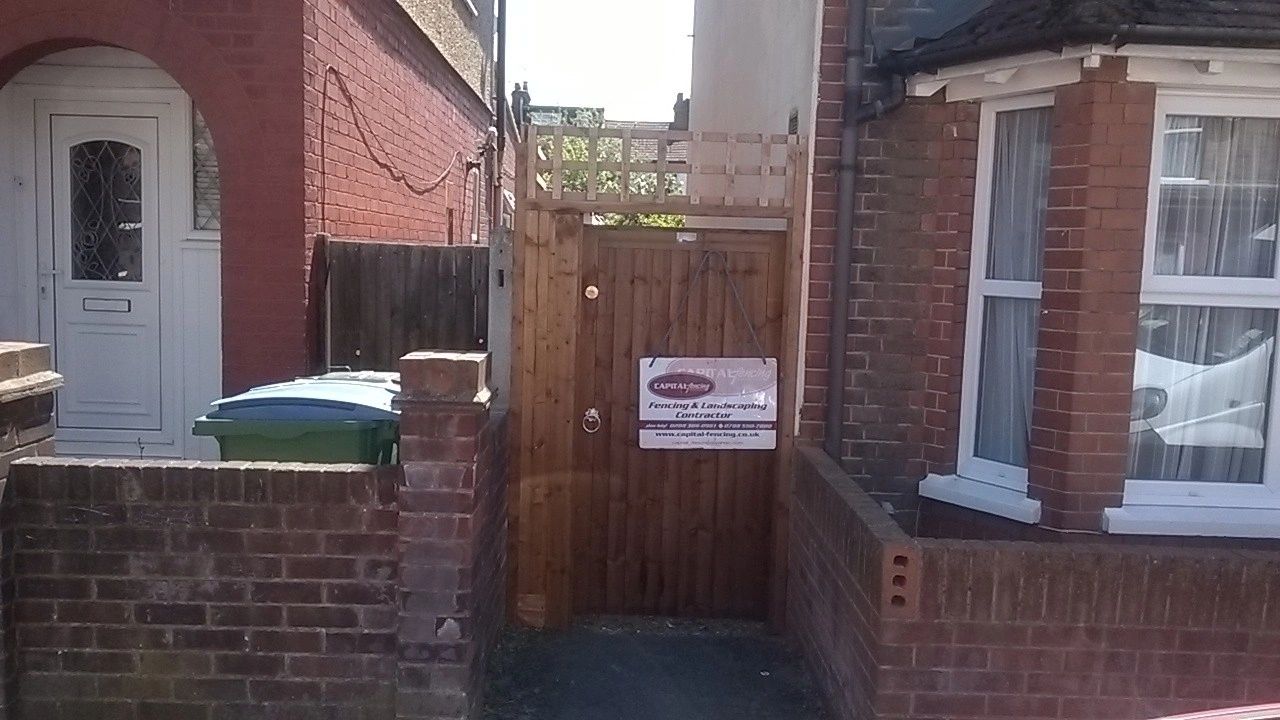
Where a fence meets a party wall or a stepped brick boundary, an ill-fitting junction leaves a gap that undoes the security of the whole run, so infill panels or a scribed timber closer are cut to follow the step rather than left square.
On an older terrace the brickwork step is rarely uniform along its length, so each junction is measured on site instead of assuming a standard offset.
Boundary fencing on land in a flood risk zone
Properties within a designated flood risk zone can be subject to additional requirements around solid boundary structures that might obstruct floodwater flow across the site.
A solid close-boarded fence can behave differently to a more open picket or post-and-rail design when it comes to how water moves through a garden during a flood event.
Where flood risk mapping shows a property is affected, checking with the local authority or Environment Agency for any relevant guidance is sensible before choosing a boundary style.
Post-mix density versus site-mixed concrete
Fast-setting bagged post-mix concrete is formulated to set rapidly with minimal water, but the resulting cured density and long-term strength are generally lower than a properly proportioned and compacted site-mixed concrete of the same nominal grade.
For a typical garden fence post carrying modest lateral load, post-mix's faster setting and convenience usually outweighs the modest strength difference, but for a heavily loaded gate post or long fence run, site-mixed concrete is sometimes specified for the added margin.
Both approaches depend on adequate hole diameter and depth relative to the post's exposed height, since undersized footings undermine either concrete type equally regardless of which mix is used.
Skip permits on a public highway
A skip placed on a public road or pavement, rather than entirely on private land such as a driveway, generally needs a permit from the local council's highways department beforehand.
Permits usually specify how the skip must be lit and marked, particularly overnight, and there are often restrictions near junctions or on narrower streets.
Placing a skip on the highway without the required permit can result in a fine, so it's worth checking with the skip hire company or council directly rather than assuming it's not needed.
Fencing above a basement lightwell or retaining structure
Where a boundary fence sits directly above a basement lightwell, sunken patio, or retaining wall with a significant drop on one side, the fence effectively doubles as a safety barrier and needs a height and gap specification suited to that fall risk rather than a standard garden boundary spec.
Post fixings in this situation often need to tie into the retaining structure itself rather than a simple ground-set post, which is a different engineering detail to a standard concrete-in post.
This is worth identifying clearly at survey stage, since treating it as a routine fence replacement without accounting for the drop below is a genuine safety oversight.
Checking wall coping condition before fixing into it
Coping stones or brick-on-edge capping along the top of a garden wall are often loosely bedded rather than solidly fixed, so drilling or clamping a fence post bracket into coping without checking it first can dislodge the coping itself.
A quick check by hand-pressure on each coping unit along the intended fixing line identifies any that are already loose, which is worth doing before committing to that wall as a fixing point at all.
Where coping is sound, spreading the fixing load across a bracket plate rather than a single point fixing reduces the chance of cracking the coping under wind load on the panels above.
Specifying fencing for an exposed hilltop plot
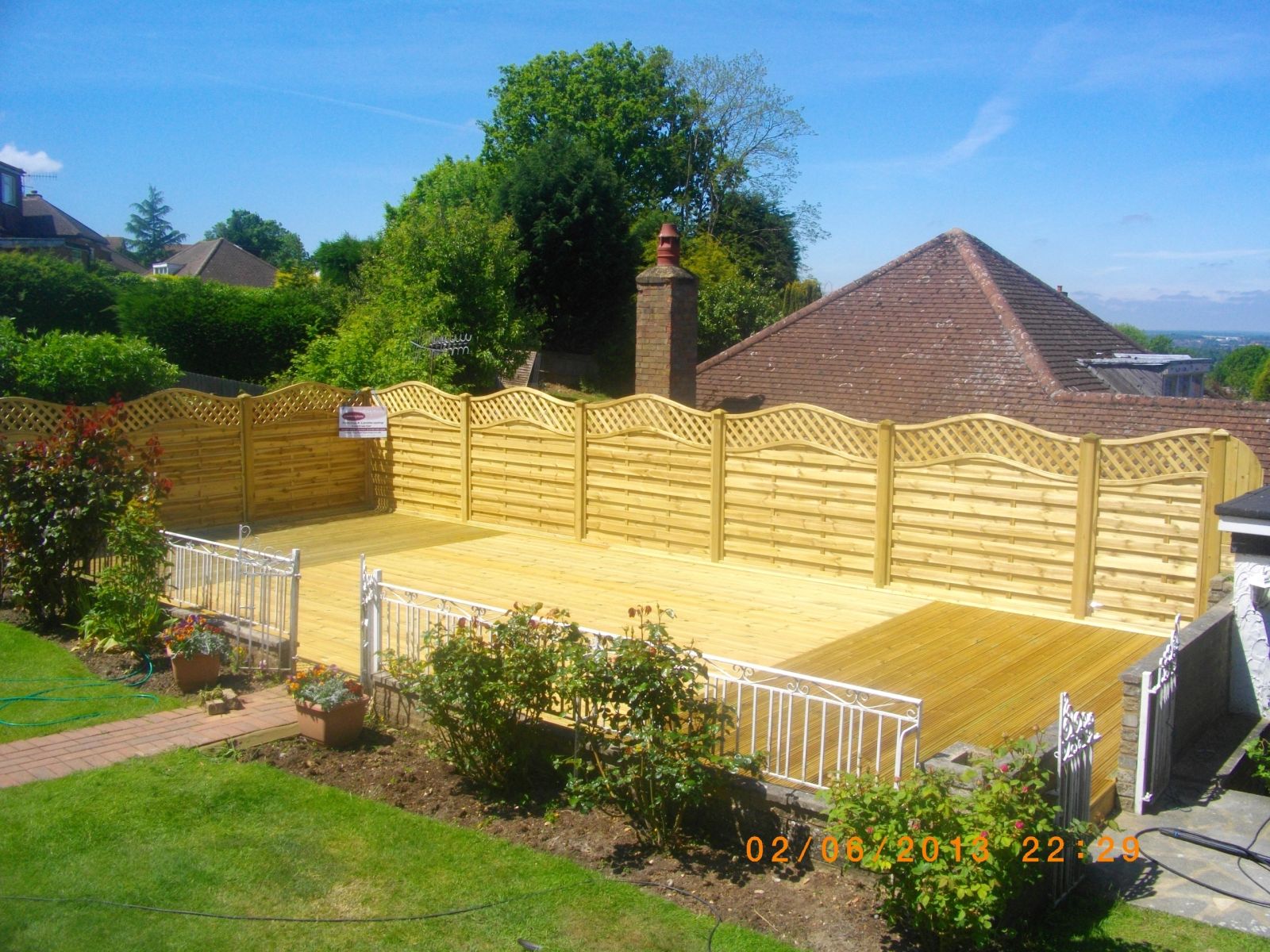
Plots on high ground with little surrounding shelter, common on the higher parts of the Chilterns and similar ridgelines, combine strong wind loading with faster-drying but also faster-weathering timber due to constant air movement.
A specification for this kind of site usually combines shorter bay spacing, part-slatted or louvred infill to reduce wind load, and a slightly heavier post section than the same height fence would need in a sheltered valley garden a few miles away.
It's a case where two gardens in the same postcode can genuinely need different specifications purely because of local topography rather than anything about the boundary itself.
Timber choice for a long-lasting gate
A gate takes more repeated stress at its joints than a static fence panel ever does, so a denser hardwood section at the hinge stile holds up noticeably better over time than a standard softwood frame in the same position.
Full treatment penetration at the joints matters more on a gate than anywhere else on the boundary, since that's where moisture gets trapped.
Wind noise through the fence itself
A poorly sealed acoustic fence can generate its own noise in high wind — whistling through small gaps or rattling loose boards — which is a different problem from the external noise it's meant to screen but is often confused with it.
Tight, well-fitted joints and secure fixings reduce this, and it's worth checking on-site during a windy period as part of a completed installation's sign-off.
A plot backing onto a rail cutting
A railway running in a cutting sits below the level of an adjoining garden, which changes the barrier calculation compared with a railway at grade or on an embankment, since the source is already partly screened by the cutting's own sides.
The wheel-rail interaction noise from a cutting can still carry surprisingly well along the open channel the cutting forms, so a barrier positioned at the top of the cutting edge is generally more effective than one set further back into the garden.