Perimeter fencing around a car park
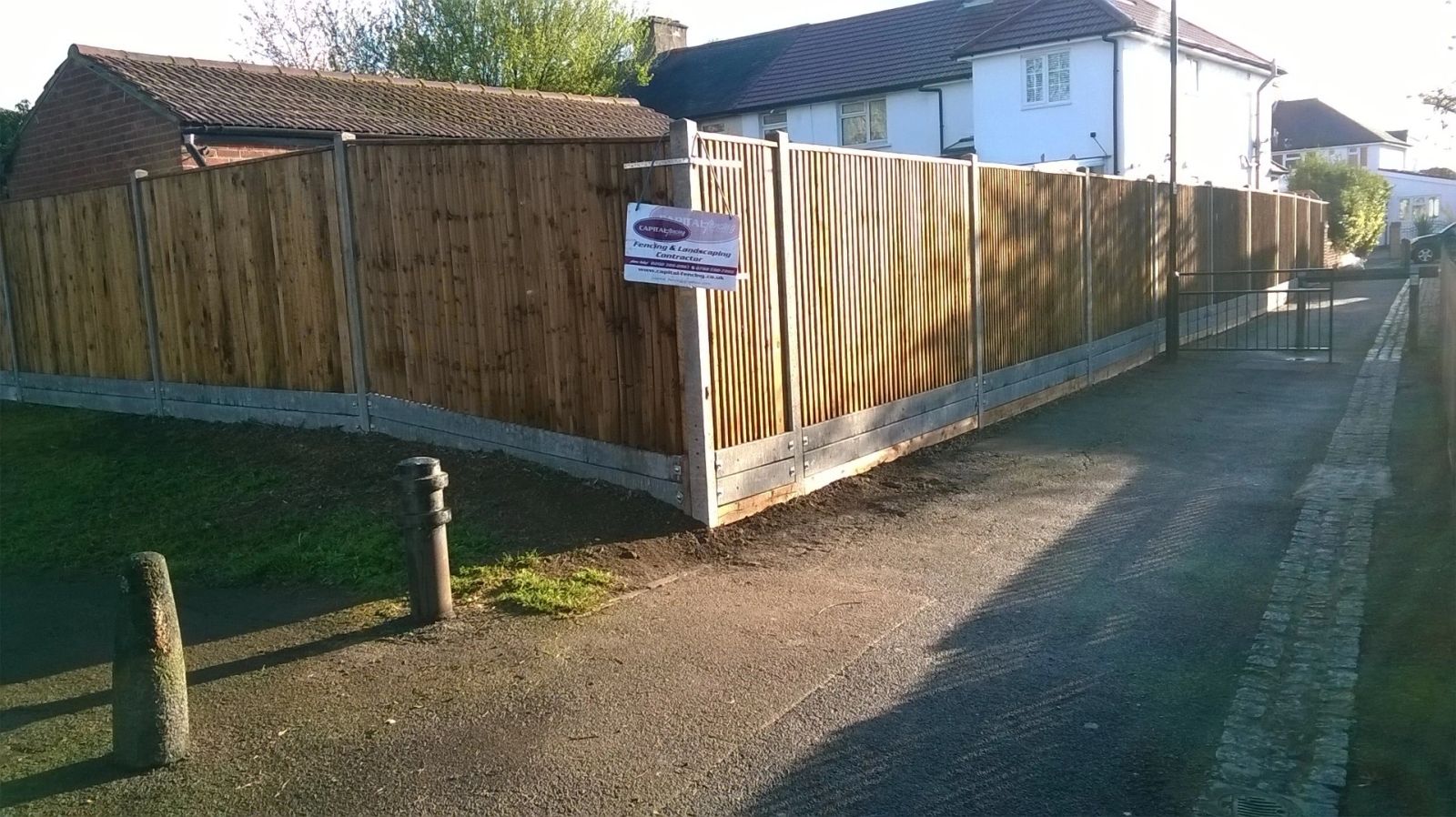
A car park perimeter combines security fencing with vehicle containment at points where a car could roll or be driven through the line, so kerbs, wheel stops or a heavier post spec are used at vulnerable edges rather than a uniform light-duty fence throughout.
Pedestrian gaps left for a footpath through the car park need their own gate or bollard treatment, since an open pedestrian route through an otherwise secure line is an easy way round the fence entirely.
Timber grading and treatment for a security spec
Where timber is used on a security run, a denser, higher-grade section holds up to sustained pressure at gate junctions and pedestrian pinch points better than a standard fence-grade board, and pressure treatment needs to penetrate fully rather than sit on the surface.
We spec the grade to the load the section will actually see, not a single grade across the whole job.
Repairing where two adjoining fence styles meet at a corner
A corner where one owner's closeboard fence meets a neighbour's panel fence is a common awkward point for repair, since damage at the corner post can affect both runs but only one owner may be instructing the work.
Where only one side is being repaired, the corner post and its fixings into both runs need checking so the finished repair doesn't leave the untouched neighbouring fence with a weaker connection than before.
Locks: nightlatch, deadlock, padlock hasps
A nightlatch-style mechanism, a mortice deadlock built into the gate frame, or a simple padlock-and-hasp arrangement each offer a different balance of convenience and resistance to forcing on an outdoor gate.
A mortice lock recessed into a timber frame is more weather-protected than a surface-mounted hasp, but needs a soundly built frame section to sit in.
End-grain sealing on cut timber
End grain is far more absorbent than a timber's long faces because it exposes the open ends of the wood's vascular cells, so a post or rail cut to length on site can soak up moisture many times faster at the cut end than elsewhere.
Leaving a fresh cut untreated is one of the more common ways a pressure-treated timber ends up rotting from the middle outwards, since the factory treatment doesn't extend to a cut made after the fact.
A brush-applied end-grain preservative or sealant on every site-cut post base and rail end restores some of that lost protection, and takes only a few minutes per cut relative to the risk it avoids.
What a repair sign-off covers
Once a repair is complete we check the repaired section moves and sits correctly against the rest of the run, not just that the immediate damage is fixed, since a post reset slightly out of line can put uneven strain on the panels either side.
We also leave the client with a clear note of what was replaced and what, if anything, is worth watching over the next year or two.
New-build plots and developer specification
New-build plots are frequently handed over with a minimal timber boundary treatment specified by the developer, sometimes with a defects-period clause that ties any alteration to the developer's own maintenance obligations for the first two years.
Ground on a recently-built plot is also often disturbed or re-graded rather than settled, so posts set too soon after landscaping can move as the ground consolidates over the following winter.
Estate-wide design codes on new developments frequently specify a single approved fence style and colour for the first several years of occupation, which is worth checking against the site's planning conditions before replacing anything.
When a neighbour won't allow access for a repair from their side
Some repairs are far more easily done working from one side of the boundary than the other, and if that's the neighbour's side and they decline access, the repair has to be planned working entirely from the client's own garden instead.
This can mean extra propping, working at an awkward angle, or in some cases a different repair method altogether, and it's worth agreeing with the client upfront rather than assuming access will be granted on the day.
Checking a post is plumb in two planes
A post checked with a spirit level on only one face can still be leaning across the run even though it looks vertical along it, so plumb needs confirming on two adjacent faces at right angles before concrete goes in.
This matters most on corner and gate posts, where a lean invisible from the main run direction becomes obvious the moment a gate is hung and doesn't swing true.
Rechecking plumb again just before the concrete starts to go off catches any post nudged out of position while backfilling or bracing, since that's a common point for a post to drift slightly unnoticed.
Mediation as a step before a formal boundary dispute
Community and property mediation services exist specifically to help neighbours resolve disagreements, including boundary and fencing disputes, without going straight to solicitors or court.
Mediation is generally faster and considerably cheaper than formal legal action, and can preserve a working relationship between neighbours who will, after all, remain neighbours.
Where a boundary disagreement is becoming entrenched, raising the idea of mediation early is often more productive than escalating straight to legal correspondence.
Detached plots with a paddock or field edge
Detached properties backing onto a paddock, field or grazing land need a boundary that does two jobs at once — keeping the garden private and, if livestock use the adjoining land, keeping animals off the garden side.
A standard close-boarded fence isn't stock-proof on its own; where horses or cattle are present on the other side, a stock fence or post-and-rail set slightly inside the garden fence is the usual belt-and-braces approach.
Field boundaries also see more vegetation growth and root pressure from hedgerows than a typical suburban fence line, so posts often need resetting or straightening more often than an equivalent garden boundary.
Footway licences for materials on a pavement
Storing fencing materials, a small skip, or scaffolding on a public footway, even briefly, can require a licence from the council responsible for that stretch of highway.
This is separate from any parking suspension for a vehicle, and covers the physical obstruction of pedestrian space rather than the road itself.
On narrow residential pavements it's worth checking the council's footway licence requirements ahead of a delivery, since blocking a pushchair or wheelchair route without authorisation can draw a complaint.
Bottom rail profiles that trap standing water
A flat-topped bottom rail on a timber gate can hold a film of standing water after rain rather than shedding it, and this repeated wetting is a common cause of rot starting at the bottom rail well before the rest of the gate shows any deterioration.
A weathered or sloped top edge on a replacement bottom rail sheds water more effectively than a flat profile, extending the life of that component specifically.
Timber species and seasonal movement differences
Softwood gate frames move more with seasonal humidity changes than a hardwood equivalent, which is why a softwood gate that fitted well in summer can bind noticeably by winter, while a well-seasoned hardwood frame shows less variation.
Understanding which timber a gate is built from helps set realistic expectations for how much seasonal adjustment it will need rather than treating every gate the same way.
Repair-versus-replace based on the remaining service life of the rest of the run
A repair on a fence that's otherwise only a few years old is a straightforward like-for-like fix, but the same repair on a run that's already close to the end of its typical service life is worth weighing against bringing the replacement forward instead.
This isn't about age alone — a well-maintained older fence can still be worth repairing — but age combined with visible general wear elsewhere on the run is a reasonable prompt to discuss the wider picture rather than only the failed section.
Powder coating and galvanising
Galvanising bonds a zinc coating to steel, usually by hot-dip, giving corrosion protection that works even if the surface is scratched because the surrounding zinc sacrifices itself to protect the exposed steel.
Powder coating is a decorative and additional protective layer baked onto the metal, giving a wide choice of colour and a harder finish than paint, but on its own over bare steel it doesn't offer the same self-healing protection as galvanising.
The durable combination for steel gates and railings is galvanising first, powder coating over the top, rather than powder coating alone, which is worth checking on a quote where both are mentioned separately.
Timing a repair around summer timber shrinkage
Timber fitted during a dry summer spell shrinks slightly as it settles to ambient moisture content, which can leave newly fixed boards or rails with small gaps that weren't visible at the point of fitting.
This is a normal part of timber behaviour rather than a fault in the repair, and it's worth explaining at the time so a client isn't surprised to see gaps open up slightly over the following weeks.
Freeholder consent for a leasehold garden
Leasehold houses and flats with a garden are usually still subject to the terms of the lease, which can require the freeholder's written consent before altering boundary structures.
This applies even where the leaseholder has full day-to-day use of the garden and has paid for previous fencing work themselves.
Checking the lease, or asking the managing agent, before committing to boundary work avoids a costly rebuild if consent turns out to be required and wasn't obtained first.
Fencing over services and cable routes
Before any post hole is dug, service records or a cable-avoidance sweep should confirm what runs under the line — a fence boundary often follows an old cable or drain route because that was the cheapest place to lay it originally.
Where a service can't be avoided, post positions are shifted along the run or a shallower surface-mounted base is used instead of digging through the service.
Maintaining ground sockets for gate drop bolts
A drop bolt socket set into the ground or a hardstanding surface collects grit, leaves and standing water over time, and a socket that isn't kept clear will stop the bolt seating fully, leaving a gate leaf that looks locked but isn't actually secured at that point.
Clearing and lightly lubricating the socket as part of routine maintenance is a small task that prevents a far more disruptive failure where a socket has to be dug out and reset after becoming completely blocked.
Staple and clout corrosion
Wire staples and clout nails used to fix wire mesh or thin capping are among the first fixings to corrode, since their small cross-section and shallow galvanising thickness give them less protection than a heavier fixing.
A repair that replaces the mesh or board but reuses corroded staples is only a partial fix, since the corroded fixings will fail again well before the new material does.
Frost heave in shallow footings
A post base set too shallow, or poured in ground that later saturates, can be lifted slightly by frost heave as ice forms and expands beneath it, then settles unevenly once it thaws.
This is most noticeable on posts set less than the recommended depth for their height, where the concrete base itself sits within the top layer of ground most affected by winter freezing.
Once a post has heaved even a few millimetres out of true, the movement tends to repeat each winter, which is why it is worth digging to the depth appropriate for the post height rather than the minimum that will stand up in summer.