Wind loading on a solid gate face
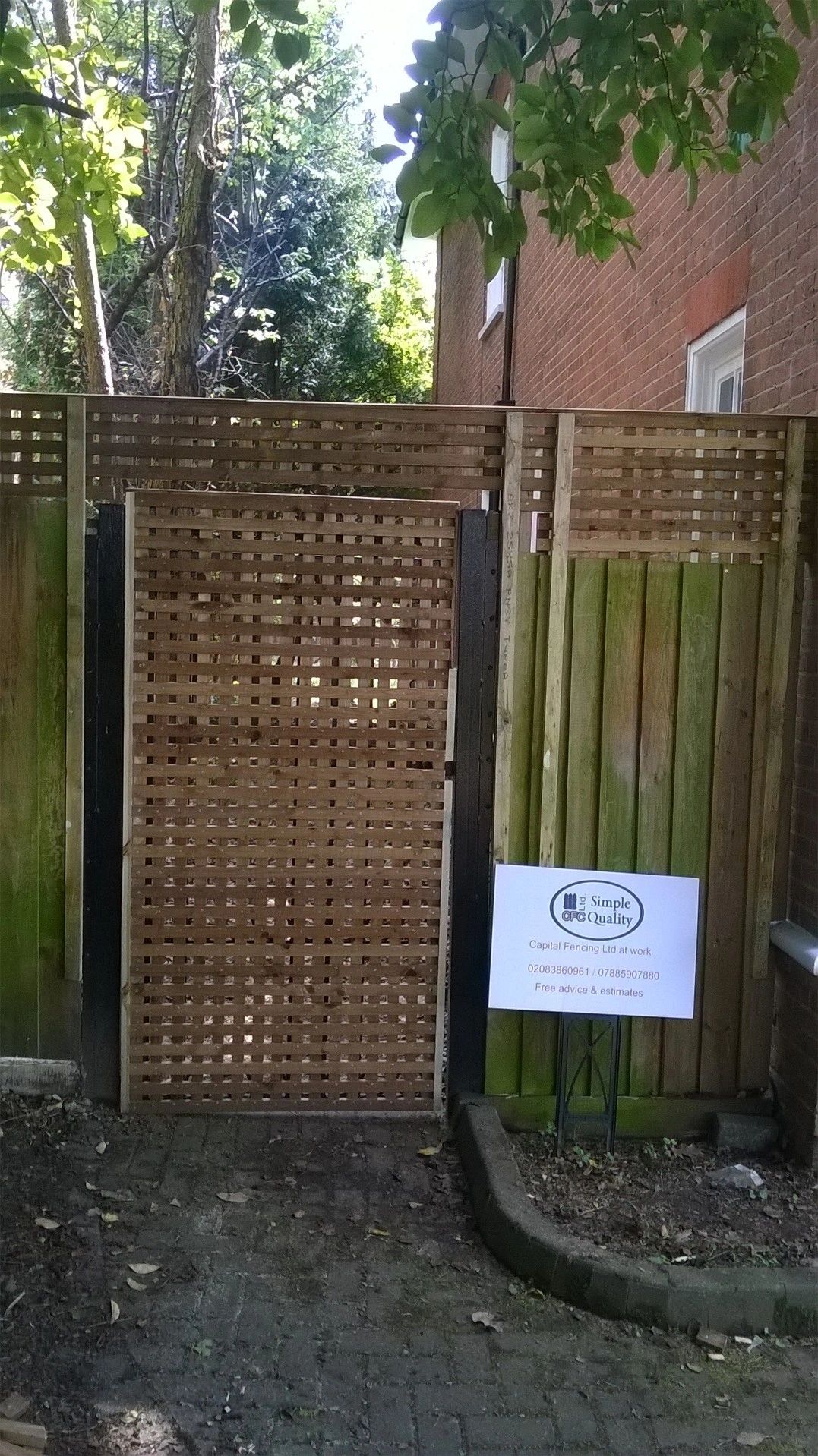
A solid gate face catches far more wind than an open-bar design of the same size, which puts extra strain on the hinge side over time — this is worth factoring in when repairing or replacing a gate on an exposed frontage.
Bracing the frame diagonally helps a solid gate resist that racking force in a way a simple butt-jointed frame doesn't.
Stabilising a pergola post that has started to rock
A pergola post rocks where its footing has cracked or where the post itself has begun rotting at the base, and because pergola posts often carry a roof structure rather than just a fence line, a rocking post carries more consequence if ignored.
Repair generally means breaking out and repouring the footing with the post braced upright and level while the concrete cures, and checking the beam fixings at the top of the post at the same time, since a post reset out of plumb strains the joinery above it.
Decking board profiles and grooves
Timber decking boards commonly come grooved (ribbed) on the top face for grip, reversible to a smooth face for a more contemporary look, or with a rounded profile that sheds water more readily but offers less traction underfoot.
Grooved boards trap dirt and moisture in the channels more than a smooth or rounded profile, so they need more regular brushing or washing to avoid becoming slippery with algae, particularly in shaded, damp positions.
Composite boards are usually extruded with a fixed groove or embossed texture rather than milled, and the profile is generally part of a wider system with matching edge trims rather than a feature that can be mixed freely between board types.
Deck boards against a shaded wall building up algae
A deck built hard against a shaded wall, fence, or dense planting on one side often shows a distinct band of algae growth along that edge well before the rest of the deck, since it dries far more slowly after rain.
This uneven wear pattern is normal rather than a sign of a substandard board, but it does mean that edge needs cleaning more often to keep slip resistance consistent across the whole deck.
Where possible, leaving even a narrow gap between the deck edge and an adjoining wall or dense hedge improves airflow along that edge and reduces how quickly algae establishes there.
When a boundary dispute reaches a solicitor's letter
A formal 'letter before action' from a solicitor is usually a sign that informal resolution has broken down and one party is preparing to escalate a boundary or fencing dispute further.
Receiving one doesn't automatically mean court is inevitable, but it does mean the matter should be taken seriously and responded to, ideally with professional legal advice rather than informally.
Most fencing disputes never reach this stage, but knowing the general process exists helps put an early disagreement into perspective before it escalates unnecessarily.
Insurance paperwork after storm damage
Most household policies distinguish between storm damage to a fence, which is often covered subject to policy wording and excess, and general wear or rot, which typically isn't, so insurers commonly ask for photographs of the damage and sometimes of the fence's prior condition.
A dated photo of the boundary from before the storm, even an incidental one, can materially help a claim where the insurer disputes whether failure was storm-related or simply due to age.
This is a general description of how these claims are typically assessed rather than a statement about any specific insurer's policy, and terms, excesses and definitions of 'storm' vary between providers and should be checked in the policy document.
Shared ownership properties and boundary consent
Shared ownership homeowners typically still need the housing association or landlord's consent for structural boundary alterations, in line with the terms of the lease, even though they own a share of the property.
This mirrors the position for full leaseholders in many respects, and skipping the consent step can create complications later, particularly when it comes to staircasing to full ownership or reselling.
Checking the specific lease terms, or asking the shared ownership provider directly, avoids doing boundary work that technically breaches the agreement.
Steel post for a heavy timber gate
A wide or solid-faced timber gate can be heavy enough that a timber hanging post, even oversized, isn't stiff enough to resist long-term leverage, in which case a concreted steel post with a welded or bolted hinge plate gives a stiffer fixing.
This is more common on wide driveway gates than standard pedestrian gates, where the extra cost of a steel post is offset by significantly less long-term sag.
Latch types: Suffolk, ring, auto-latch, gravity
A Suffolk latch and a ring latch both use a thumb-operated lever to lift a bar out of a keep, while an auto-latch closes itself on contact and a gravity latch relies on weighted design to drop into place — each needs different striker alignment to work reliably.
Replacing a worn latch with a like-for-like type is usually simpler than switching types, since the keep and striker positions are often already cut for that specific mechanism.
Managing noise during a security fence installation
Post-hole augering, breaking out old concrete footings and cutting steel palisade to length all generate noise that's worth flagging to neighbours or site occupants in advance, particularly on a compound or commercial job with fixed working hours nearby.
Where a site has noise-sensitive neighbours, sequencing louder tasks earlier in the working day and confining cutting to one area reduces the disruption without slowing the job significantly.
Keeping new-build estates consistent
Uniform estates built to a single developer specification often have an unwritten (or sometimes written, via estate covenant) expectation that boundary fencing matches the original height, colour and panel style across the whole street.
Departing from that pattern on a single plot — a taller fence, a different stain colour, an unusual gate style — tends to stand out more starkly on a visually consistent estate than it would on a street of individually built houses.
Where a management company or residents' association enforces an estate covenant, it's worth checking the permitted specification before ordering materials, since a non-compliant fence can sometimes have to be replaced at the owner's cost.
Dry-mix versus wet-mix concrete for post bases
A dry mix — post-fixing concrete poured dry into the hole around a braced post and left to draw moisture from the surrounding ground — sets over a day or two and suits smaller domestic posts in reasonably moist soil.
A wet mix, gauged and mixed with water before placing, gives more control over strength and is generally preferred for larger posts, gate posts under lateral load, or very dry, free-draining ground where a dry mix may not draw enough moisture to cure properly.
Wet mix also allows proper tamping to remove air pockets around the post, which a dry mix poured in stages can't achieve to the same degree.
Guide wheel and channel wear on sliding gates
A sliding gate runs along a bottom track or overhead guide rather than swinging on hinges, and wear in these components shows up as the gate binding, jumping the track, or leaning as it travels rather than dropping at a hinge corner.
Debris in the track is one of the most common causes of a sliding gate sticking, and clearing it is worth checking before assuming a wheel or motor fault.
Through-fixing a hasp for padlock security
A hasp fixed only with screws from the accessible face can be forced or unscrewed relatively easily, whereas through-bolting it with fixings passing right through the gate frame to a backing plate resists that kind of attack far better.
This is a straightforward upgrade on an existing gate that already has a hasp fitted, without needing to replace the hasp itself.
Pet-proofing a garden boundary
Dogs that dig will often go under a fence line rather than over it, so a gravel board or buried mesh apron at the base does more to keep a determined digger in than extra height above ground.
Gaps at gate thresholds and where a fence meets a wall or building are the most common escape points, and are worth checking specifically rather than assuming a continuous fence line is actually continuous at ground level.
Smaller or younger dogs and cats can fit through gaps that look too small to be a concern, so picket or trellis-style boundaries usually need a solid section or mesh backing if pet containment is the priority.
Appealing a refused boundary planning application
Where a planning application for a taller or otherwise non-permitted boundary structure is refused, there's a formal right of appeal to the Planning Inspectorate within a set time limit.
Appeals are considered on planning merit rather than personal circumstances, and can take several months to be decided, which is worth factoring into any timeline.
Getting professional planning advice before submitting an appeal often improves the prospects of addressing the reasons for the original refusal effectively.
Downpipe discharge points near a fence base
A downpipe discharging directly onto open ground near a fence line, rather than into a proper drain or soakaway, concentrates a large volume of roof water at one specific point along the boundary during heavy rain.
Over time this creates a permanently saturated patch that behaves like a high water table locally, even though the rest of the garden drains normally.
Redirecting the discharge with a short length of pipe or a small soakaway a metre or two from the fence line resolves the issue far more effectively than trying to compensate with a more resistant post base.
Why corner posts fail more often and need stronger repair specification
A corner post carries the combined load of two fence runs meeting at an angle rather than a single run passing through, so it's under more sustained stress than an intermediate post and often fails first on an ageing boundary.
Repairing a corner post is worth specifying to a slightly higher standard than a mid-run post — larger section, deeper footing, sometimes additional bracing — given the extra load it carries permanently rather than only occasionally.
Nesting birds in vegetation on a fence line
Dense hedging, ivy or overgrown trellis attached to a fence can hold active bird nests during the spring and summer nesting season, and disturbing a nest in use is an offence regardless of how routine the fence repair itself is.
Where a repair requires cutting back vegetation that might be nesting habitat, checking for active nests first and, if found, delaying that part of the work until the nest is no longer in use is the straightforward way to stay compliant.
Repair-versus-replace where the original fence style is discontinued
Where a damaged section uses a panel style, board profile or post section that's no longer manufactured, a close match might be achievable for a small repair, but a larger area of damage can tip the balance toward replacing the whole run in a current style rather than chasing an increasingly poor match.
This is a judgement client conversation as much as a technical one, since some clients prioritise keeping the existing look even with a visible join, while others would rather have a uniform new run.
Re-tensioning chain-link mesh that has sagged
Chain-link sags where the line wire running through the top of the mesh has stretched or where a straining post at the end of the run has leaned, taking the tension off the whole span rather than just the section that looks slack.
Repair usually starts at the straining post — replumbing or reinforcing it — before the line wire is re-tensioned with a winder, since re-tensioning against a leaning straining post just pulls it further out of line.
Gravity latch weight and pivot balance
A gravity latch relies on its own weight to drop the bar into the keep as the gate closes, so the pivot point and the latch's weight distribution both need to be correct for it to fall reliably rather than sticking mid-drop.
A latch that's been repainted heavily can gain enough extra weight or friction at the pivot to stop working properly, which is worth checking before assuming the mechanism itself has failed.