Working safely on a roadside or public-facing boundary
A security fence often runs along a frontage that faces a pavement, a school run or a shared access road, so material storage, tool use and post-hole cover are managed to keep the public side of the works safe throughout.
On a commercial site this extends to keeping a fire route or loading bay clear while the new line goes in.
How a security job is sequenced
Work generally runs boundary-first — posts and the main line go in before gates, so gate openings are set against a fixed, already-concreted frame rather than guessed at in advance.
On a longer commercial perimeter the line is broken into manageable sections so part of the site can stay secure while another part is being worked on.
Pet-proofing gaps at gate edges and thresholds
A small dog or cat can exploit a surprisingly narrow gap at a gate's hinge edge, latch edge or bottom clearance, and a gate that's perfectly secure against people can still let a determined pet through if these gaps aren't considered separately.
Closing plates, a lowered threshold detail or a secondary mesh infill are common ways to pet-proof a gate without rebuilding it entirely.
Use Class 4 versus Use Class 3 timber
The European use-class system grades timber by the exposure it's treated to withstand: Use Class 3 covers timber above ground but exposed to weather, such as capping or fascia boards, while Use Class 4 covers timber in ground contact or fresh water, such as posts.
A Use Class 4 post buried in soil needs a deeper, longer-lasting retention of preservative than a Use Class 3 rail bolted between two posts, because the ground contact zone stays damp for far longer than an exposed but well-drained horizontal timber.
Specifying the wrong class isn't always obvious at installation, since both can look identical when new, but it shows up years later as premature rot concentrated at ground level rather than along the whole length.
Properties with no registered title at all
A small proportion of properties in England and Wales, usually those that haven't changed hands or been mortgaged for a very long time, still aren't registered with HM Land Registry at all.
In these cases, boundary questions rely entirely on the original paper deeds held by the owner, which can be less detailed or harder to interpret than a modern registered title plan.
First registration can be triggered voluntarily or by certain transactions, and often brings helpful clarity to boundary questions that were previously only defined by older paper deeds.
Planning enforcement notices on unauthorised boundaries
Councils have enforcement powers to require unauthorised boundary structures to be altered or removed, usually triggered by a neighbour's complaint or a routine site visit for unrelated work.
There are time limits on enforcement action for most breaches, though these vary by the type of breach and don't apply to work within a conservation area or affecting a listed building in the same way.
Responding promptly and cooperatively to any enforcement contact from a council generally leads to a better outcome than ignoring it.
Boundaries adjoining registered common land
Land registered as common land under the Commons Registration Act carries specific legal protections, and fencing along a boundary with it can require consent from the Planning Inspectorate under separate legislation.
This is a different and more specialist process than an ordinary planning application, reflecting the protected status of common land itself.
Anyone with a boundary adjoining registered common land should check its status carefully before assuming a straightforward fence replacement is all that's needed.
Repair-versus-replace decision based on how many posts have failed
Where only one or two posts in a run have failed, individual repair is usually the more sensible option, but once roughly a third or more of the posts along a run show the same rot or movement, a full run replacement often ends up more reliable and no more disruptive.
Counting failed posts as a proportion of the run, rather than judging each one in isolation, gives a clearer basis for that decision than reacting to whichever post has failed most recently.
Boundary questions raised during a property sale
Conveyancing on a property sale routinely asks the seller to confirm boundary ownership and flag any known disputes, which can bring long-dormant boundary questions to the surface.
A fence built or replaced without proper regard to the true boundary line can complicate or delay a sale if it comes up during these enquiries.
Keeping any boundary agreements, planning permissions or correspondence about a garden fence on file makes answering these standard conveyancing questions considerably easier when the time comes.
Hedge pressure on a fence line
An unmanaged hedge planted close to a boundary fence pushes against the panel or rail as it thickens, and that steady lateral pressure can bow a panel or rack a post over several seasons even without any storm involved.
Cutting the hedge back from the fence line at repair time reduces the chance of the same section failing again shortly after.
Matching a new run to an existing style
Matching an extension or repair to an existing fence starts with identifying the actual system in use — panel type, post type, rail count, board profile — rather than assuming any similarly-priced product from a different range will look consistent alongside it.
Weathered timber and faded composite are both difficult to match exactly with new material, so a visible seam between old and new sections is often unavoidable and worth agreeing with the client at quote stage rather than promising an invisible join.
Where a manufacturer has changed a profile or a colour range since the original was fitted, matching sometimes means re-doing a full run rather than extending it, which is worth flagging before ordering a small top-up quantity.
Stainless fixings in exposed positions
Stainless steel fixings resist corrosion better than galvanised equivalents and don't leave the dark rust streaks that a failing galvanised screw head can bleed into pale or oiled timber.
They're specified more selectively than as a blanket upgrade, typically on coastal or otherwise highly exposed sites, on hardwood where tannins react badly with ordinary galvanised steel, or on visible ironmongery where staining would be obvious.
Grade matters even within stainless — 304 is adequate for most exposed domestic fencing work, while a genuinely coastal or salt-exposed site is better served by the more corrosion-resistant 316 grade.
Feather-edge versus overlap panel construction
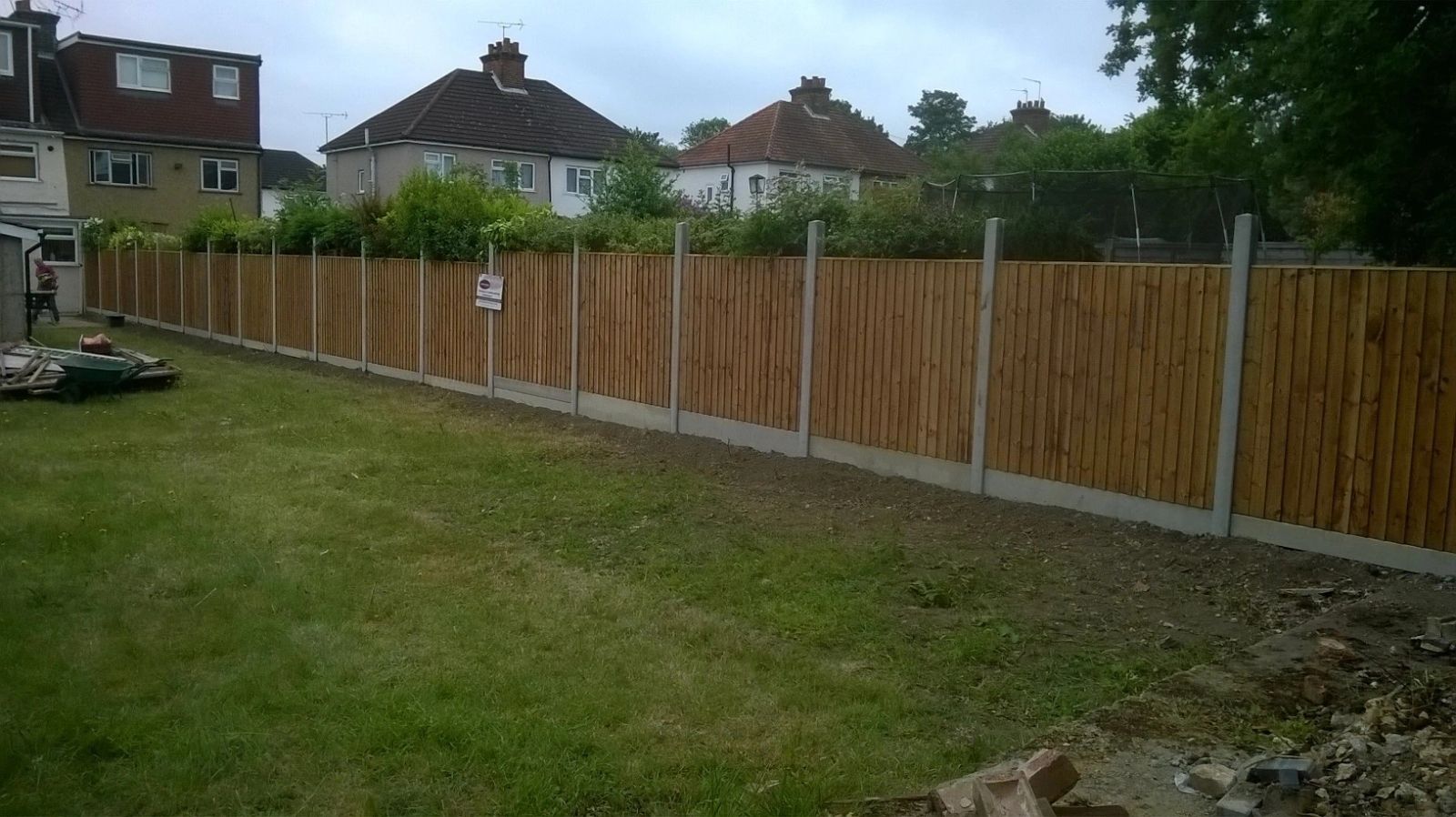
Feather-edge fencing uses individual tapered boards nailed vertically to horizontal arris rails, built up on site board by board, which makes it easier to repair a single damaged board without disturbing the rest of the run.
Pre-made overlap or lap panels are faster to install since they arrive as a complete unit, but a single split board usually means replacing the whole panel rather than one board.
Feather-edge also tends to be the sturdier choice on an exposed or long run, since the individual boards and rail structure resist wind loading better than a thinner factory panel.
Protecting a boundary fence during nearby building work
Where building work, an extension or a loft conversion is happening on an adjoining property, existing boundary fences and their footings are sometimes shifted, undermined or damaged by machinery or excavation.
It's reasonable to raise this in advance with a neighbour undertaking major building work, ideally recording the fence's condition beforehand with photographs.
Where a party wall notice has been served for related works, that process can sometimes address boundary condition issues as part of a schedule of condition, which is worth asking about.
Setting posts in clay
London clay and the heavier Hertfordshire boulder clays shrink and swell noticeably between a dry summer and a wet winter, which is exactly the movement that works a badly-set post loose over a few seasons.
The fix is depth and drainage rather than just more concrete: posts need to go below the zone that dries out and cracks seasonally, typically deeper than the standard 600mm used on free-draining ground, with a stone or gravel key at the base so water isn't trapped against the timber.
Postcrete alone on shallow clay bases is one of the most common reasons we're called out to replace a fence that's only a few years old.
Obstruction offences under the Highways Act
The Highways Act 1980 makes it an offence to obstruct a public highway, including the footway, without lawful authority, which is the underlying reason fencing, skips or materials on a pavement need proper authorisation.
This applies regardless of whether the obstruction is temporary for a delivery or intended as a permanent boundary feature encroaching onto highway land.
Where any part of planned boundary work might extend onto or over a public footway or verge, checking with the highway authority first avoids a straightforward enforcement issue later.
The typical sequence for installing a fence run
A well-run fencing job generally sets out the full line first, digs and concretes every post before fixing anything else, and only starts hanging panels, rails or boards once every post has had time to cure.
Fixing panels to posts before the concrete has cured risks knocking a post out of true, which is why rushing straight from digging into panel-fitting on the same visit is usually avoided on anything beyond a very small repair.
Working this way also means any post that turns out to be misaligned is caught and corrected before panels are cut to fit it, rather than after, when correcting the post means undoing finished work.
Helical pile foundations for a commercial security run
A helical pile is screwed into the ground using hydraulic or mechanical torque rather than being set in an excavated and concreted hole, giving a foundation that can be installed quickly on a site where digging is disruptive or where ground conditions are variable along the run.
Load capacity is checked by torque readings taken during installation rather than assumed from a standard depth, which makes helical piling useful on a site where soil type changes noticeably across the length of the boundary.
Knot loosening in structural timber
Knots are the base of a branch embedded in the trunk, and as timber dries the knot itself shrinks less than the surrounding wood, which can leave it loose or eventually cause it to drop out and leave a hole.
A live knot, still bonded to the surrounding fibres, is far less of a concern than a dead knot with a dark ring around it, which indicates the branch had already died before the tree grew over it and bonds poorly.
On load-bearing sections like arris rails, a cluster of large or dead knots near a fixing point is worth avoiding, since it reduces the effective cross-section carrying the load at that point.
Checking for adjacent drainage runs before excavating
A land drain or perimeter drainage run laid to keep a garden from waterlogging is easy to miss during a routine dig, since it's often shallower and less obviously marked than a mains service.
Digging through one doesn't usually cause an immediate problem visible on the day, but it can quietly reintroduce a waterlogging issue the drain was originally installed to solve, sometimes not noticed until the following wet season.
Where a garden has a known history of standing water that was previously addressed with drainage work, it's worth asking the client what's down there before digging rather than finding out by breaking through a pipe.
Fastener embedment depth in timber
A fixing's holding strength in timber depends heavily on how far its threaded or ring-shanked section penetrates into the receiving timber, not just its total length, since a screw mostly passing through a thin outer board contributes little grip in that board alone.
General guidance for screwed timber connections aims for at least the full thread length engaged in the receiving member, which for a typical fencing fixing means selecting screw length based on both boards' combined thickness rather than the visible board alone.
Under-length fixings that barely reach the receiving timber are a common, easily overlooked cause of boards or rails working loose within a season, particularly where a shorter screw was substituted for convenience during fitting.
Weld mesh and chain link
Weld mesh panels are a rigid grid of welded steel wire, usually galvanised and often polyester-coated, and they hold their shape under impact far better than chain link, which is why they're common on boundaries needing a firmer physical barrier.
Chain link is a diamond-pattern woven wire fixed to line wires and posts rather than a rigid panel, which makes it cheaper and easier to tension over long or uneven runs but more prone to sagging or distorting under repeated pressure.
Neither offers meaningful privacy on its own, so both are frequently paired with hedging or slatted infill where visual screening is also wanted alongside the containment.