Practical points for boundary work in Cranborne
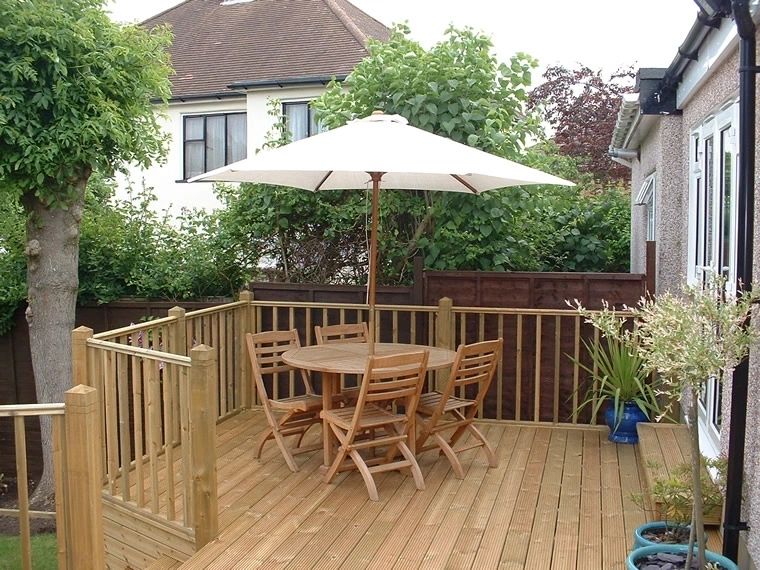
Decking substructure ventilation
A decking substructure needs airflow underneath it to dry out after rain, which is why ground-level decks are built with a ventilation gap rather than sitting directly on solid paving or soil, and why skirting the underside solid on all sides is a common cause of premature substructure rot.
Low decks close to the ground are the highest risk, since there's little room for cross-ventilation, and some ground preparation — a weed membrane and gravel bed rather than bare soil — helps keep humidity down in that void.
Composite deck boards themselves tolerate damp better than timber, but a timber joist substructure underneath a composite deck still needs the same ventilation and ground clearance as it would under timber boards.
Where the adopted highway boundary actually sits
The legal edge of an adopted public highway doesn't always match the visible edge of the tarmac or verge, and can extend further onto what looks like private land in some cases.
Erecting a fence, wall or gate on adopted highway land without authorisation is a separate issue from planning permission, and the highway authority can require its removal.
Where there's any doubt about the exact highway boundary, the local highway authority can usually confirm the extent of the adopted highway against its own records.
Dealing with a manhole cover sitting on the boundary line
A manhole or inspection chamber cover on or near the fence line has to stay accessible, since utility companies and drainage authorities retain a right to lift covers for maintenance regardless of what's built nearby.
The practical fix is usually to offset the nearest post to one side and let a shortened panel or gravel board span across above the cover, rather than boxing it in or fencing directly over it.
Where the chamber serves a shared drain, it's worth confirming with a neighbour or the water company which covers must stay clear before finalising post positions, since covering one by mistake can mean taking the fence apart again later.
Prescriptive easements from long use
An easement — such as a right of way or right to run services — can sometimes arise through long, uninterrupted use of land even where nothing was ever formally granted in writing, known as a prescriptive easement.
Establishing whether one genuinely exists is a legal question with specific tests around the nature and duration of the use, not something settled by opinion on site.
Where a longstanding informal path or access crosses a boundary being fenced, it's worth raising the history with a solicitor rather than assuming it can simply be closed off.
Checking screw and bolt length matches the timber section
A fixing that's too short doesn't engage enough timber to hold under load, while one that's too long can punch through the far face of a rail or post, both of which are easy mistakes when reaching for whatever's in the tool bag rather than checking the actual section thickness first.
As a rough guide, a screw fixing generally wants to penetrate the receiving timber to a meaningful multiple of its own diameter to hold securely, which is worth checking against the actual post or rail dimensions being used on a given job rather than assumed from habit.
Where a through-bolt is used instead of a screw, matching the bolt length to the combined thickness of both pieces plus washer and nut avoids either an unsightly protruding stub or a bolt that can't be tightened properly.
Removing an old panel without damaging sound posts
Panels are usually fixed to posts with clips, brackets or nails through the frame, and levering a panel out with a bar without first locating and releasing those fixings risks splitting a post that would otherwise have been reusable.
Cutting through corroded nails with a reciprocating saw, rather than forcing the panel free, is often quicker and safer for the post than sustained levering.
Where only one panel in a run has failed, working carefully to free just that panel's fixings keeps the neighbouring panels and their posts undisturbed rather than loosening more of the run than necessary.