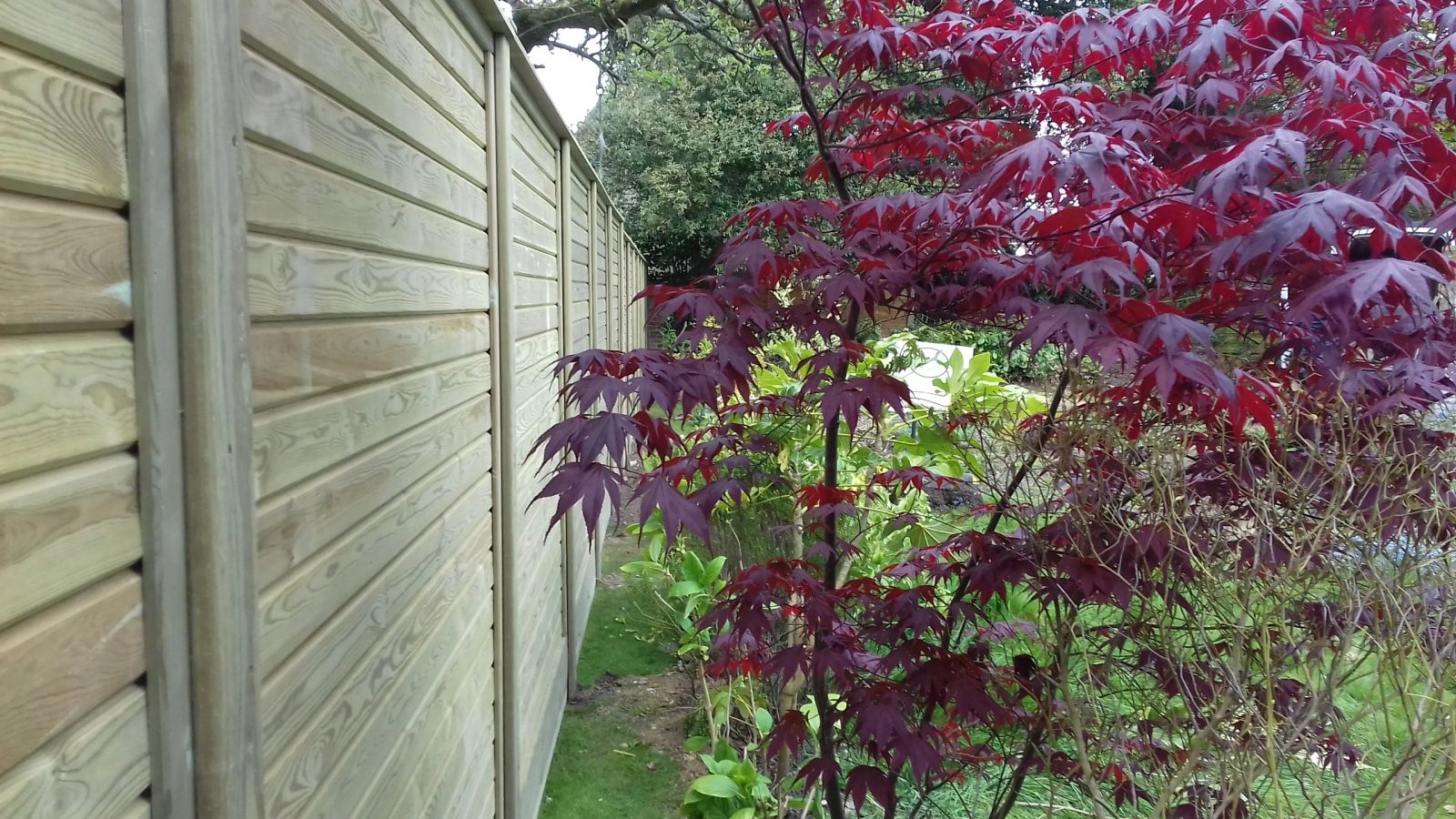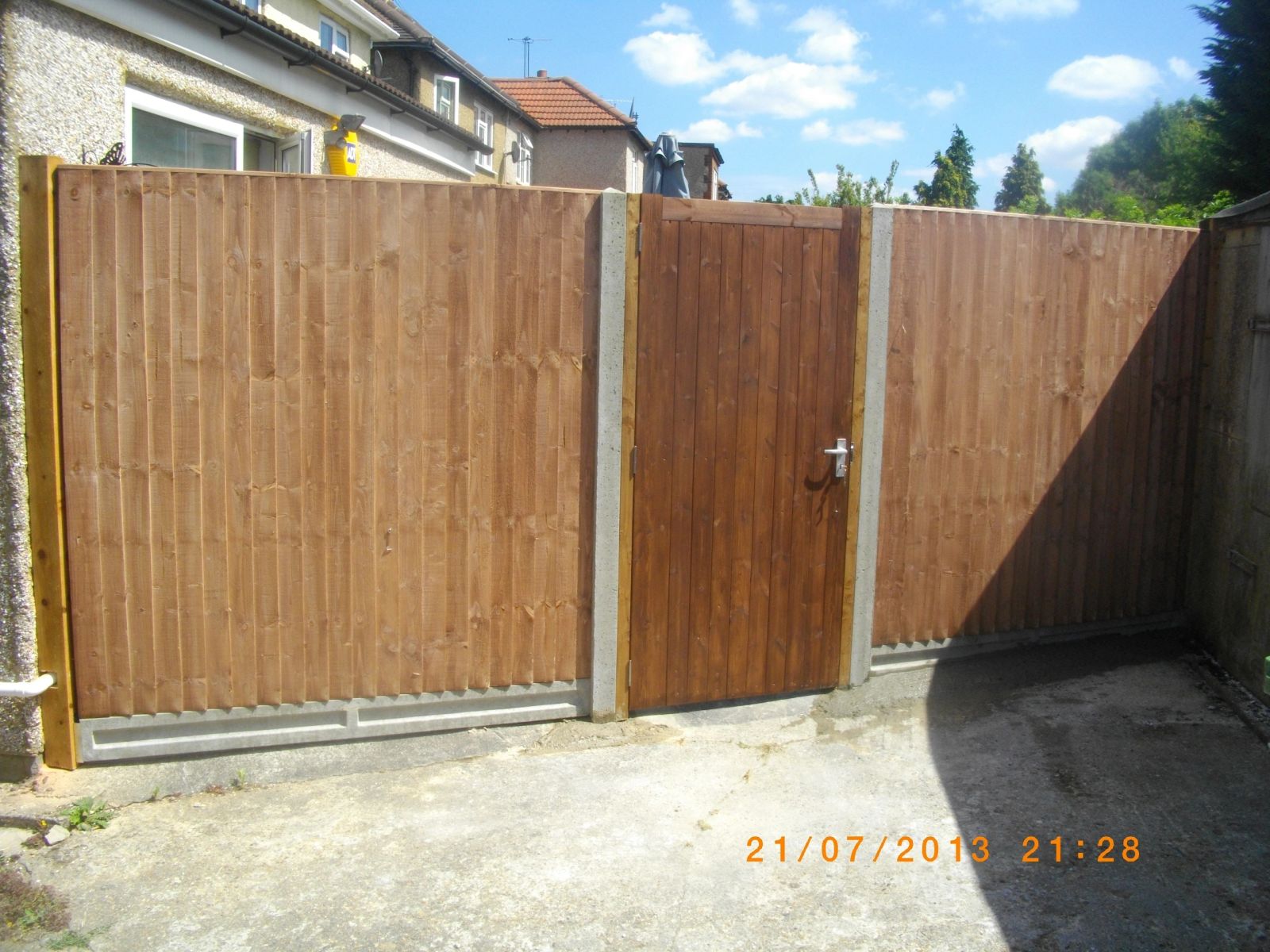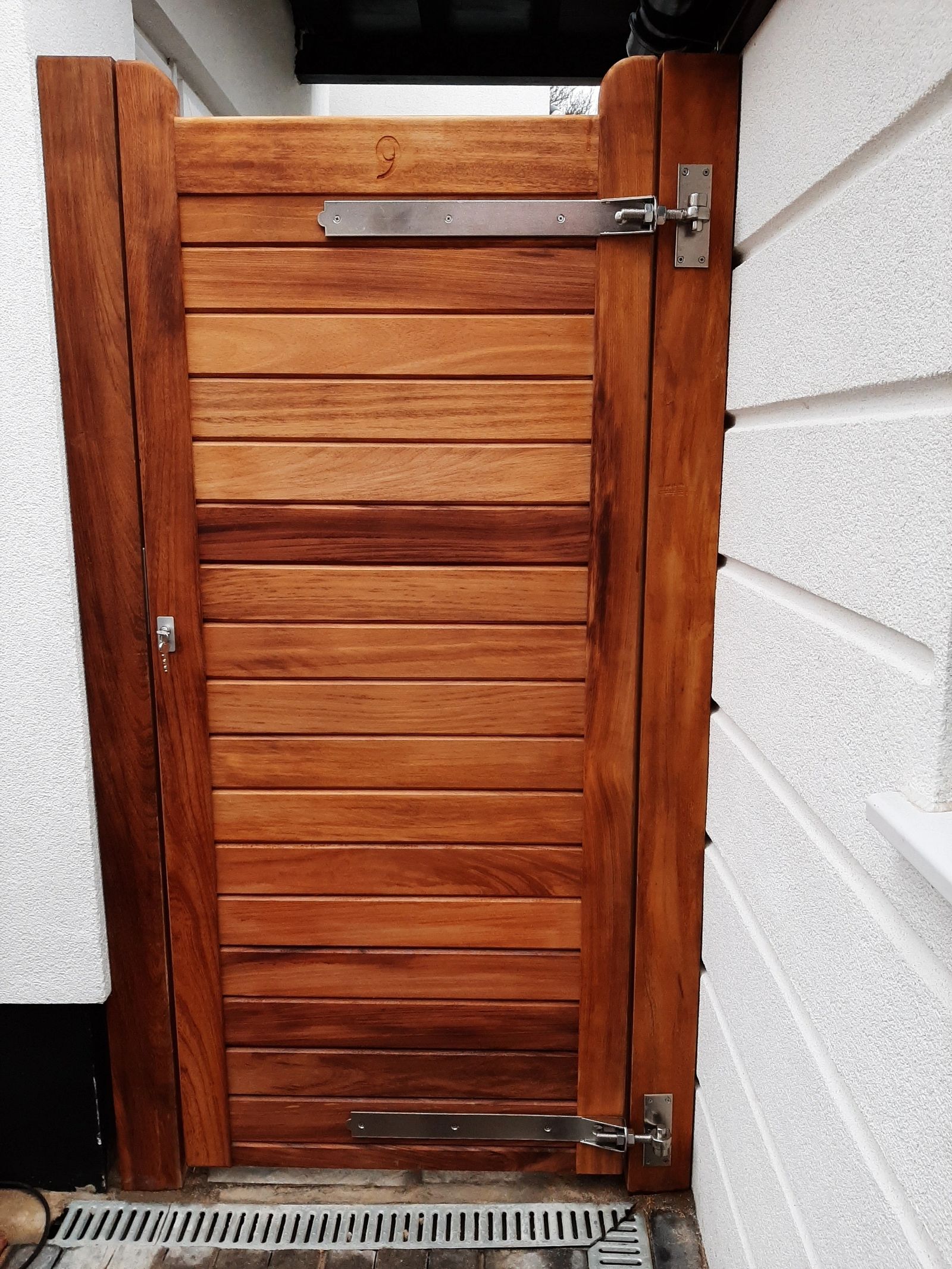
Trees, roots and protected planting near a secure line
Mature trees on or near a boundary change post positions more than most clients expect — a protected tree's root protection area can rule out a straight post line altogether, and we offset posts around roots rather than cutting through them.
Where a tree is covered by a preservation order, work near it is checked against that restriction before any post hole is dug.
Ring-shank versus smooth nails
Ring-shank nails have a series of raised rings machined into the shank, which bite into surrounding timber fibres as they're driven and resist being pulled back out far more effectively than a plain smooth shank.
That extra grip matters on fencing components subject to repeated movement from wind load, such as feather-edge boards on rails, where smooth nails can gradually work loose over several seasons of flexing.
The trade-off is that ring-shank nails are harder to remove cleanly for repairs, often splitting the timber around them rather than sliding out, whereas smooth nails can usually be levered free without damaging the board.
Dealing with a manhole cover sitting on the boundary line
A manhole or inspection chamber cover on or near the fence line has to stay accessible, since utility companies and drainage authorities retain a right to lift covers for maintenance regardless of what's built nearby.
The practical fix is usually to offset the nearest post to one side and let a shortened panel or gravel board span across above the cover, rather than boxing it in or fencing directly over it.
Where the chamber serves a shared drain, it's worth confirming with a neighbour or the water company which covers must stay clear before finalising post positions, since covering one by mistake can mean taking the fence apart again later.
How garden slope affects water shedding along a fence base
On a sloped garden, water naturally runs along the base of a fence line toward the lowest point, which means the downhill end of a run often sits in wetter ground than the uphill end even though both were built to the same specification.
This uneven exposure is a common reason why one end of an otherwise uniform fence needs gravel board replacement years before the rest.
A shallow cross-fall drainage channel or a slightly raised gravel board at the low point can intercept some of this flow before it pools against the timber.
Cutting a panel down for a short bay
A lap or closeboard panel can usually be cut down in width by removing boards from one edge and refixing the cut edge to the panel's own frame, provided there's still a batten or rail to fix into once the cut is made.
Concrete panels generally can't be cut at all, which is one of the practical reasons timber is chosen over concrete gravel-board-and-panel systems on an irregular boundary with several odd-width bays.
Whatever is cut, the new edge needs its own vertical support — either an extra batten screwed to the frame or, for a wider cut-down section, a slip post — so the panel doesn't flex or drop at the trimmed end.
Timber fence panel frame construction
A standard lap or overlap fence panel is built around a timber frame, typically with a mortice-and-tenon or simple butt-jointed corner, into which the individual overlapping boards are stapled or nailed.
The frame's own timber section size and joint quality do more to determine a panel's racking resistance in wind than the thin overlap boards themselves, since the boards carry little structural load on their own.
A panel with a lightweight, thin frame section will flex and rack under wind load even if the boards look identical to a panel built on a heavier frame, which is one reason nominally similar panels vary noticeably in longevity.
Checking metal fixings for corrosion even where the timber looks sound
A post or rail can look structurally fine while the nails, screws or brackets holding it together have corroded enough to have lost most of their holding strength, which only becomes obvious once the timber is put back under load.
A repair that only replaces damaged timber and refits with the original corroded fixings risks a second failure at the fixing point shortly afterwards, so checking fixing condition is worth doing as a routine part of any repair, not just where timber damage is visible.
Controlling dust and debris close to a neighbour
Angle grinding a metal fixing or breaking out an old concrete footing throws dust and fine debris further than expected, which matters on a repair close to a neighbour's washing line, patio furniture or parked car.
Sheeting off the immediate work area and clearing debris before leaving site each day is worth doing even on a short repair, since a small job that leaves a mess behind causes disproportionate friction with a neighbour compared with the size of the work itself.
Utility marker posts near a boundary line
Small yellow, blue or red marker posts near a boundary often indicate a buried gas, water or telecoms service running close to or along the line, placed there by the relevant utility company.
These markers are a useful early warning but aren't a precise map, so it's still worth requesting formal utility plans from the relevant providers before digging post holes nearby.
Damaging a utility service while digging can be both costly to repair and, in the case of gas or high-voltage cabling, genuinely dangerous, which is why checking first matters more than the fence design itself.
Why repaired sections sometimes weather differently
New timber fitted into an older run will weather at a different rate to the surrounding boards for the first year or two, simply because the existing timber has already taken its first few seasons of treatment and UV exposure.
This settles down over time and isn't a sign of a poor repair — we explain this at the point of quoting so it isn't a surprise later.
Gravel boards in timber and concrete
A gravel board sits at the base of a fence, between the ground and the lowest board or panel, taking the ground contact and splash-back so the panels above it don't have to.
A timber gravel board is cheaper and easier to cut to length but is the component most likely to need replacing within a few years, since it sits closest to damp ground; a concrete gravel board costs more up front but essentially removes that recurring repair.
Either type should sit slightly proud of finished ground level with a stone bed beneath it, rather than being buried, so water can drain away instead of sitting against the timber or panel edge.
Re-securing wire fencing where staples have popped
Fencing wire under tension gradually works staples out of a timber post as the timber itself shrinks and swells with the seasons, and once enough staples along a run have popped the wire starts to sag between posts.
Repair means re-tensioning the wire with a strainer before re-stapling, since driving new staples into a slack wire only delays the same sagging rather than fixing it.
Setting posts in clay
London clay and the heavier Hertfordshire boulder clays shrink and swell noticeably between a dry summer and a wet winter, which is exactly the movement that works a badly-set post loose over a few seasons.
The fix is depth and drainage rather than just more concrete: posts need to go below the zone that dries out and cracks seasonally, typically deeper than the standard 600mm used on free-draining ground, with a stone or gravel key at the base so water isn't trapped against the timber.
Postcrete alone on shallow clay bases is one of the most common reasons we're called out to replace a fence that's only a few years old.
Public liability considerations on a shared boundary
Work that takes place on or near a shared boundary inherently affects two properties, which is one reason contractors carry public liability insurance covering damage or injury arising from the works, generally quite separate from any specific job guarantee.
Clients are entitled to ask to see a contractor's current public liability certificate before work starts, and for jobs involving excavation near a neighbour's structure or a shared wall it's reasonable practice to confirm cover explicitly rather than assume it.
This is a generic industry consideration rather than a claim about any particular policy, and the details of cover, exclusions and limits vary between insurers and should be checked directly with the provider.
Keep wear from repeated latch impact
A keep takes the direct impact of the latch bar every time the gate closes, and over years of use the keep's opening can wear wider than the bar, letting the latch rattle loose even when the latch mechanism itself is fine.
Replacing a worn keep is usually far cheaper than replacing the latch it serves, so it's worth checking the keep first on an older gate with a loose-feeling latch.
Earthing and bonding requirements for a substation compound fence
A metal fence around an electrical substation compound needs to be correctly bonded to the site's earthing system, since an ungrounded metal fence near live electrical equipment can become dangerously energised under fault conditions.
Bonding work at a substation compound is carried out to the network operator's own specification rather than a general fencing standard, and a fencing contractor working on this type of site coordinates closely with the operator's engineers on sequencing and isolation.
Out-of-hours security considerations for a GP surgery boundary
A GP surgery boundary needs to accommodate a high daytime footfall of patients and visitors alongside stronger overnight security around bin stores, plant rooms and any area holding clinical waste, which often means combining an open, welcoming frontage with a more solid, higher-security rear compound.
Access for ambulance and emergency vehicles is checked against gate width and turning space before a security gate is specified, since a locked or narrow rear gate can delay emergency access if not planned around actual vehicle routes.
Distinguishing checking from structural splitting
Surface checking, fine drying cracks confined to the outer face of a timber section, is cosmetic and doesn't usually run deep enough to compromise a post or rail's strength.
A structural split runs further into or along the timber, sometimes right through a section, and can significantly reduce the effective load-bearing area at that point, particularly if it passes through a fixing or joint.
The practical test is depth and location: a shallow surface check away from any fixing is rarely a concern, while any split intersecting a bolt hole, mortice or bearing point is worth assessing before continued use.
Tuning an adjustable bolt-on hinge
An adjustable hinge allows small changes to a gate's height and lean after fitting via a cam or slotted fixing, without unbolting the hinge from the post, which is useful for correcting seasonal timber movement without a full repair visit.
These adjustments have a limited range, though, and a gate that's moved beyond what the hinge can correct needs the underlying cause addressed rather than the hinge wound to its limit.
Setting the centre gap on double gates
The gap at the centre where two gate leaves meet needs to be tight enough to look intentional and resist being forced apart, but not so tight that seasonal swelling causes the two leaves to bind against each other in wet weather.
A drop bolt or cane bolt on one leaf, engaged before the other leaf is latched, helps keep this centre gap consistent over repeated use rather than relying on the latch alone.
Rights of way and access easements
An easement giving a neighbour or utility a right of way across part of a garden — commonly a rear access strip or shared side passage — survives a change of ownership and restricts what can be built across it, including fences and gates.
A gate across an easement is sometimes acceptable if it's left unlocked or a key is provided to the dominant owner, but a solid fence that blocks the route entirely is a breach even if the current beneficiary rarely uses it.
The Land Registry title register will usually record a formal easement, so it's worth checking before fencing off any access strip that looks unused, since 'unused' and 'extinguished' are legally different things.
Outbuildings casting permanent shade onto a fence run
A shed, greenhouse or garage built close to a boundary casts a fixed shadow over part of the adjoining fence run for some or all of the day, creating the same slower-drying conditions as a north-facing aspect regardless of the fence's actual orientation.
This localised shading is easy to overlook when assessing a whole boundary's exposure, since the rest of the run a few metres away may be in full sun.
It's worth treating the shaded section as its own microclimate for treatment and inspection purposes rather than assuming uniform conditions along the full length.