Removing an old boundary before the new one goes in
Old fencing, damaged palisade or rusted mesh is cleared and taken off site as part of the job rather than left for the client to deal with, and any concrete post stumps are broken out where the new line needs a fresh, sound base rather than being built around old debris.
Where a section is genuinely sound we'll say so and reuse it rather than clearing it needlessly.
Tamper-proof fixings and shear-nut bolts
Standard hex-head bolts can be undone with a spanner from outside a compound, so security runs use shear-nut or one-way bolts that snap the head off once torqued, leaving nothing for a tool to grip.
These are fitted at pale-to-rail junctions and on any panel that could otherwise be unbolted from outside the line, and they cost little more than standard fixings for a meaningful gain in tamper resistance.
Quick-set post mix versus mixed concrete
A quick-set post concrete cures within a few hours and is convenient for a single-post repair where the fence needs to take load again quickly, but a standard mixed concrete generally gives a denser, longer-lasting footing for a larger job.
For a repair affecting several posts along a run, mixed concrete is usually the more durable choice even though it takes longer to reach working strength.
Security fencing directly alongside a public footpath
A fence running hard against a public footpath needs anti-climb toppings avoided or set back for pedestrian safety, and any gate opening onto the footpath must not swing out into it, since an outward-opening gate on a shared path is both a trip hazard and often a rights-of-way issue.
Where the footpath is well used, sightlines along the path are kept open at any pinch point rather than allowed to be blocked entirely by a solid fence, partly for personal safety of path users after dark.
Garden levels raised by decking or patios
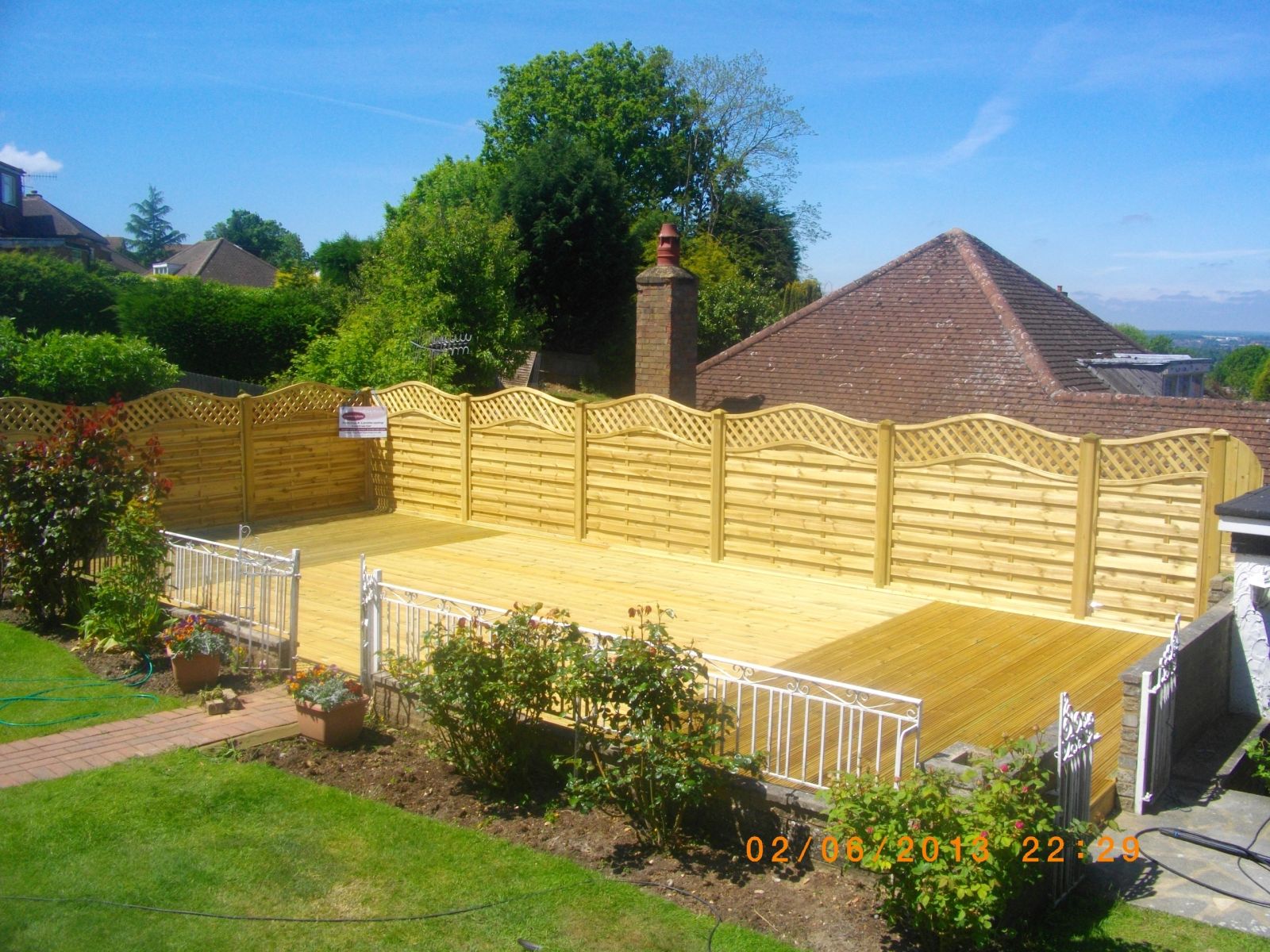
A raised deck or built-up patio on one side of a boundary can leave the finished surface level noticeably higher than the fence's original ground-level reference, sometimes reducing the effective fence height as seen from that side.
Where a neighbour raises their ground level after a fence is already installed, drainage that previously ran away from the fence can be redirected toward it, so it's worth checking finished levels on both sides before agreeing a new fence height or base detail.
A fence installed at the same time as a client's own raised patio should account for the new level from the outset, rather than being set to the pre-existing grade and later needing extension.
Repair-versus-replace where a run mixes several different panel types
A boundary added to or repaired piecemeal over many years sometimes ends up with two or three different panel styles along its length, which makes a small further repair harder to match convincingly to any one of them.
In that situation it's worth discussing with the client whether continuing to patch in whichever style is easiest to source is acceptable, or whether it's the point to standardise the whole run to a single style during a larger repair.
Strainer posts and wire tensioning loads
A strainer, or straining post, anchors the end of a tensioned wire or mesh run and needs to resist a sustained pulling load along the line of the fence, which is a materially different stress to the mostly lateral wind load an intermediate post experiences.
Strainer posts are typically set deeper, in a larger concrete footing, or braced with a diagonal strut back to a second post, specifically to resist this sustained pull rather than an occasional gust.
Under-specifying a strainer post relative to the wire tension applied is a common cause of an entire fence run gradually leaning inward from one end, since the strainer post itself moves rather than the wire actually loosening.
Landlord void period turnarounds
A rented property between tenancies is often the only window a landlord has to get fencing repaired without disrupting an occupied garden, and void periods are typically measured in days rather than weeks.
Fast turnaround work in a void needs the survey, quote and material order compressed into that period, which means a landlord instructing work should flag the void dates as early as possible rather than after keys have already changed hands.
It's also the point at which deferred repairs flagged in a previous check-out report tend to get actioned, so it's worth reviewing that report against the fence line before starting rather than duplicating what's already been noted.
Re-securing wire fencing where staples have popped
Fencing wire under tension gradually works staples out of a timber post as the timber itself shrinks and swells with the seasons, and once enough staples along a run have popped the wire starts to sag between posts.
Repair means re-tensioning the wire with a strainer before re-stapling, since driving new staples into a slack wire only delays the same sagging rather than fixing it.
Planning material handling for single-access rear gardens
A rear garden with no side access at all means every post, panel and bag of aggregate has to go through the house, so protecting flooring and doorways along that route is as much a part of the job planning as the fencing itself.
Breaking deliveries into smaller loads that fit through internal doorways and turns avoids the alternative of discovering a full-length panel won't clear a hallway corner on the day.
Where the volume of material makes carrying through the house impractical, a temporary lift or chute over a side wall, arranged and agreed with the client in advance, is sometimes the more efficient option despite the extra setup time.
Concealed versus visible fixings on heavier gates
A heavier timber or metal gate can be hung with either visible surface-mounted hinges or concealed fixings recessed into the frame, and the concealed option gives a cleaner appearance but is harder to inspect and adjust once installed.
Choosing between the two is partly aesthetic and partly practical, since a gate that's likely to need periodic adjustment is often better served by accessible, visible hardware.
Wheels and rollers on old sliding gates
Wheels on an older sliding gate wear unevenly over years of use, and a gate that starts to lean or drag to one side as it slides is often down to worn wheels rather than a bent frame.
Replacing worn wheel or roller assemblies is usually straightforward provided the track or guide rail underneath is still true.
House numbering and signage fixed to gates
A house number, nameplate or intercom panel is sometimes fixed directly to a gate rather than a post or wall, and this needs planning into the gate's design so the fixing doesn't interfere with the frame's structural members or the gate's swing clearance.
Retrofitting signage to an existing gate should avoid fixing through a stile or rail in a way that weakens it, favouring surface-mounted brackets instead where possible.
Tamper-evident caps over external fixing bolts
A plastic or metal tamper-evident cap fitted over an external bolt head shows visible signs of damage if someone has attempted to remove it, giving a maintenance team an early visual signal that a section of fence has been interfered with even where nothing has actually come loose.
This is a low-cost addition on a run where fixings are otherwise exposed, and it's most useful on a boundary that isn't checked in person every day, where interference could otherwise go unnoticed for some time.
Temporary bracing while concrete cures
A freshly-concreted post has no strength to resist knocks or wind until the concrete has gone off, so it needs temporary raking struts or timber braces fixed to hold it plumb and in line while curing.
Braces are best left in place for at least the manufacturer's stated initial cure time, and longer in cold weather, rather than removed as soon as the concrete looks solid on the surface.
A post nudged out of true during this window is much harder to correct afterwards than one checked and adjusted while the mix is still workable, so the check-and-brace step is worth the extra few minutes per post.
Deck board gapping to allow seasonal movement
Timber deck boards expand slightly when they absorb moisture and contract as they dry, so boards laid without a small gap between them can cup, bow or push against each other as conditions change through the year.
The correct gap depends on the moisture content of the timber at the time of laying — kiln-dried boards laid tight in winter may need a slightly wider gap than the same boards laid already at a higher moisture content in summer.
Composite boards move with temperature rather than moisture and have their own manufacturer-specified gap and expansion allowance, particularly at butt joints and against fixed edging.
Shiplap board profiles
Shiplap boards are machined with a rebated lap joint along each long edge, so adjoining boards interlock rather than simply overlapping flat, which sheds water more effectively than a plain overlap.
The rebate also means shiplap panels sit with a smaller visible overlap than feather-edge for the same weather resistance, giving a flatter, more even panel face.
Because the interlocking edges rely on a consistent machined profile, shiplap doesn't tolerate the same board-to-board variation as waney-edge, and a warped board can be harder to seat correctly in the joint.
Overhanging branches crossing a boundary line
A property owner generally has the right to cut back branches or roots that cross the boundary from a neighbour's tree, up to the boundary line, though the cut material technically still belongs to the tree's owner and should be offered back.
This self-help right doesn't apply where the tree is protected by a Tree Preservation Order or sits in a conservation area, in which case permission is needed before cutting.
Where a fence line is being planned near an overhanging tree, checking the tree's protected status first avoids inadvertently carrying out unauthorised work.
Tongue-and-groove board joints
Tongue-and-groove boards have a projecting tongue on one edge and a matching groove on the other, which locks adjacent boards together and stops the panel racking or gapping as timber moves.
This gives a fully solid-looking panel face with no gaps even as the boards season, unlike an overlapping feather-edge panel where gaps can open as the wood shrinks.
The tight interlocking fit does mean less room for movement overall, so tongue-and-groove panels are more prone to visible buckling if fitted without a small expansion allowance at each end.
Resin anchor fixings for a bolted baseplate post
A resin anchor sets a threaded stud into a drilled hole in existing concrete or masonry using a two-part chemical resin, giving a strong fixing for a bolted baseplate post where excavating a new footing isn't practical, such as on an existing hardstanding.
Anchor depth and resin cure time both need to match the manufacturer's data for the load expected, and a resin anchor installed into damp or dusty concrete without proper hole cleaning will pull out well below its rated capacity.
Concreting a hanging post deeper than the run
Because the hanging post carries more leverage than a standard line post, it's often set deeper into the ground and into a larger concrete base than the rest of the boundary, even where the fence posts either side are set to a standard depth.
Skipping this extra depth on the hanging post specifically is a common reason a gate post leans within a few years while the rest of the run stays sound.
Post-repair adjustment after settling
A newly concreted or reset gate post can settle slightly in the weeks after installation, particularly in looser or made-up ground, which can throw a freshly hung gate's swing or latch alignment out again.
A follow-up adjustment to hinges or the latch keep after the post has settled is normal practice rather than a sign the original repair was done incorrectly.