Footway licences for materials on a pavement
Storing fencing materials, a small skip, or scaffolding on a public footway, even briefly, can require a licence from the council responsible for that stretch of highway.
This is separate from any parking suspension for a vehicle, and covers the physical obstruction of pedestrian space rather than the road itself.
On narrow residential pavements it's worth checking the council's footway licence requirements ahead of a delivery, since blocking a pushchair or wheelchair route without authorisation can draw a complaint.
How a restrictive covenant is actually enforced
A restrictive covenant on a title is enforced privately by whoever holds its benefit — often a neighbour, a management company, or occasionally the original developer — rather than by the council.
This means a fence can be entirely lawful under planning rules and still breach a private covenant, with enforcement coming through a civil claim rather than council action.
Checking who benefits from a known covenant, and whether they're likely to object, is worth doing before assuming a technically 'planning-compliant' fence is automatically fine.
Checking for secondary damage after a fence has fallen flat
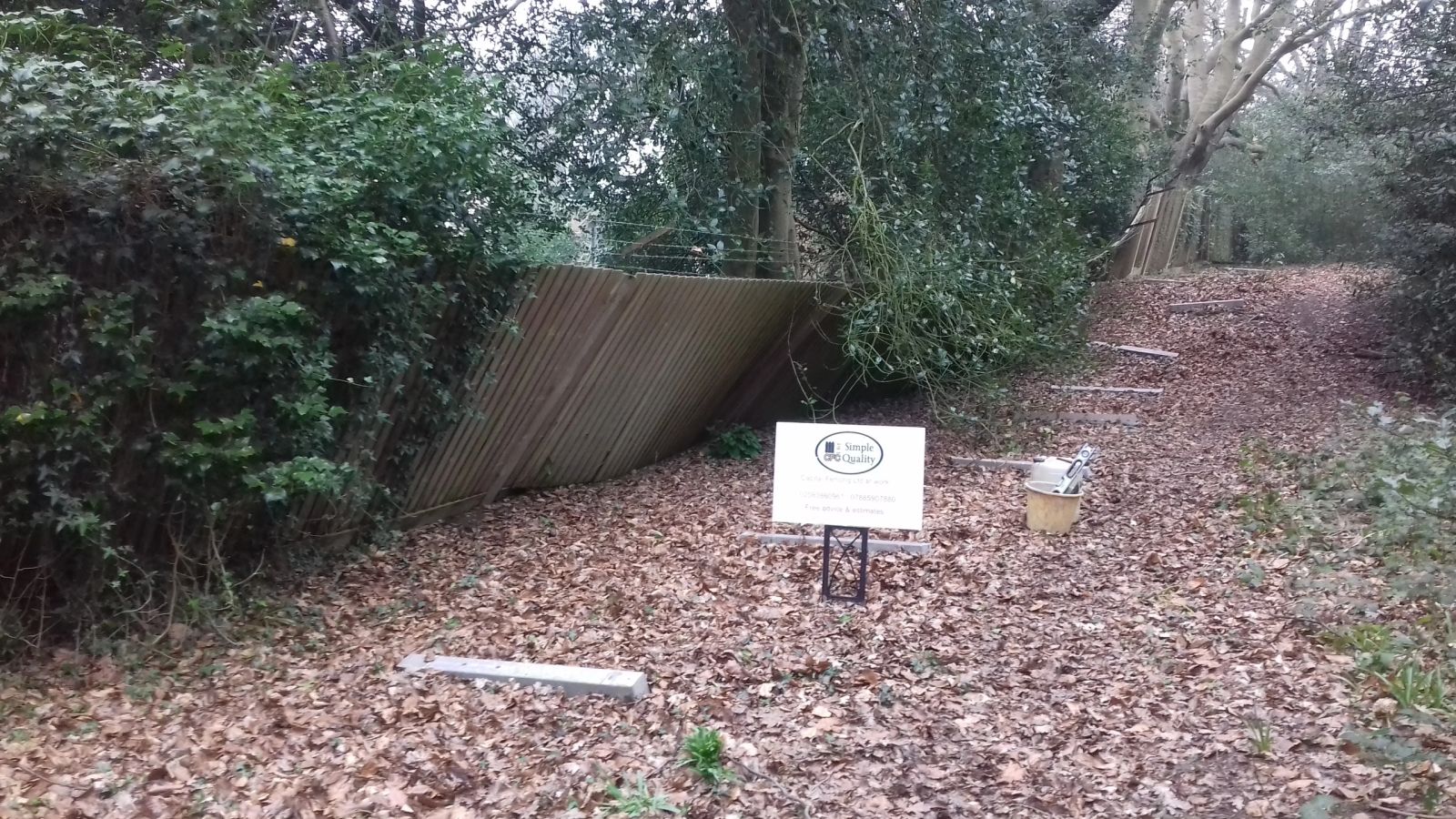
Once a section of fence has actually fallen rather than just leaning, it's worth checking what it fell onto or against — a shed, a parked car, planting — since secondary damage from the fall is sometimes the more significant repair cost.
The fallen section itself also needs assessing for whether any timber is still reusable, since a fall can snap fixings without necessarily destroying the panel or boards, which affects how much of the repair is replacement versus refitting.
Latch types: Suffolk, ring, auto-latch, gravity
A Suffolk latch and a ring latch both use a thumb-operated lever to lift a bar out of a keep, while an auto-latch closes itself on contact and a gravity latch relies on weighted design to drop into place — each needs different striker alignment to work reliably.
Replacing a worn latch with a like-for-like type is usually simpler than switching types, since the keep and striker positions are often already cut for that specific mechanism.
Conservation area material rules
Inside a conservation area, the council can restrict fence height, colour and material even within otherwise-permitted development limits, usually through an Article 4 direction that removes some of the usual PD rights.
The common ask is close-boarded or picket timber in a natural or traditionally painted finish rather than modern composite or bright stains, particularly on frontages visible from the street.
For a listed building itself, or land within its curtilage, listed building consent can apply even to a garden fence, so it's worth a call to the conservation officer before committing to a spec.
Choosing a skip or a grab lorry for waste removal
A skip left on site suits a job generating waste steadily over several days and where there's a legal spot to place it, such as a driveway, but it needs a permit if it sits on the public highway.
A grab lorry collects loose spoil, rubble and old fencing directly without a skip being dropped and left, which suits a single big clearance visit and avoids occupying space on a narrow driveway or street for the whole job.
For a small domestic run, van-and-tip removal on the last day is often simpler than either option, and the right choice generally comes down to waste volume and how long the site can accommodate a static skip.
Prevailing wind direction and driven rain exposure
In much of southern England the prevailing wind and driven rain come predominantly from the south-west, so a south-west-facing fence face typically weathers, silvers and needs re-coating faster than the opposite face of the same run.
This uneven exposure is worth explaining to clients who are puzzled that one side of a boundary looks noticeably more weathered than the other despite being installed on the same day from the same materials.
Where a client wants a more even appearance over time, orienting board overlap so the leading edge faces the prevailing weather sheds rain more effectively than the reverse arrangement.
Protecting a patio surface during fencing work
Dragging posts, panels or a wheelbarrow across paving can chip edges or scratch a polished or textured finish, so boards or protective sheeting laid along the route reduce that risk on a patio the client wants kept intact.
Concrete spillage from mixing or haunching is another common cause of permanent staining on natural stone or porous paving, and it sets far harder to remove than it is to prevent with a simple dust sheet under the mixing point.
Where post holes have to be dug close to a patio edge, protecting the adjoining slabs from spoil and tool marks is worth doing before digging starts rather than cleaning up afterwards.
Hardwood options for gates
Gates take more racking stress than a fixed fence panel, opening and closing on a single edge, which is why hardwoods such as oak or iroko are often specified for gates even where the adjoining fence is softwood.
Oak's natural durability means it can be left untreated and will weather to silver-grey, but it also moves seasonally and can stain surrounding masonry with tannin run-off in wet weather, which is worth flagging before it's fitted next to a pale render or paving.
Hardwood gate frames are usually built with mortice-and-tenon joints rather than the simple nailed or bracketed joints acceptable on a softwood panel, since the joint has to resist years of racking without loosening.
Board orientation and grain direction
A board fixed with its bark side facing outward tends to cup away from the fixings as it dries, since the outer growth rings shrink tangentially more than the inner ones, pulling the board's edges outward.
Orienting the bark side inward on a fence board means any cupping pulls the edges toward the fixing rather than away from it, which keeps the board flatter and the fixings under less repeated strain.
This detail is easy to overlook when boards are cut from mixed stock without checking growth ring orientation, but it becomes visible within a season or two as boards from the same batch cup in opposite directions.
School and nursery boundary rules
School and nursery boundaries are typically specified higher than a domestic fence and without footholds, finger-trap gaps or climbable rail patterns, because the boundary has to keep young children in as well as keep intruders out.
Gate self-closing and self-latching, non-climbable infill and a lockable-from-outside-only pedestrian gate are common requirements checked against the site's own policy rather than a general rule of thumb.
Seasonal timing for fence repairs
Repairs undertaken in late autumn or winter often coincide with wetter ground and slower-curing concrete, which can extend how long a post takes to reach full strength before it should be loaded.
Where a repair isn't urgent, timing it for a drier period gives both the timber treatment and any concrete footing a better chance to cure properly before winter weather returns.
Wind loading on exposed runs
A fence on an open, elevated or unsheltered boundary — a plateau, a field edge, or a long unbroken run with no buildings breaking the wind — takes a real structural load that a sheltered suburban garden never sees.
Standard 75x75mm posts and full-height solid panels are the combination most likely to fail here; heavier posts, shorter bays between them, and a slatted or louvred profile that lets some wind through all reduce the load rather than fighting it head-on.
It's a specification decision made at quote stage, not something to retrofit after the first panel goes over in a storm.
Gating a shared driveway
A gate across a driveway shared by more than one property needs the agreement of everyone with a right to use it, since restricting access — even with a key provided to all parties — changes how that access can practically be used, especially for larger vehicles or emergency access.
Automated gates on a shared drive raise additional questions about who controls the opening mechanism, who pays for maintenance, and what happens if the power or motor fails, all of which are worth agreeing in writing before installation.
Where the shared drive is used by refuse collection or emergency services, checking minimum clear widths and turning circles with the council or fire service before fitting a gate avoids a structure that later has to be removed.
Removing or working around hedges
A mature hedge along a boundary line often needs partial removal or heavy cutting back before a new fence can go in behind or in place of it, and stump and root removal is usually a bigger job than the hedge above ground suggests.
Where a hedge is being kept and a fence added behind it, root disturbance during digging needs the same care as any other established planting — cutting a major root to fit a post line can visibly stress or kill the hedge over the following season.
Some hedgerows, particularly older boundary hedgerows in a rural or semi-rural setting, are protected under separate hedgerow regulations, so it's worth checking before removing one entirely rather than just cutting it back.
Choosing post hole diameter for the post size
A hole cut too close to the post's own width leaves no room for concrete to fully surround it, which weakens the base and gives water a direct channel down alongside the timber rather than a solid seal.
A generally quoted rule is a hole roughly three times the post's width, so a 100mm post wants in the region of a 300mm diameter hole, adjusted upward on poor ground or for taller, more heavily loaded posts such as gate posts.
Oversized holes aren't free either — they use more concrete and take longer to backfill and haunch neatly, so the aim is the right diameter for the post and ground rather than simply digging as wide as convenient.
Levelling ground before building a decking substructure
A decking frame built over uneven ground without first levelling or terracing the site ends up with support posts of wildly inconsistent length, which is harder to get right and more prone to individual post settlement than a site graded roughly level first.
Removing turf and topsoil under the deck footprint rather than building over it also reduces the organic material that would otherwise decompose and settle unevenly under the structure.
Where the ground has a genuine and significant fall, working out whether to terrace the ground itself or simply vary support post heights is a decision made before any joists are cut, since it changes the whole substructure design.
Sizing a hinge post to the gate's actual weight
A hinge post needs to be sized to the specific gate it will carry, since a heavy solid timber or metal gate loads its post far more than a lightweight picket gate of the same height, and an undersized post will lean over time even if correctly concreted.
This sizing decision is best made before the post goes in, since upsizing a post after a lean has developed generally means digging it out and starting again.
Use Class 4 versus Use Class 3 timber
The European use-class system grades timber by the exposure it's treated to withstand: Use Class 3 covers timber above ground but exposed to weather, such as capping or fascia boards, while Use Class 4 covers timber in ground contact or fresh water, such as posts.
A Use Class 4 post buried in soil needs a deeper, longer-lasting retention of preservative than a Use Class 3 rail bolted between two posts, because the ground contact zone stays damp for far longer than an exposed but well-drained horizontal timber.
Specifying the wrong class isn't always obvious at installation, since both can look identical when new, but it shows up years later as premature rot concentrated at ground level rather than along the whole length.
Aluminium and steel railings
Aluminium railings are lighter, don't rust, and hold a powder-coated finish well without the ongoing maintenance steel needs, which makes them common for low-boundary and pool-safety railings where upkeep is meant to be minimal.
Steel railings are heavier and stiffer for the same section size, which suits taller or higher-security applications, but the finish has to be maintained — a scratch through galvanising or powder coating exposes bare steel to rust from that point.
Both are usually supplied as welded panels between posts rather than built up rail-by-rail on site, so panel width and post spacing need to be agreed before ordering rather than adjusted afterward.
Corrosion at ground line on steel posts
The point where a post meets the ground or concrete collar is where corrosion concentrates, because moisture sits there longest and any coating is most easily scuffed during installation.
A sacrificial sleeve, extra coating thickness, or a slight fall on the concrete collar to shed water all reduce this, and it's worth checking on any steel post that's been in the ground more than a few years.
Backfilling technique around a set post
Backfilling isn't just tipping soil or concrete into the gap around a post — compacting it in stages as it's added, rather than filling the hole in one go, avoids leaving voids that let the post shift later.
Where soil rather than concrete is used as backfill on a lighter garden fence, layering and firming it every 100-150mm gives a noticeably more stable result than one loose fill tamped only at the top.
Overfilling and mounding backfill above ground level around the post, rather than finishing flush or slightly domed for drainage, is a common shortcut that leaves a lip where water collects against the post face.