BS 1722 and palisade fencing specification
BS 1722 covers dimensions, materials and fixing details for various fence types including steel palisade, and specifying to a named part of the standard gives a common reference point between client, contractor and any approving body rather than relying on informal descriptions of height and gauge.
Referencing the standard doesn't remove the need for site-specific judgement on threat level, but it does establish a baseline for pale gauge, post spacing and fixing that a site-specific spec can then be built up from.
Pale spacing tolerance on a palisade run
Palisade pale gaps are set to a maximum spacing so a foot or hand can't find purchase between adjacent pales, and drift beyond that tolerance over a long run is usually a sign the pales were fixed by eye rather than gauged off a jig.
A gauge batten cut to the exact centre spacing keeps every bay consistent, which matters more on security runs than on a purely decorative fence because a single wider gap becomes the obvious point of attack.
Ironmongery grades for gates
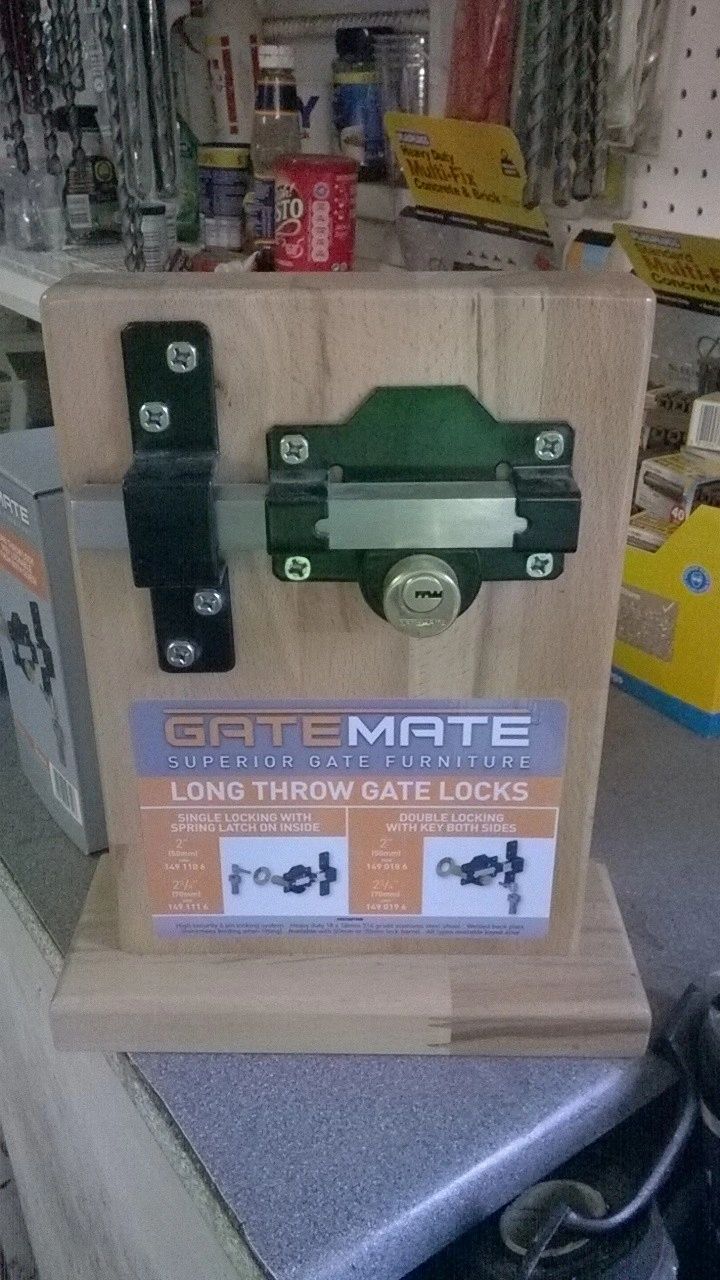
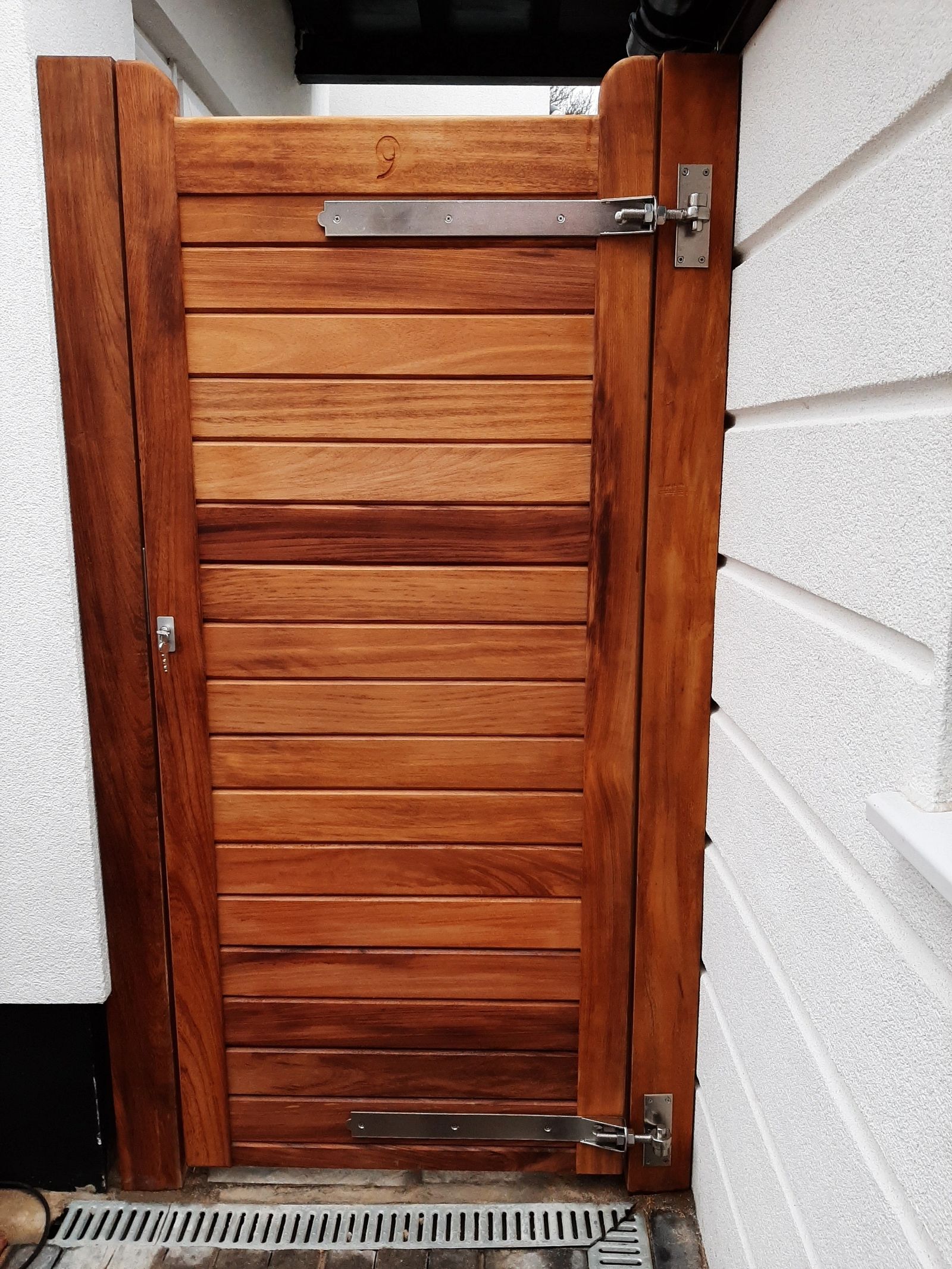
Gate hinges, latches and drop bolts are graded broadly by size and load rating rather than sold as one universal fitting, and undersized ironmongery on a heavy hardwood gate is a common cause of early sagging even when the frame itself is well built.
Externally, ironmongery needs a corrosion-resistant finish suited to constant weather exposure — galvanised, stainless or a specifically outdoor-rated coated finish — rather than internal-grade fittings that will rust and seize within a season or two.
A self-closing hinge or a matching pair of hinges rated for the gate's actual weight is worth specifying explicitly on a quote, since 'a pair of hinges' without a load rating leaves the actual spec to whatever's in stock.
Handling older timber treated with preservatives no longer in use
Timber treated with older preservative formulations that have since been withdrawn or restricted can still be present in fences installed some years ago, and cutting or sanding that timber during a repair can release different residues than modern treated timber would.
Where a fence is old enough that its original treatment is uncertain, working with good ventilation, gloves and dust control, and disposing of offcuts as general waste rather than burning them, is the sensible default.
Wind uplift risk on raised, open-sided decking
A raised deck open underneath on an exposed site can experience wind getting beneath the structure and creating an uplift force on the boards, distinct from the lateral wind loading that affects a fence panel.
This is rarely a problem on a low, well-fixed deck but becomes relevant on taller raised platforms in genuinely exposed locations, where board fixings need to resist being lifted as well as simply holding the board flat.
Screwing rather than hidden clip-fixing boards down in these conditions gives a more positive mechanical fixing against uplift, at some cost to the clean, fixing-free appearance clip systems are chosen for.
When a Party Wall Act notice might apply
The Party Wall etc. Act 1996 mainly concerns shared walls between buildings and excavations near a neighbour's structure, and doesn't generally apply to an ordinary timber garden fence.
It can become relevant where work involves a masonry party fence wall genuinely astride the boundary, or excavation for posts close enough to a neighbour's foundations to fall within the Act's distance rules.
Where there's doubt about whether notice is needed, a party wall surveyor or solicitor can confirm this far more reliably than guessing on site.
Rising damp at the gravel board
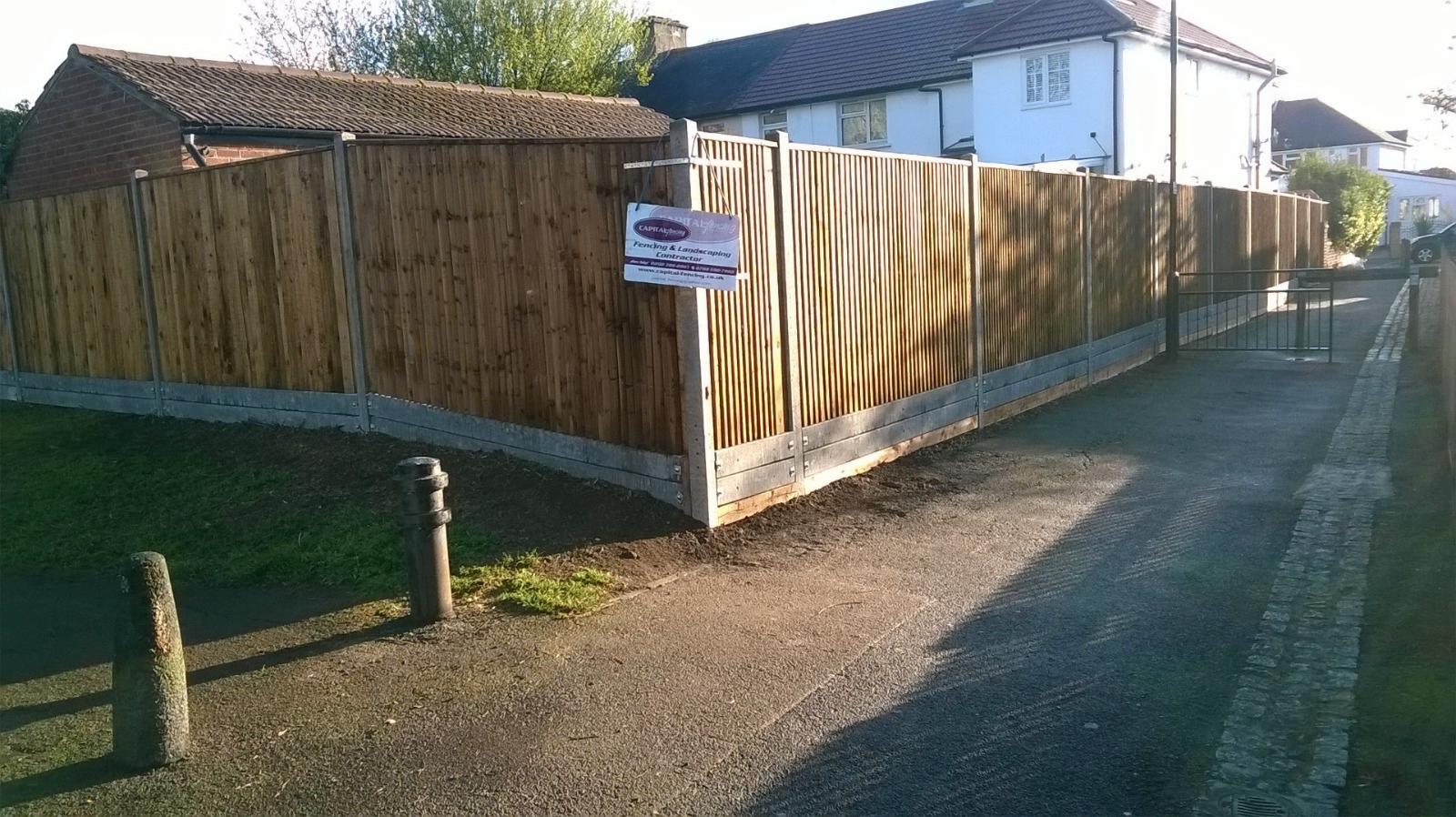
A timber gravel board sitting flush against damp soil draws moisture upward by capillary action in the same way a wall can suffer rising damp, and it is usually the first component to fail on an otherwise sound fence.
Concrete gravel boards avoid this entirely and are now the standard base for that reason, but where timber boards are kept for appearance, setting them a few millimetres proud of finished ground level makes a real difference.
Backfilling right up against a timber board with topsoil or mulch defeats the point, since it holds moisture directly against the face that most needs to stay dry.
Dog damage and low-level reinforcement
Repeated pushing, chewing or digging by a dog tends to damage the lowest section of a fence first, since that's the section within reach and the section closest to any dug-out gap at ground level.
Reinforcing the repaired section with a mesh liner or a kickboard behind the lower boards addresses the recurring cause rather than just replacing the damaged timber.
Adjusting closing force on a self-closing gate
A spring or hydraulic closer set too strong can slam a gate hard enough to damage the latch or frame over repeated cycles, while one set too weak may not fully latch, especially into a headwind on an exposed boundary.
Closers are adjustable and should be tuned on site after fitting rather than left at a factory default, with a final check that the gate reliably latches under the worst wind condition it's likely to face.
Gravity latch weight and pivot balance
A gravity latch relies on its own weight to drop the bar into the keep as the gate closes, so the pivot point and the latch's weight distribution both need to be correct for it to fall reliably rather than sticking mid-drop.
A latch that's been repainted heavily can gain enough extra weight or friction at the pivot to stop working properly, which is worth checking before assuming the mechanism itself has failed.
Visibility splays for vehicle gates onto a road
A driveway gate opening directly onto a road needs to be positioned or set back so that a driver waiting to exit can see approaching traffic clearly, and a solid gate that opens outward across the pavement can obstruct pedestrians as well as sightlines if not set back far enough.
This is a site layout consideration that needs addressing at the design stage, since it's much harder to correct once posts are concreted in a fixed position.
Earthing and bonding requirements for a substation compound fence
A metal fence around an electrical substation compound needs to be correctly bonded to the site's earthing system, since an ungrounded metal fence near live electrical equipment can become dangerously energised under fault conditions.
Bonding work at a substation compound is carried out to the network operator's own specification rather than a general fencing standard, and a fencing contractor working on this type of site coordinates closely with the operator's engineers on sequencing and isolation.
Upgrading security at a farm gateway
A farm gateway is a common target for rural theft of machinery, fuel and livestock, and a five-bar field gate on its own offers little more than a visual boundary marker, so a security upgrade typically adds a padlockable hasp, a stronger hinge set and sometimes a second inner gate as a layered deterrent.
Positioning a gate slightly back from the road with a locked field gate behind an open highway gate can slow a vehicle-based theft attempt without obstructing the farmer's own daily access.
Supplementing a hedge line boundary with security fencing
A mature hedge gives limited security on its own because gaps at the base and thin patches higher up both offer a way through, so a low stock fence or mesh run installed within or just behind the hedge line closes those gaps without removing the hedge's screening value.
The supporting fence is set back enough from the hedge to allow future trimming access, since a fence built hard against the hedge line makes routine maintenance of the hedge itself far harder.
Perimeter fencing around a school playing field
A playing field perimeter separate from the main school building boundary is usually lower and more open than the building line itself, since its job is containing pupils during use and deterring casual trespass out of hours rather than resisting a determined intrusion.
Gates onto a playing field are positioned to give staff a clear sightline for supervision, and a field boundary shared with a public path often needs a stock-proof rather than fully solid design to keep sightlines open both ways.
Removing or working around hedges
A mature hedge along a boundary line often needs partial removal or heavy cutting back before a new fence can go in behind or in place of it, and stump and root removal is usually a bigger job than the hedge above ground suggests.
Where a hedge is being kept and a fence added behind it, root disturbance during digging needs the same care as any other established planting — cutting a major root to fit a post line can visibly stress or kill the hedge over the following season.
Some hedgerows, particularly older boundary hedgerows in a rural or semi-rural setting, are protected under separate hedgerow regulations, so it's worth checking before removing one entirely rather than just cutting it back.
Moss build-up on shaded paths beside a north boundary fence
A path or step running alongside a permanently shaded north-facing fence often develops moss faster than the same surface elsewhere in the garden, since the fence itself blocks low winter sun that would otherwise help the surface dry.
This isn't strictly a fence maintenance issue but is worth mentioning to clients, since a fence replacement project is often the moment a client is already thinking about that part of the garden and receptive to fixing a related slip hazard at the same time.
A lighter, more open fence design along that boundary, where privacy allows, can let in enough additional light to measurably reduce moss growth on the path beside it.
Gravel-board clearance over uneven ground
A gravel board sitting flush with the soil on one section of a run can end up buried a couple of inches by the time the ground rises further along an uneven boundary, trapping moisture against timber that was specified to sit clear of the soil.
Stepping the board height slightly at each post, rather than running one continuous level line, keeps a consistent clearance above grade along the whole run.
Concrete gravel boards tolerate this ground contact better than timber ones, which is one reason they're specified as standard on plots with visibly uneven levels.
Fixing a post that has rotated in its concrete base
A post can twist within a slightly oversized or cracked footing without leaning, so the panels either side pull out of square even though the post still stands upright, which is easy to miss on a quick visual check.
Repair means breaking out enough concrete to free the post, resetting it square to the run, and packing and re-pouring rather than trying to twist it back while still gripped by the old footing.
Who owns which boundary
Boundary ownership in England isn't settled by which side the posts face — it's set by the title deeds, and where the deeds are silent the presumption (a T-mark on old Ordnance Survey-derived plans, or the 'ad medium filum' rule for some hedges) only gets you so far.
Before any post goes in we ask to see the deed plan, or at minimum agree the line and height with the neighbour in writing, because replacing a fence in the wrong place is a genuinely common and avoidable dispute.
Where ownership is contested we'll fit on the client's own side of the line rather than guess, even if that means a slightly narrower run.
Fire escape routes and non-lockable egress
A secure gate on a fire escape route or final exit path must allow people to get out without a key, even if it stays locked against entry from outside — a simple push-bar or thumb-turn release satisfies this on the inside face.
This is checked against the building's fire strategy before a lockable gate is fitted on any route marked as an escape path, because a fully keyed gate on both faces is a genuine life-safety fault.
London Clay shrink-swell behaviour
London Clay is one of the most shrinkable soils in the country, expanding when saturated over winter and pulling away from anything set in it during a dry summer, sometimes opening a visible gap around a post base.
That cycle is what loosens posts that were adequately firm when first concreted in, rather than any fault in the original installation.
Depth and a granular key at the base do more to resist this movement long-term than simply increasing the volume of concrete around a shallow post.