Decking joist spans by board thickness
Joist spacing for a deck is set by the thickness and species of the board being laid over it, not by a single universal figure — a standard 28mm softwood board typically wants joists no more than about 400-450mm apart, while thinner composite boards often need closer spacing again.
Manufacturers publish specific span tables for their composite products because the flex characteristics differ from timber, and installing outside those tables is one of the most common causes of a bouncy or springy deck.
Diagonal laying patterns also reduce the safe span compared with a straight run, since the board is effectively supported at a shorter distance along its length.
Scoping a repair linked to an insurance claim
Where a repair follows an insured event, the scope of work is agreed and documented before starting, since insurers typically require a clear description of what failed and what's being replaced rather than a general like-for-like statement.
Photographs and a written note of the failure are kept alongside the repair record, which is useful if further questions come up later in the claims process.
Security fencing directly alongside a public footpath
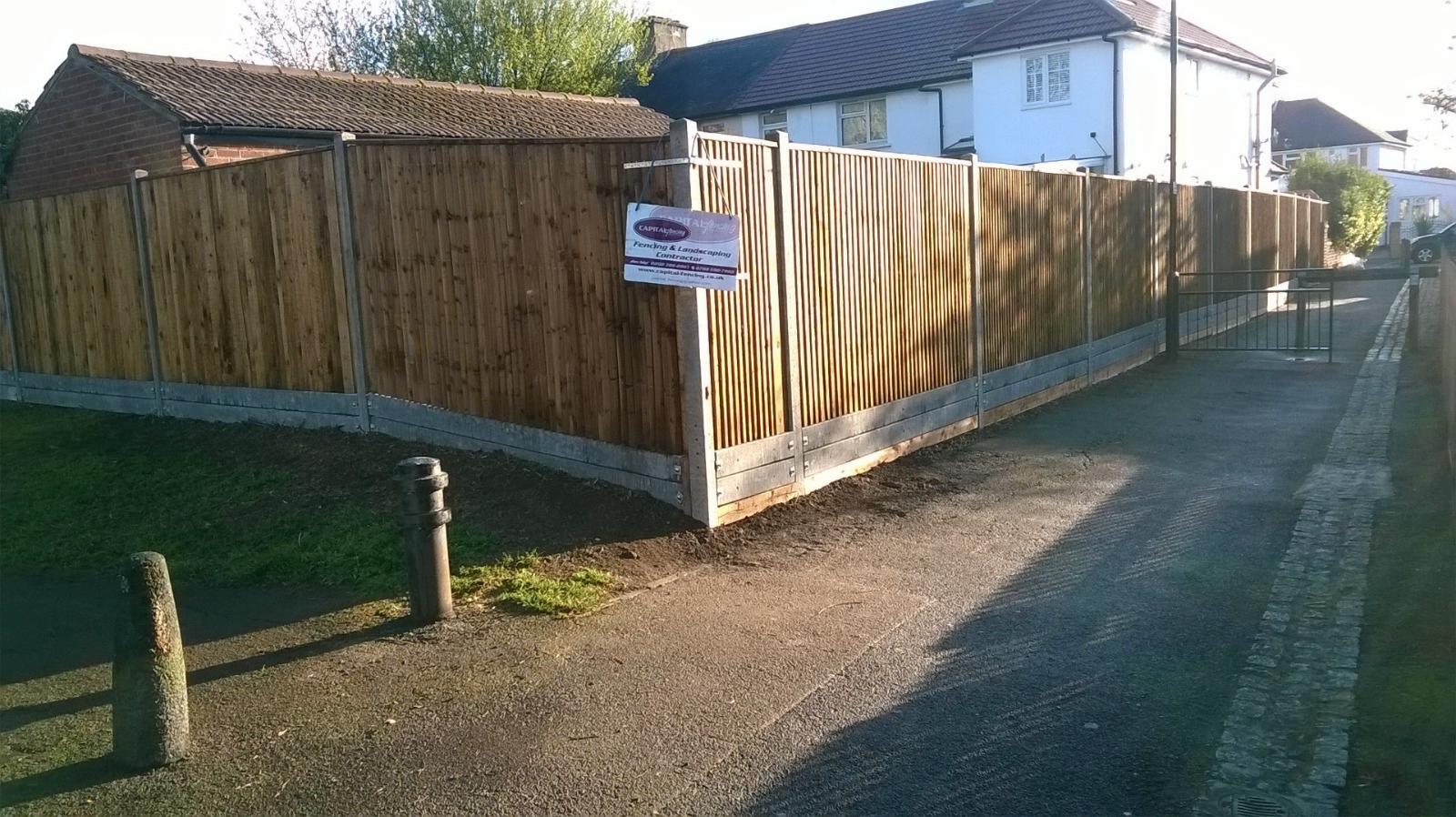
A fence running hard against a public footpath needs anti-climb toppings avoided or set back for pedestrian safety, and any gate opening onto the footpath must not swing out into it, since an outward-opening gate on a shared path is both a trip hazard and often a rights-of-way issue.
Where the footpath is well used, sightlines along the path are kept open at any pinch point rather than allowed to be blocked entirely by a solid fence, partly for personal safety of path users after dark.
Mortice-and-tenon versus halving joints
A mortice-and-tenon frame joint has more glued and pegged surface area than a halving joint, which is simply two timbers notched and lapped over each other, so it resists racking better but is harder to repair once it's failed.
We identify which joint type a frame uses before quoting a repair, since a halving joint can often be re-fixed with new screws and adhesive where a failed mortice needs the whole corner remade.
Article 4 directions and lost permitted development rights
An Article 4 direction is a specific order a council can make to remove some or all permitted development rights across a defined area, often a conservation area but sometimes a single estate or street with particular character to protect.
Where one applies, work that would normally be permitted development elsewhere — a new front boundary wall, a taller side fence, even a gate replacement in some cases — needs a full planning application instead.
Article 4 areas are listed on the council's own planning pages or can be confirmed by a quick call to duty planning, and it's worth checking before ordering materials rather than finding out at inspection stage.
Visibility splays on corner plots and driveways
Corner plots and driveways onto a road often have a highway visibility splay — a triangular zone near the junction — where boundary height is restricted so drivers and pedestrians can see each other clearly.
These restrictions are usually lower than the standard 1m front-boundary limit and are enforced by the highway authority rather than just general planning policy, so it's worth checking with the council for any plot near a junction or driveway crossing a footway.
Open railings or low planting within a visibility splay are common solutions where some boundary definition is still wanted without blocking sightlines.
Right to light and boundary structures
A right to light is a legal easement that can be acquired after twenty years of uninterrupted light through a defined window, and it protects a level of illumination to that window rather than an open view or unobstructed garden outlook.
An ordinary garden fence or low wall almost never generates a right to light issue, but a tall close-boarded fence, high wall or dense screening structure built close to a window that has enjoyed light for decades in principle could, particularly in dense urban plots.
In practice this rarely affects standard fencing height, but it's a different legal question from planning permission and worth being aware of on unusually tall or solid boundary structures near windows.
Balancing tight mesh apertures against airflow around plant equipment
A tight-aperture high-security mesh gives strong resistance to climbing and reach-through, but wrapped closely around outdoor plant equipment such as chillers or generators it can restrict airflow needed for the equipment to run efficiently.
Setting the mesh enclosure at a slight distance from the equipment casing, or specifying a marginally larger aperture where the site's threat assessment allows it, keeps most of the security benefit while avoiding an airflow restriction that could affect equipment performance.
Checking whether an existing post can be reused
A post that looks sound above ground can still have rotted through at the point where it meets the concrete, so a proper check means levering the post gently and looking for movement at the base, not just inspecting the visible timber.
Concrete posts rarely rot but can develop hairline cracks from impact or corroding internal reinforcement, which shows up as rust staining bleeding through the surface before the crack itself is obvious.
Reusing a post that fails a proper check to save a day's digging usually costs more later, since replacing one post in an otherwise finished run means disturbing the panels either side of it.
Construction hoarding versus the permanent boundary
Temporary site hoarding during a build is a separate specification from the permanent boundary that eventually replaces it — hoarding is chosen for site security and public safety during works, often under a party wall or highways licence, while the permanent fence is chosen for the finished property.
Where a boundary needs both, it's worth planning the sequence so the permanent fence isn't installed and then damaged by ongoing construction traffic before the build finishes.
Hoarding on a public highway usually needs its own licence from the council, separate from any planning permission covering the building work itself, and unlicensed hoarding on a footway can be removed by the authority.
Surface-water run-off across a boundary
Where one garden sits higher than its neighbour, or has a hard surface that sheds rain quickly, surface water often crosses the boundary line rather than staying on the plot it fell on.
A solid close-boarded fence with gravel boards set into the ground can act as an unintended dam, backing water up against the base and accelerating rot in the boards nearest the high side.
A small gap under the boards, or a French drain running parallel to the fence line, lets water pass through without saturating the timber, and is worth raising with a client before installation rather than after a wet winter.
Boundary questions in conveyancing enquiries
When a property is sold, standard conveyancing enquiries (the TA6 form) ask the seller to confirm boundary ownership and disclose any known disputes, including informal agreements about fence lines that were never registered.
An unrecorded verbal agreement about who maintains which boundary can cause problems at sale stage if it isn't consistent with the T-marks or general boundary on the title plan, since the buyer's solicitor will flag the discrepancy.
Keeping a simple written note or email trail of any boundary agreement reached with a neighbour, even an informal one, makes a later sale considerably smoother than relying on memory years afterwards.
Minimum clear width for pedestrian gate access
A pedestrian gate needs enough clear width once open to comfortably pass through with hands full, a pushchair or a wheeled bin, and a gate that technically opens but leaves very little usable width against an adjacent wall or post is a common design oversight on tight side returns.
Checking the actual clear opening, not just the gate leaf's nominal width, avoids this problem before a gate is ordered.
Maintaining ground sockets for gate drop bolts
A drop bolt socket set into the ground or a hardstanding surface collects grit, leaves and standing water over time, and a socket that isn't kept clear will stop the bolt seating fully, leaving a gate leaf that looks locked but isn't actually secured at that point.
Clearing and lightly lubricating the socket as part of routine maintenance is a small task that prevents a far more disruptive failure where a socket has to be dug out and reset after becoming completely blocked.
Tuning an adjustable bolt-on hinge
An adjustable hinge allows small changes to a gate's height and lean after fitting via a cam or slotted fixing, without unbolting the hinge from the post, which is useful for correcting seasonal timber movement without a full repair visit.
These adjustments have a limited range, though, and a gate that's moved beyond what the hinge can correct needs the underlying cause addressed rather than the hinge wound to its limit.
Spike-free zones at shared access points
Anti-climb spikes or barbed toppings are avoided near a shared gate, bin store or path where members of the public or neighbours pass close to the fence, to reduce injury risk at the point of highest foot traffic.
The deterrent topping is instead concentrated on the less-trafficked stretches of the same boundary, keeping the overall line consistent in height while varying what sits on top of it.
Fox digging beneath chicken runs and fence lines
Foxes are capable diggers and will exploit any soft ground at the base of a fence or run, particularly around poultry enclosures, so a below-ground barrier matters as much as the fence height itself.
An L-shaped buried apron of mesh, turned outward from the base of the fence rather than straight down, stops digging by making the animal hit an obstruction before it reaches the fence line itself, which is more reliable than depth alone.
This detail is worth specifying separately from the fence quote for anyone keeping poultry or small livestock, since standard fence installation doesn't normally include a buried predator barrier.
What an Article 4 direction actually does
An Article 4 direction is a mechanism councils use to withdraw specific permitted development rights across a defined area, often to protect the character of a conservation area or estate.
Where one applies to boundary treatments, works that would normally need no permission at all — like replacing a fence panel-for-panel — can require a planning application.
Article 4 directions are published by the local authority and searchable against individual addresses, so checking before ordering materials avoids an unwelcome retrospective planning conversation.
Brown versus green treatment pigments
The green or brown tint in pressure-treated softwood comes from a pigment or dye added to the preservative solution during treatment, largely as a visual indicator that the timber has been through the process rather than for any protective purpose.
Green pigments were historically more common but have become less fashionable, with brown or 'tanalised brown' now the more usual finish for fencing timber sold in the UK.
Because the colour is only pigment-deep in places, freshly cut ends and any surface planing during fitting will expose the paler, untreated-looking wood beneath, which is another reason to treat cut ends separately.
What a repair sign-off covers
Once a repair is complete we check the repaired section moves and sits correctly against the rest of the run, not just that the immediate damage is fixed, since a post reset slightly out of line can put uneven strain on the panels either side.
We also leave the client with a clear note of what was replaced and what, if anything, is worth watching over the next year or two.
Overhanging roofline drip lines onto a boundary
A fence running close to a house or outbuilding without gutters, or with a gutter that overshoots during heavy rain, can sit directly under a concentrated drip line that soaks one section of the run far more than the rest.
Over time this shows up as a localised patch of accelerated rot or algae growth that doesn't match the general weathering pattern of the rest of the boundary.
Where this can't be resolved by fixing the guttering itself, a slightly increased offset from the wall or a more resistant board section at that specific point avoids repeat localised failure.
Recycled plastic fence posts
Posts made from recycled plastic, sometimes blended with additives for UV resistance and rigidity, avoid timber's rot and insect vulnerability entirely, since the material has no organic content for fungi or insects to attack.
They tend to be more flexible than an equivalent timber section of the same size, which can be an advantage in absorbing impact but a disadvantage where rigidity is needed to resist sustained wind load without visible sway.
Their thermal expansion behaviour is closer to other polymer products than to timber, meaning fixings and adjoining materials need similar allowance for movement as with composite boards rather than being treated as a timber-equivalent product.