Working safely on a roadside or public-facing boundary
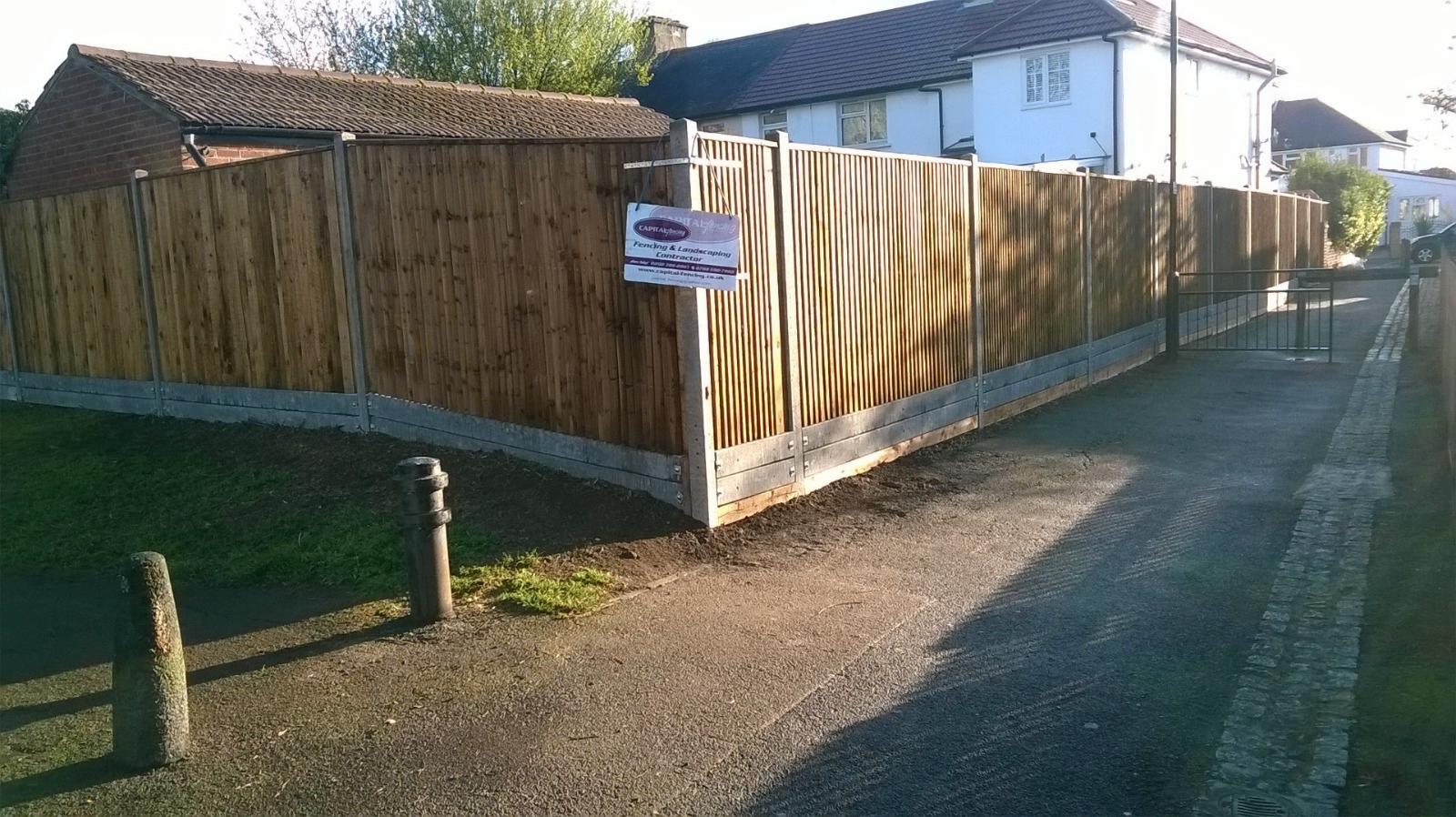
A security fence often runs along a frontage that faces a pavement, a school run or a shared access road, so material storage, tool use and post-hole cover are managed to keep the public side of the works safe throughout.
On a commercial site this extends to keeping a fire route or loading bay clear while the new line goes in.
Cane bolts on double gates
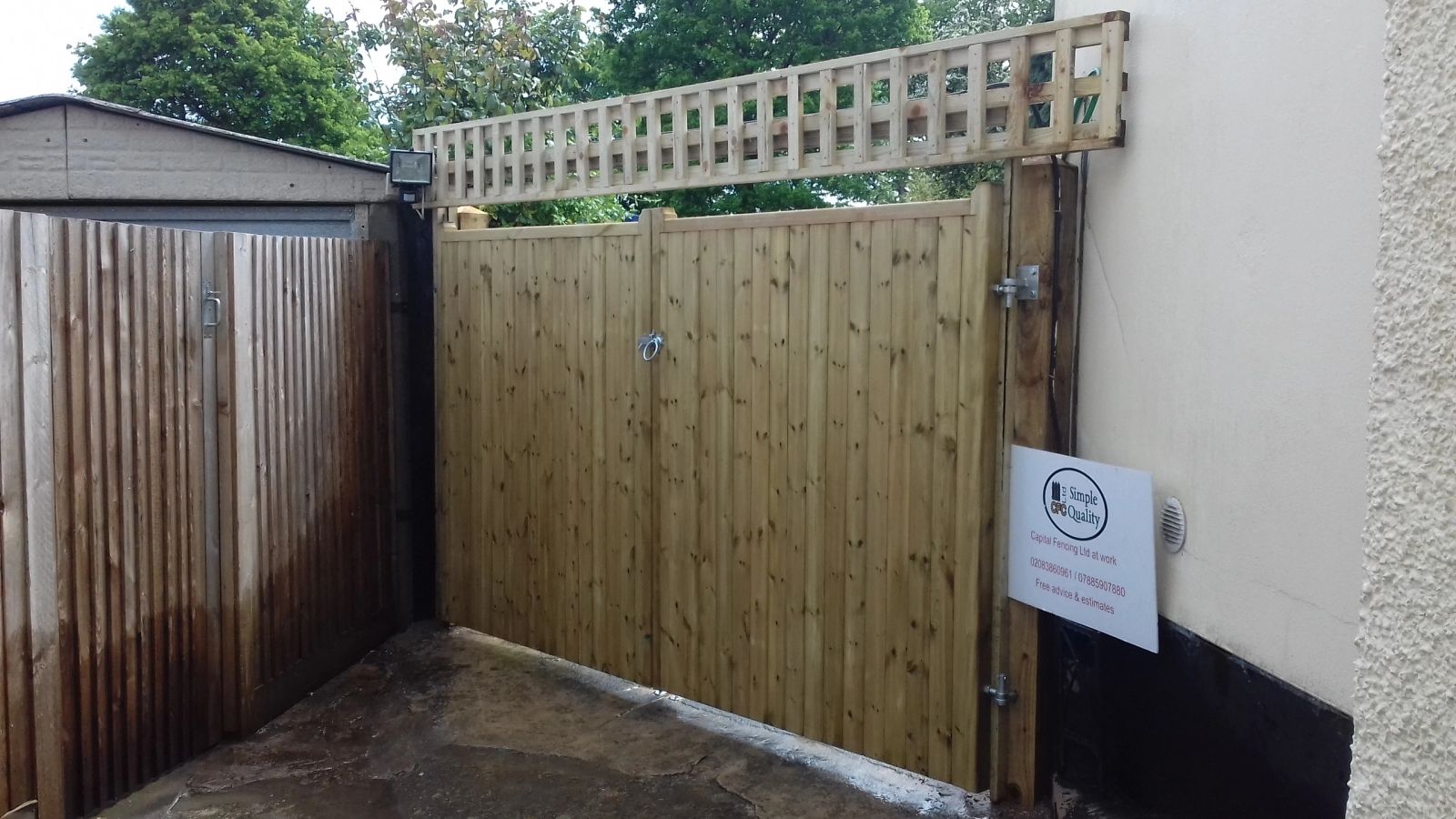
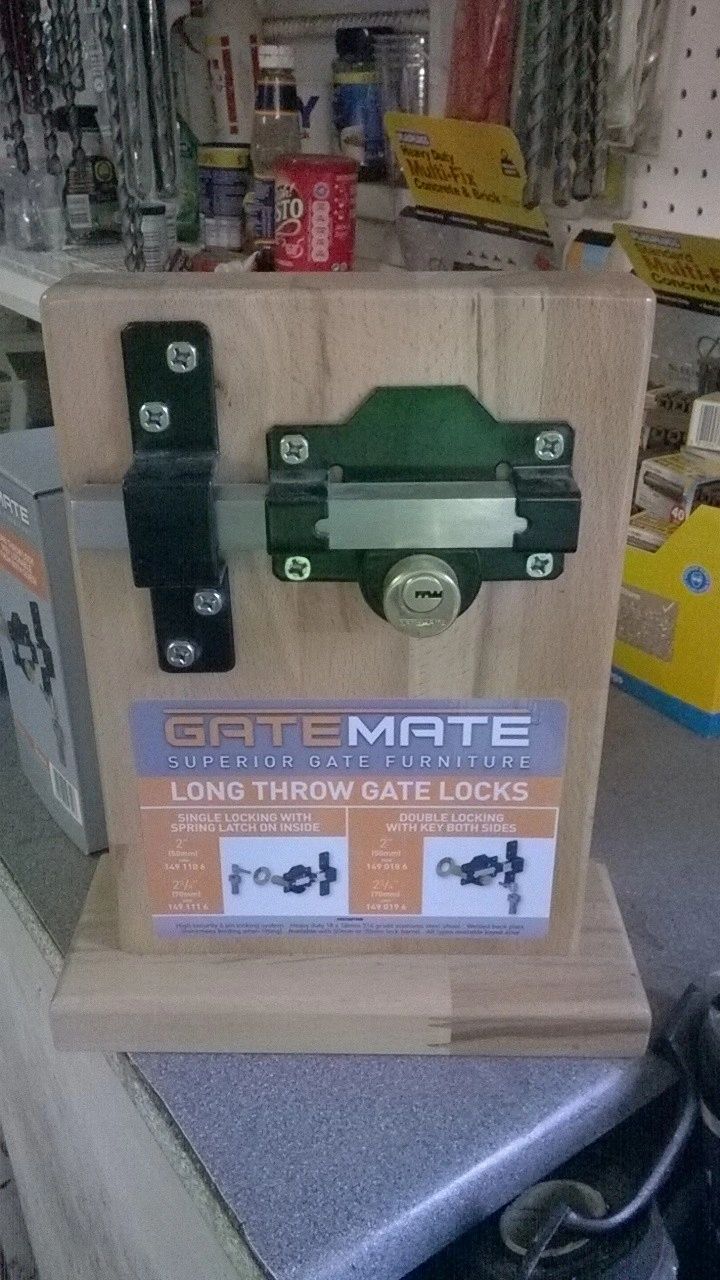
A cane bolt is a long sliding bolt dropped into a separate ground socket some distance below the gate, giving more holding leverage against wind or knock than a short drop bolt on a wide double-gate leaf.
They're common on wider vehicle gates where a standard drop bolt alone doesn't give enough resistance to the leaf swinging in wind.
Deck height relative to the house damp-proof course
Building guidance generally recommends decking be kept at least 150mm below the house's damp-proof course, since a deck built level with or above the DPC risks bridging it and allowing damp to track into the house wall.
This is a common issue on a sloping plot where the natural ground level near the house is already close to the DPC, leaving very little room to build a deck without breaching that clearance.
Where the clearance genuinely can't be achieved without lowering the deck excessively, a drained gap or a change in construction detail near the house wall is a better solution than ignoring the clearance altogether.
Sloped gardens and retaining
A sloping plot usually rules out a single level run of panel fencing — the choice is between stepping the fence in even drops between posts, or raking the panels to follow the slope continuously.
Stepped runs look tidier on a steeper gradient and are simpler to repair panel-by-panel; raked runs suit a gentler, more even slope and avoid the small triangular gaps a stepped fence leaves underneath.
Where the drop is severe enough to need a retaining structure rather than just a stepped fence, that's a different job with its own drainage and engineering requirements, not something to bolt onto a fencing quote as an afterthought.
Landlord void period turnarounds
A rented property between tenancies is often the only window a landlord has to get fencing repaired without disrupting an occupied garden, and void periods are typically measured in days rather than weeks.
Fast turnaround work in a void needs the survey, quote and material order compressed into that period, which means a landlord instructing work should flag the void dates as early as possible rather than after keys have already changed hands.
It's also the point at which deferred repairs flagged in a previous check-out report tend to get actioned, so it's worth reviewing that report against the fence line before starting rather than duplicating what's already been noted.
Choosing a skip or a grab lorry for waste removal
A skip left on site suits a job generating waste steadily over several days and where there's a legal spot to place it, such as a driveway, but it needs a permit if it sits on the public highway.
A grab lorry collects loose spoil, rubble and old fencing directly without a skip being dropped and left, which suits a single big clearance visit and avoids occupying space on a narrow driveway or street for the whole job.
For a small domestic run, van-and-tip removal on the last day is often simpler than either option, and the right choice generally comes down to waste volume and how long the site can accommodate a static skip.
Mixed hedge-and-fence boundaries and shared responsibility
Many boundaries in practice aren't purely fence or purely hedge but a fence backed by an established hedge on one or both sides, which complicates simple assumptions about who maintains what.
Deeds rarely specify hedge maintenance in the same way they specify fence ownership, so in practice it tends to be agreed informally between neighbours, which is worth clarifying in writing before installing a new fence against an existing hedge.
A fence installed too close to an existing hedge on the boundary line can also restrict future access for cutting that hedge from one side, which is worth flagging before positioning posts.
Checking existing boundary alignment before a like-for-like rebuild
Rebuilding a fence on the line of an existing one assumes that existing line was accurate, which isn't always the case — old fences can have drifted from the true boundary over successive repairs and replacements.
A quick check against any available reference, such as a boundary marker, an adjoining wall, or a neighbour's fence that's known to be accurate, is worth doing before assuming the old line should simply be copied.
Where a discrepancy is found, it's a conversation for the client and neighbour to have before rebuilding, since quietly correcting or quietly perpetuating a boundary error both carry consequences beyond the fencing job itself.
Smallholdings
A smallholding often needs several different boundary specifications on one plot — stock fencing for grazing paddocks, a more secure perimeter around poultry runs to keep foxes out, and a conventional garden fence around the house itself.
Movement of livestock between fields is usually managed with gates rather than continuous fence removal, so gate positions need agreeing against the smallholder's actual rotation pattern rather than simply the shortest route.
Because smallholdings often combine agricultural and residential use on the same title, it's worth checking which parts of a boundary project count as agricultural permitted development and which fall under the standard residential rules.
Mesh tensioning on a chain-link or weld-mesh run
Mesh that's fitted slack sags between posts and can be pulled or climbed more easily, so a straining wire and turnbuckle at each end of a run tension the mesh evenly before it's clipped or tied to the line wires.
Re-tensioning is a routine maintenance task on an older mesh run, since posts settling slightly or ground movement over a season will slacken a mesh that was originally taut.
Meeting stiles on double gates
Where two leaves of a double gate meet in the middle, the meeting stiles need to stay flush and aligned with each other for the latch or bolt arrangement to work, and seasonal movement or a dropped hinge on either leaf throws this alignment off first.
We check both leaves together rather than adjusting one side in isolation, since a fix on one leaf alone can leave the meeting point mismatched.
Scribing a gravel board to uneven ground
Ground level rarely runs perfectly straight between two posts, so a gravel board cut square often leaves a gap under one end and digs into the ground at the other unless it's scribed to follow the actual contour.
Scribing means holding the board in position, marking the ground profile onto its face, and cutting along that line so the board's bottom edge follows the undulation rather than an assumed flat datum.
On concrete gravel boards this isn't possible after casting, so uneven ground either needs the board bedded on a shaped mortar bed or a timber board used instead where the ground profile is particularly irregular.
Hinge screw pull-out and through-bolting
Screws pulling out of a timber hinge post is one of the most common gate faults, usually caused by repeated leverage working the fixing loose in the grain over time rather than a single overload event.
Through-bolting the hinge with a coach bolt and washer plate on the far side of the post gives a mechanical fixing that doesn't rely on the timber's grip the way a screw does.
Producing an accurate cutting list before ordering materials
An accurate cutting list — exact post count, panel or board lengths, and any bespoke cut sizes for short bays or gate openings — worked out from a proper site survey avoids the delay of a return trip for materials missed on the first order.
Rounding measurements generously rather than precisely is common practice for consumable items like fixings and concrete, but panel and post counts benefit from being counted exactly, since over-ordering large items wastes money and under-ordering stalls the job.
Where a run includes several different bay widths from stepping around obstructions, listing each bay's exact requirement separately rather than assuming an average avoids ordering a batch of identical cut panels that don't actually fit their intended positions.
Conservation area consent process and fees
Applications affecting conservation areas or listed curtilage structures are usually submitted through the same planning portal as a standard householder application, with an additional heritage statement often required to justify the proposed materials and design against the area's character.
Determination periods and validation requirements are broadly the same as ordinary planning applications, typically eight weeks for a straightforward decision, though heritage input from a conservation officer can extend that where the proposal is contentious.
Fees for these applications follow the standard national planning fee schedule rather than a separate heritage tariff, so cost isn't usually the barrier — the main risk is a longer timeline if amendments are requested.
Replacing a concrete gravel board that has crumbled
A concrete gravel board crumbling at one end usually points to a spalled or corroded reinforcing wire near a corner or a slot where standing water has sat against it longest, rather than a fault along its whole length.
Because concrete gravel boards slot into the posts, a single damaged board is normally lifted and swapped without disturbing the panel above, provided the slot itself hasn't also broken away.
What a like-for-like quote comparison should include
Two quotes for what looks like the same job can differ significantly once post spacing, timber grade, gravel board inclusion, waste removal and warranty terms are properly compared line by line rather than just as a single headline figure.
A cheaper quote that's silent on post spacing or omits gravel boards and waste removal often isn't actually cheaper once those items are added back in to match a more detailed competing quote.
Asking each quote to specify the same checklist of items — materials, spacing, base type, removal, and what's covered afterwards — is the most reliable way to compare on a level footing.
Dealing with a manhole cover sitting on the boundary line
A manhole or inspection chamber cover on or near the fence line has to stay accessible, since utility companies and drainage authorities retain a right to lift covers for maintenance regardless of what's built nearby.
The practical fix is usually to offset the nearest post to one side and let a shortened panel or gravel board span across above the cover, rather than boxing it in or fencing directly over it.
Where the chamber serves a shared drain, it's worth confirming with a neighbour or the water company which covers must stay clear before finalising post positions, since covering one by mistake can mean taking the fence apart again later.
Front boundary choices and kerb appeal
A front boundary is one of the first things anyone sees of a property, and low-key choices — a consistent gate style, tidy capping, a colour that complements the brickwork — do more for kerb appeal than an expensive but mismatched material choice.
Open or low front boundaries tend to suit properties where the frontage itself is attractive and worth showing off, while a higher, more solid front boundary suits a busier road or a desire for more privacy from passers-by.
It's worth thinking about a front boundary as a long-term fixture rather than following short-lived trends, since it's one of the more visible and slower-to-replace elements of a property's exterior.
Chain link wire coating options
Chain link fencing wire is available galvanised, or galvanised with an additional PVC coating bonded over the zinc, which adds a further weatherproof barrier and is available in a range of colours rather than plain galvanised silver.
The PVC coating also cushions the wire slightly, reducing the risk of the sharp cut ends common on plain galvanised chain link snagging clothing or skin.
Where the PVC coating is damaged or cut through, for example at a repair splice, the exposed galvanised wire beneath is still protected by the zinc, though it will weather to a different appearance than the surrounding coated wire.
Where neighbours disagree on sharing a repair cost
A boundary fence repair is sometimes split between neighbours by informal agreement, but there's no automatic legal requirement for a neighbour to contribute unless the deeds specifically say so, and disagreement over cost-sharing is common enough to plan for.
In practice it's simpler to quote the repair to whichever party is instructing the work and let that client resolve any cost-sharing conversation separately, rather than trying to split an invoice between two parties who haven't agreed terms.
Internal caged units within a self-storage facility
Beyond the site's outer perimeter fencing, many self-storage facilities also fit individual mesh cages or partition walls between units, giving each customer's space its own lockable boundary independent of the main building's access control.
Mesh cage partitions are usually specified with a smaller aperture than the outer perimeter mesh, since the concern at that internal scale is preventing reach-through between adjoining units rather than resisting an external climb-over attempt.