Cane bolt leverage on wide leaves
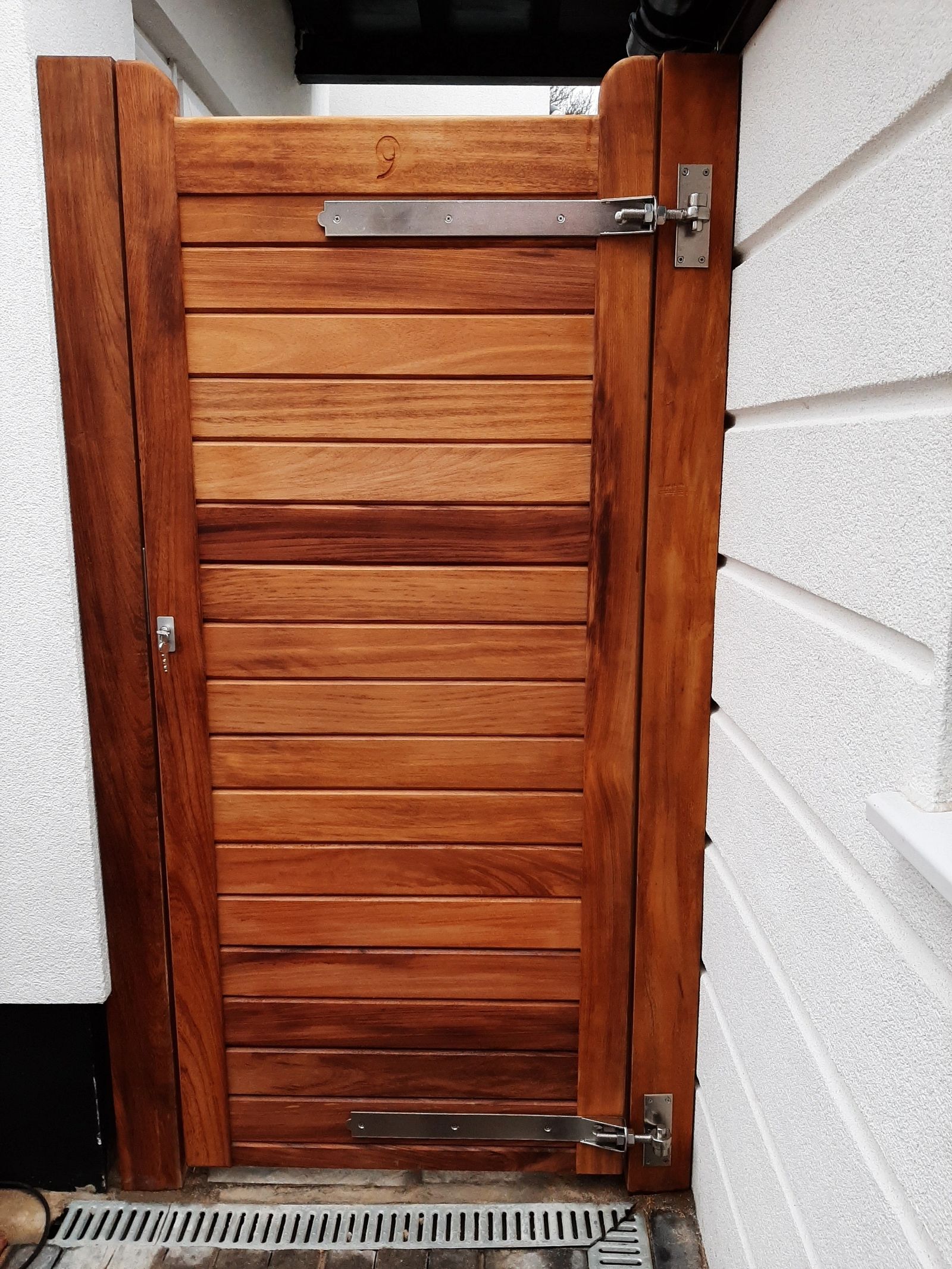
The long shaft of a cane bolt gives more leverage against a wide gate leaf twisting in wind than a short bolt fixed close to the bottom rail, which is why they're specified on wider double-gate leaves rather than narrow pedestrian gates.
A cane bolt still needs a properly prepared ground socket to work, and a shaft dropped onto uneven paving without a socket wears quickly and loses its holding grip.
Pedestrian gate self-closing devices
A hydraulic or spring-loaded self-closing hinge brings a pedestrian gate back to a closed and latched position automatically, which is useful where a gate needs to stay shut for security or to keep a garden secure for children or pets.
These devices need occasional tension adjustment as they wear, and a gate that no longer closes fully is often a closer needing adjustment rather than a hinge fault.
Snagging checklist items on a completed security run
A snagging check on a finished security boundary covers gate alignment and latch engagement, gap sizes at ground level and junctions, fixing torque on any tamper-proof bolts, and that capping or gravel boards sit flush along the whole run.
Any item that's marginal on day one — a slightly sticking latch, a small ground gap — is worth fixing immediately rather than left as a wear item, since these are exactly the points a determined attempt will test first.
Listed and period properties
A listed building's curtilage can bring garden walls, railings and even historic fence posts within the scope of listed building consent, regardless of the general permitted development rules that would apply to an unlisted house next door.
Cast iron railings removed during wartime salvage are a common feature many period properties never had reinstated, and some conservation officers now encourage sympathetic replacement rather than modern panel fencing on street-facing boundaries.
Consent applications for listed curtilage work typically want a heritage-appropriate material and jointing method specified up front, so it's worth involving the conservation officer before, not after, a design is finalised.
Garden levels raised by decking or patios
A raised deck or built-up patio on one side of a boundary can leave the finished surface level noticeably higher than the fence's original ground-level reference, sometimes reducing the effective fence height as seen from that side.
Where a neighbour raises their ground level after a fence is already installed, drainage that previously ran away from the fence can be redirected toward it, so it's worth checking finished levels on both sides before agreeing a new fence height or base detail.
A fence installed at the same time as a client's own raised patio should account for the new level from the outset, rather than being set to the pre-existing grade and later needing extension.
Timber post taper and strength distribution
A sawn timber post is typically a constant cross-section along its length, whereas the bending moment from wind load on the attached panel is greatest at ground level and reduces toward the top, meaning the post's strength margin isn't evenly used along its height.
This is why increasing embedment depth or post section size, rather than simply extending post height, is generally the more effective way to improve resistance to wind-induced snapping at ground level.
A post that fails from wind load almost always fails at or just below ground level rather than partway up its exposed length, reflecting where the bending stress genuinely concentrates.
Bin and bike access considerations
A gate used regularly to move bins or bikes through needs enough clear width and a low enough threshold that wheels don't catch, which is a different design priority to a gate that's mostly left closed.
Where this is the main use of a side gate, we factor it into leaf width and threshold detail at repair or replacement time rather than defaulting to a standard pedestrian gate size.
Recognising hinge wear before a gate fails
A gate that's begun to drop at the latch side, or that needs lifting to engage the latch, is usually showing hinge pin or bush wear rather than a problem with the gate frame itself, and catching it at this stage is a simple pin or bush replacement rather than a full hinge rebuild.
Left unaddressed, a worn hinge puts increasing strain on the hinge post fixing as the gate's weight is carried at an angle rather than square, which can eventually work the post loose as well.
Breaking out old concrete footings
An old post base often left in the ground after a previous fence comes out will usually be a lump of concrete far bigger than the post it once held, and it rarely sits exactly where a new post needs to go.
Breaking it out with a hand tool or breaker takes real time compared with digging clean ground, and on a long run of old fencing there can be one buried lump per post rather than just an occasional obstruction.
Where a footing can't be fully removed without excessive disruption, offsetting the new post's position by a short distance is usually more practical than fighting the old base to keep exact spacing.
Repairing fence sections undermined by fox or badger digging
A gap dug beneath a gravel board or the base of a panel is usually a fox rather than a badger unless it's part of a larger, more established sett system, and the repair approach differs depending on which is causing it.
Fox damage can usually be repaired by reinforcing the base with a buried mesh skirt or a deeper gravel board, but any active badger sett close to the boundary is legally protected and needs specialist advice before any digging near it as part of the repair.
Boundary fencing between garden and agricultural land
Where a residential garden backs onto agricultural land, stock-proof fencing standards relevant to livestock containment may be a factor the adjoining farmer expects, separate from purely decorative garden fencing considerations.
Responsibility for maintaining this kind of boundary can be split differently to a typical suburban arrangement, sometimes reflecting historic agricultural tenancy agreements rather than standard residential conveyancing norms.
Checking with the adjoining landowner and the title documents together gives a fuller picture than assuming the same rules apply as between two ordinary garden neighbours.
Haunching a post base above ground level
Haunching means shaping the concrete around a post so it stands slightly proud of the surrounding ground and slopes away from the post in all directions, rather than finishing flush or dished.
That slope sheds rainwater away from the timber-to-concrete interface, which is the point most prone to trapping moisture and starting rot at the base of an otherwise sound post.
A flush or dished base, by contrast, holds a shallow puddle around the post after every rainfall, quietly shortening the post's life regardless of how well the timber itself was treated.
Consent needed near a formal flood defence
Land adjoining a designated main river or formal flood defence structure can require Environment Agency consent for works within a specified distance, which can include fence post foundations in some cases.
This is separate from general flood risk zone planning considerations and relates specifically to protecting the integrity of flood defence infrastructure.
Where a boundary sits close to a river, culvert or known flood defence structure, checking with the Environment Agency before groundworks begin is a reasonable precaution.
Overhead cables and clearance for gate operation
A gate installed beneath or near an overhead service cable needs its swing or opening path checked against that cable's height and any sag, particularly for a wider vehicle gate that might otherwise catch a low cable at its highest point of travel.
This is a straightforward site check to make before installation, since moving a gate's position after cables have been identified as a clearance problem is far more disruptive than checking beforehand.
Non-slip decking finishes
A grooved board profile gives some grip when dry but can still become slippery once algae builds up in a shaded or north-facing spot, which is a maintenance issue rather than something a profile alone solves permanently.
Anti-slip decking strips or grit-impregnated coatings can be added to steps and high-traffic areas as a supplementary measure, and are worth specifying on steps or ramps even where the main deck area doesn't need them.
Some composite ranges are manufactured with a textured or embossed surface aimed specifically at slip resistance, which is worth checking against a wet-slip rating rather than assuming all composite boards perform the same underfoot.
Dog-proofing details at ground level and gaps
Dogs test a fence at ground level far more than at height, so gaps under gravel boards, worn hollows on sloping ground, or wide overlaps between adjacent panels are the points most likely to let a determined dog through or under.
A close-fitting concrete gravel board set with minimal gap to the ground, rather than a timber board that can warp and lift, closes off the most common escape route without changing the overall fence design.
For persistent diggers, a buried mesh apron or paving strip just inside the fence line at ground level stops excavation without needing to alter the visible fence at all.
Stain, oil and paint finishes compared
A stain sits mostly on the surface with some absorption, giving colour and some UV protection while still letting the timber's grain show through, and it typically needs reapplying every couple of years on an exposed fence.
An oil penetrates further into the timber and feeds it rather than just coating it, which suits open-grained hardwood decking and cladding, but it wears off through foot traffic and weathering faster than a stain on a vertical surface.
Paint gives the most complete colour coverage and hides the timber grain entirely, but it also traps moisture behind an intact film if the substrate isn't fully dry, and a failed paint film is harder to recover from than a faded stain, which just needs cleaning and recoating.
Picket fence styles and spacing
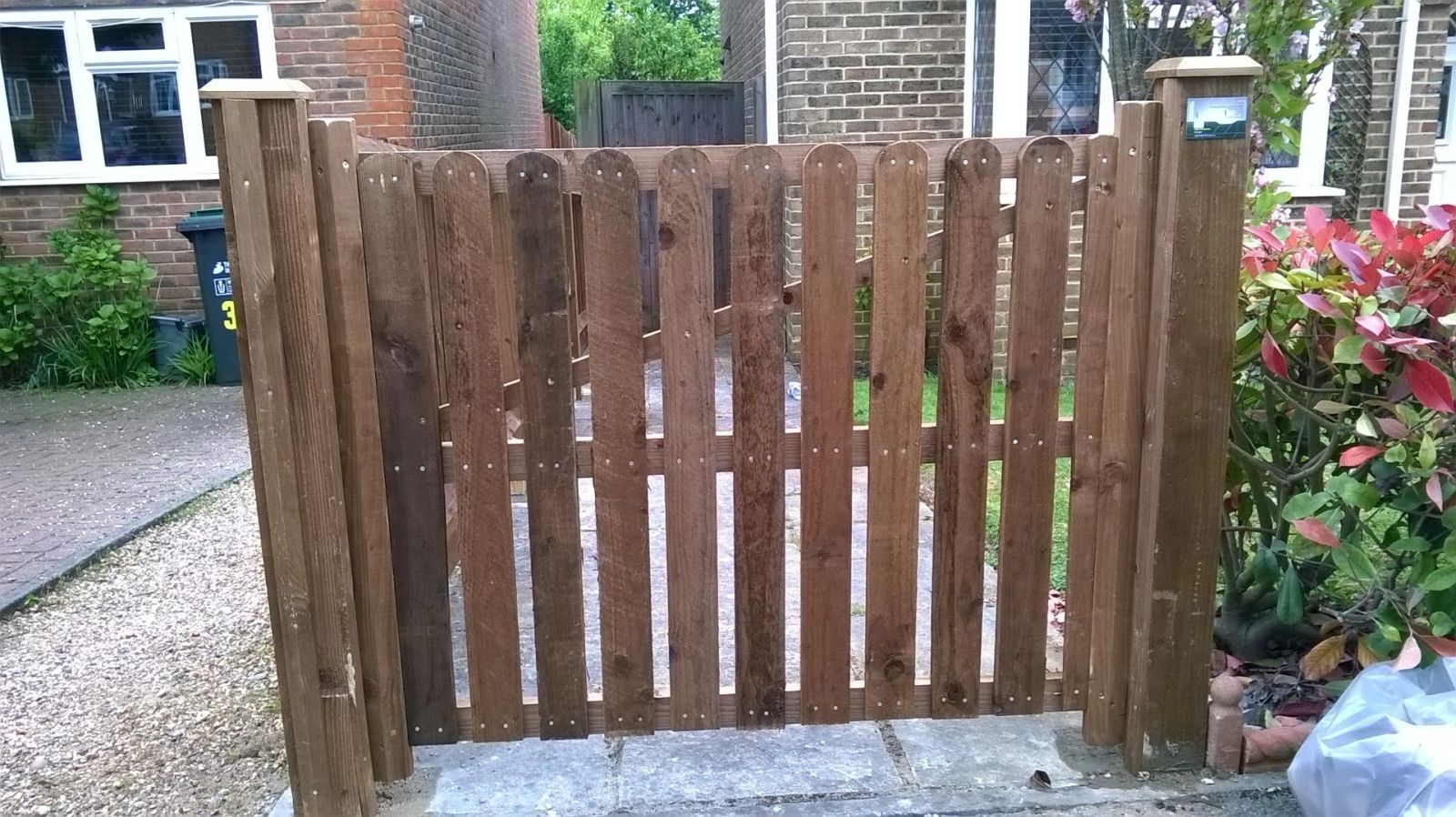
Picket fencing trades privacy for a lower, more open boundary, which suits front gardens where sightlines to the street and a welcoming appearance matter more than screening.
Picket spacing is a genuine design choice — narrower gaps look more traditional and offer a bit more containment for small pets, while wider spacing uses less timber and lets more light and air through a planted border behind it.
Because picket fencing is low, it rarely needs the same post depth as a taller closeboard run, though corner and gate posts still need proper concrete footings regardless of the fence's height.
Timber choice for a long-lasting gate
A gate takes more repeated stress at its joints than a static fence panel ever does, so a denser hardwood section at the hinge stile holds up noticeably better over time than a standard softwood frame in the same position.
Full treatment penetration at the joints matters more on a gate than anywhere else on the boundary, since that's where moisture gets trapped.
Cleat fixing at pale-to-rail junctions
Pales are commonly bolted to rails through a cleat rather than welded, because a bolted cleat can be replaced individually if a pale is damaged, whereas a welded joint means cutting into the rail to make a repair.
Cleats are punched to match the pale profile so the fixing sits flush rather than proud, and a mismatched cleat left loose is one of the more common defects found on an older palisade run at survey stage.
Repairing stock fencing pushed over or leaned on by animals
Fencing bordering land grazed by livestock takes a different kind of load to a garden boundary — sustained leaning and rubbing rather than occasional wind load — and posts along that kind of boundary often fail by gradually leaning outward rather than snapping.
Repair on this type of boundary is worth specifying with a stronger post spacing or additional strainer posts at intervals, since a repair matching a garden-fence specification often fails again quickly under the same ongoing pressure.
Timber stain versus paint breathability
A translucent or semi-transparent stain generally remains vapour-permeable, allowing moisture that gets into the timber to escape back out again as the wood dries, which reduces the risk of trapped moisture driving rot.
Solid, opaque paint films are often less permeable, and a paint film that cracks or is breached can trap moisture behind it against the timber, sometimes accelerating localised decay compared with an unpainted equivalent.
Modern microporous exterior paints aim to combine paint's fuller colour coverage with a degree of vapour permeability, narrowing but not eliminating this trade-off between appearance and moisture management.