Access through a house for a rear repair
Where a rear garden has no side access, materials and tools sometimes have to be carried through the house itself, which needs agreeing with the client in advance and protecting flooring and doorways along the route.
This is more common on terraced properties than detached ones, and it's worth factoring into how a repair is scheduled and priced.
Nail versus screw fixing on repairs
Nailed fixings are faster to install and are the standard on new panel builds, but a screwed fixing holds better in timber that's already slightly softened by weathering, which makes screws the more reliable choice on a repair into older stock.
Screws also allow a board or rail to be removed cleanly if it needs replacing again later, whereas a nailed fixing usually damages the surrounding timber on removal.
Dealing with a feather-edge board that has cupped
A board cups when one face dries and shrinks faster than the other, usually where the weathered outer face has taken more sun and rain cycling than the sheltered inner face, and it's most common on wide boards cut from flatter-sawn stock.
A cupped board rarely flattens back out once set, so repair is a straight swap rather than an attempt to refix it flatter, and choosing narrower or more vertically grained replacement stock reduces the chance of the same board cupping again.
Trellis toppers and wind load
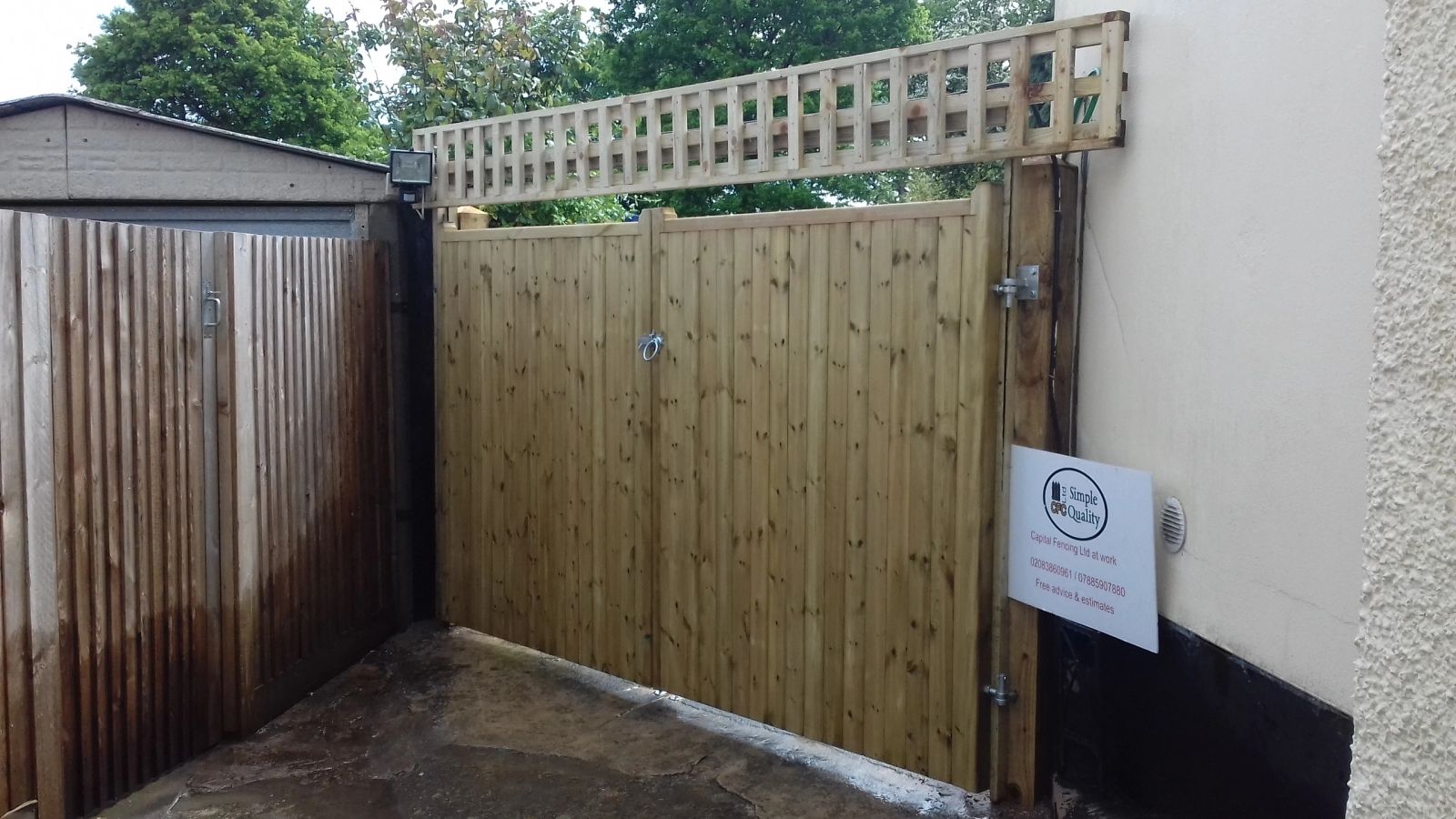
A trellis topper adds height to an existing or new fence — commonly for climbing plants or extra privacy — and because it's open lattice rather than solid boarding it adds relatively little wind load for the height gained.
That's useful on boundaries close to the 2m permitted development limit, where a solid panel extension would push both height and wind loading up together, but it only works if the topper is genuinely open lattice rather than a solid infill dressed up as trellis.
Fixing a topper to an old or undersized post rather than the fence itself is the most common reason toppers come loose, since the extra leverage at height needs a post that was sized for it from the start.
Trellis toppers and additional wind load
Adding a trellis topper to increase privacy height also increases the wind load a fence has to carry, since even open lattice trellis catches more air than its slim appearance suggests, especially once climbing plants fill in the gaps.
Posts sized correctly for a 1.8m panel don't automatically have the reserve strength for panel-plus-trellis at 2.1m or more, particularly on an exposed run.
Where a taller finished height is wanted, it's worth specifying posts for the full combined height from the outset rather than treating the trellis as a lightweight afterthought bolted to the top.
When deeds don't say who owns a boundary
It's common for older title deeds to be entirely silent on which side owns a given boundary, especially on properties built before detailed conveyancing plans became standard practice.
In that situation there's no single automatic rule that applies in every case, and long-standing practical evidence — who has always maintained the fence, existing physical features — can carry real weight.
Where ownership genuinely isn't clear, we'd always suggest raising it with the neighbour and, if needed, a conveyancing solicitor, rather than assuming a default answer.
Running bamboo and rhizome pressure on boundaries
Running bamboo species spread through underground rhizomes that can travel several metres from the parent plant and push up through gravel boards, path joints or even through weak points in a fence base.
Unlike tree roots, rhizome growth is fast and can reappear within a single growing season after being cut back, so a fence base alone rarely stops it without a physical rhizome barrier buried alongside it.
Where established running bamboo sits on a neighbouring boundary, it's worth flagging to the client that fence replacement won't solve the underlying spread on its own.
Licences for scaffold or skip on the highway
Placing a skip, scaffold or hoarding on the public highway, including the pavement outside a property, needs a licence from the council's highways team, arranged before the item arrives rather than after a complaint.
Licences typically specify lighting, cones or barriers around the obstruction overnight, a maximum duration, and sometimes a requirement for the skip to be removed or covered at weekends, with conditions varying between boroughs.
Unlicensed obstructions can result in a fixed penalty or a requirement to remove the item at short notice, so on any job needing highway space for materials or waste it's worth building the licence lead time into the programme.
Powder coating versus galvanising for steel security fencing
Hot-dip galvanising bonds a zinc layer to the steel that self-heals minor scratches through sacrificial corrosion, making it the more durable base finish for an exposed or coastal boundary.
Powder coating adds colour and a smoother surface but relies on the coating staying intact — galvanised-then-powder-coated steel combines both, giving corrosion protection under a decorative finish, and is the usual spec where appearance matters as much as longevity.
Curing time before hanging panels or gates
Post-fixing concrete reaches a usable strength within a day or two but continues gaining strength for weeks afterwards, which is why manufacturers usually specify a minimum wait — commonly around 24-48 hours in mild weather — before loading a post with a panel.
Hanging a heavy gate is a bigger test of an early-cured base than fixing a lightweight panel, since the gate applies a constant leverage on the post rather than a static side load, so gate posts generally want the longer end of any recommended cure window.
Cold weather slows the chemical reaction that hardens concrete significantly, so a cure time that's fine in summer may need extending in winter before it's safe to load the post.
Narrow access and carrying materials by hand
Where there's no side access wide enough for a barrow, materials have to be hand-carried through the house or over a boundary, which changes both the time a job takes and the choice of components — shorter, lighter sections are far easier to move this way than long concrete gravel boards.
Protecting internal flooring and doorways during a through-house carry is worth agreeing before the first delivery arrives, since a scuffed hallway wall is one of the most common complaints on this kind of access.
On some terraces the only alternative is craning or lifting material over a roof or side wall, which needs its own access and safety plan rather than being treated as a simple manual carry.
Checking for secondary damage after a fence has fallen flat
Once a section of fence has actually fallen rather than just leaning, it's worth checking what it fell onto or against — a shed, a parked car, planting — since secondary damage from the fall is sometimes the more significant repair cost.
The fallen section itself also needs assessing for whether any timber is still reusable, since a fall can snap fixings without necessarily destroying the panel or boards, which affects how much of the repair is replacement versus refitting.
Timber species and surface spread of flame
Untreated softwood used for fencing and cladding has a fairly modest natural resistance to flame spread, and where fencing sits close to a building boundary, some specifications reference surface spread of flame classification for the cladding or fencing material used.
Flame-retardant treatments can be applied to timber to improve its classification, working by charring the surface to slow flame spread rather than by making the timber genuinely non-combustible.
This consideration applies mainly to close-boundary or party-wall-adjacent structures rather than typical open garden fencing, where fire classification of the timber itself is rarely a specified requirement.
Timber species and seasonal movement differences
Softwood gate frames move more with seasonal humidity changes than a hardwood equivalent, which is why a softwood gate that fitted well in summer can bind noticeably by winter, while a well-seasoned hardwood frame shows less variation.
Understanding which timber a gate is built from helps set realistic expectations for how much seasonal adjustment it will need rather than treating every gate the same way.
Coordinating a dropped kerb with a new vehicle security gate
A new vehicle gate needs a dropped kerb or existing crossover in the right position before it's ordered, since a gate that opens onto a kerb face rather than a level crossover will scrape or jam on every use.
Where no dropped kerb exists, this is a highway authority matter separate from the fencing work itself and needs its own approval and lead time, which is worth flagging early so the gate installation isn't delayed waiting on it.
Hedge pressure on a fence line
An unmanaged hedge planted close to a boundary fence pushes against the panel or rail as it thickens, and that steady lateral pressure can bow a panel or rack a post over several seasons even without any storm involved.
Cutting the hedge back from the fence line at repair time reduces the chance of the same section failing again shortly after.
Boundary fence position relative to a neighbour's extension
A recently built extension or conservatory next door can sometimes have its own planning conditions relating to adjacent boundary treatments, particularly around overlooking or privacy screening.
Where this applies, it's the extension's planning history rather than general permitted development rules that governs what's expected at that specific boundary.
Checking a neighbour's relevant planning permission, available on the council's public register, can clarify this before assuming standard rules apply to that stretch of boundary.
Temporary fencing while a permanent boundary is rebuilt
Removing an old boundary fence before the new one is built leaves a gap that matters for security, for keeping pets or children contained, and for site safety around an open excavation.
A simple temporary screen — netting on stakes, or hurdles wired together — bridges that gap without committing to a full second install, and is worth agreeing with the client if the job will span more than a day.
On a site backing onto a road, path or shared area, a temporary barrier around open post holes overnight is also a basic precaution against someone stepping into an unmarked hole in the dark.
Fixing a fence run to an existing masonry wall
Tying a timber fence into an existing brick or block wall usually means fixing a timber post or batten flat to the wall face with masonry bolts or heavy-duty frame fixings rather than digging a post hole hard against the footing.
The wall's own condition matters before any fixing goes in — loose pointing, spalled brick faces or a wall already leaning shouldn't be relied on to carry lateral load from a fence panel.
Where the wall belongs to a neighbour or is shared, fixing into it without agreement can be a boundary matter in its own right, separate from the fencing work itself.
Night latches on garden and side doors
A night latch, more commonly seen on house front doors, is sometimes fitted to a solid garden door or side gate door for self-latching convenience, engaging automatically on closing while still allowing free egress from inside.
It needs a solid, well-fitted frame to work reliably outdoors, since timber movement that would be barely noticeable indoors can be enough to throw an exterior-mounted night latch out of alignment.
Realistic panel replacement frequency on an exposed plot
A standard timber panel on a sheltered suburban plot might reasonably be expected to last a decade or more before replacement; the same panel on a genuinely exposed, wind-loaded boundary can fail in structural terms — cracked rails, a bowed or blown-out panel — well inside that timeframe regardless of treatment quality.
Setting client expectations around this at quote stage, rather than after an early failure, avoids the impression that a product or installation was faulty when the real cause is unmanaged exposure.
Where budget allows, specifying for the exposure from the outset is cheaper over the fence's life than replacing a standard panel repeatedly on the same exposed run.
Ground movement and gate frame problems
Ground movement under a gate post — from clay shrinkage in dry summers or waterlogging in wet winters — is a common cause of a gate that suddenly starts sticking or dropping after years of working fine.
We check whether the post itself has moved before assuming the fault is in the hinges or the gate face.