Boundary fencing near a service riser or meter cupboard
A boundary fence positioned close to a gas, electric or water meter cupboard needs to leave clear access for the utility to read or maintain the meter without needing a key to the fence itself, which sometimes means a lockable inspection gate or a section that opens independently of the main line.
Utility providers generally have a minimum clearance requirement in front of a meter cupboard door, and a fence encroaching on that clearance can be flagged at inspection even if the rest of the boundary is compliant.
Simple maintenance that prevents gate failure
Checking hinge screws are still tight and that the gate still closes flush against the frame once or twice a year catches the early stages of sag before it becomes a full repair job.
A gate that's starting to catch on the ground is far cheaper to fix at that stage than after the frame has racked further out of square.
Bin store gates and repeated daily wear
A gate fitted to a bin store gets opened and closed far more often than a garden gate used a few times a week, which accelerates hinge and latch wear well beyond what the timber or hardware size would normally suggest.
Specifying hardware rated for frequent use, rather than standard light-duty fittings, reduces how often these gates need attention once installed.
Managing noise during a security fence installation
Post-hole augering, breaking out old concrete footings and cutting steel palisade to length all generate noise that's worth flagging to neighbours or site occupants in advance, particularly on a compound or commercial job with fixed working hours nearby.
Where a site has noise-sensitive neighbours, sequencing louder tasks earlier in the working day and confining cutting to one area reduces the disruption without slowing the job significantly.
Restrictive covenants on newer estates
Many post-war and modern estates carry restrictive covenants in the original transfer deeds that go beyond planning law, commonly limiting fence height, requiring a specific style, or banning solid boundary treatments on front gardens entirely to preserve open-plan sightlines.
These covenants are a private legal matter between landowner and the estate's management company or original developer, so full planning permission being unnecessary doesn't mean the fence is automatically allowed.
Breach of covenant is usually enforced by a neighbour, resident's association or management company rather than the council, and can result in a requirement to remove the work at the owner's cost, so checking the title register for covenants before ordering is worthwhile on any estate build.
Fencing near listed buildings
Listed building consent applies to works that affect the character of a listed building, and that can extend to boundary treatments within its curtilage even where the fence itself isn't old or notable.
In practice this usually means sticking to traditional materials and profiles — timber rather than metal panel systems, painted rather than stained finishes matching existing joinery — and checking with the conservation officer before ordering rather than after installation.
Unauthorised alterations near a listed building can require reversal at the owner's cost, so a five-minute enquiry call is cheap insurance against a much more expensive mistake.
Rising butt hinges for self-lifting clearance
A rising butt hinge lifts the gate slightly as it opens, which helps it clear a rug, threshold upstand or slightly uneven paving that a standard hinge would catch on, then lowers it again as it closes.
They're more common on side gates and garden doors than on driveway gates, where the clearance problem they solve is less likely to occur.
Boards splitting along the line of the fixing nail
A board that splits at a nail has usually been fixed too close to its edge or fixed with the nail driven into an existing check in the grain, and the split then runs further with each wet-dry cycle until the board finally lets go.
Repair is either refixing with screws set further from the edge and pre-drilled to avoid a repeat split, or replacing the board outright where the split has already reached the board's full width.
Temporary hoarding compared with a permanent boundary fence
Temporary site hoarding erected during building works is generally treated differently under planning rules to a permanent boundary fence, often allowed for a limited period without full permission where it's clearly temporary and related to authorised works.
Problems arise where hoarding intended as temporary is left in place indefinitely once building work finishes, which can then be treated as an unauthorised permanent structure.
Anyone planning to convert temporary site hoarding into a permanent boundary feature should check whether separate permission is needed rather than assuming continuity is automatic.
Downpipe discharge points near a fence base
A downpipe discharging directly onto open ground near a fence line, rather than into a proper drain or soakaway, concentrates a large volume of roof water at one specific point along the boundary during heavy rain.
Over time this creates a permanently saturated patch that behaves like a high water table locally, even though the rest of the garden drains normally.
Redirecting the discharge with a short length of pipe or a small soakaway a metre or two from the fence line resolves the issue far more effectively than trying to compensate with a more resistant post base.
Utility marker posts near a boundary line
Small yellow, blue or red marker posts near a boundary often indicate a buried gas, water or telecoms service running close to or along the line, placed there by the relevant utility company.
These markers are a useful early warning but aren't a precise map, so it's still worth requesting formal utility plans from the relevant providers before digging post holes nearby.
Damaging a utility service while digging can be both costly to repair and, in the case of gas or high-voltage cabling, genuinely dangerous, which is why checking first matters more than the fence design itself.
Choosing a self-closing mechanism for pool or drive gates
A spring-loaded hinge, hydraulic closer, or gravity-hinge design (where the hinge itself is angled so the gate swings closed under its own weight) each achieve self-closing in a different way, with different maintenance needs and different feel in use.
Gravity hinges are mechanically simple and low-maintenance but rely on the gate post and hinge post staying accurately set, since any settling changes the closing behaviour.
Hydraulic or spring closers give a more consistent, adjustable close but are an additional mechanical component that itself needs occasional servicing or replacement over the gate's life.
Aluminium extrusion profiles
Aluminium fencing and gate components are typically formed by extrusion, forcing heated aluminium billet through a shaped die to produce a continuous profile with a consistent cross-section, which allows complex hollow or ribbed shapes not practical in sawn timber or rolled steel.
Extruded profiles are usually finished with an anodised or powder-coated surface, since bare aluminium forms a natural oxide layer that resists corrosion well but can look dull and inconsistent if left unfinished.
Aluminium's lower strength relative to steel for a given section size means extruded profiles are often designed with internal ribbing or a boxed cross-section to achieve adequate rigidity without excessive material thickness.
Boundaries against a railway embankment
A boundary running along a railway embankment is very often owned and maintained by the railway infrastructure operator rather than the adjoining householder, and any work close to the operator's land, including digging near its toe or crest, usually needs prior notice or permission.
Embankment ground can also be made up of variable historic fill rather than natural strata, since many were built up from spoil during original construction, which affects both digging and the stability assumptions for post bases near the base of the slope.
Access for materials and machinery along these boundaries is frequently restricted, so confirming land ownership and any operator consent needed is a necessary step before quoting the work.
Snapped concrete posts and slotted-panel swaps
A slotted concrete post system lets a panel be lifted out and a new one dropped in without disturbing the posts either side, which makes panel replacement quick, but the post itself is far less forgiving to repair once it's cracked or snapped.
A snapped concrete post is generally replaced outright rather than patched, since a repaired crack under load doesn't reliably hold the same weight as the original casting.
Picket profiles and spacing
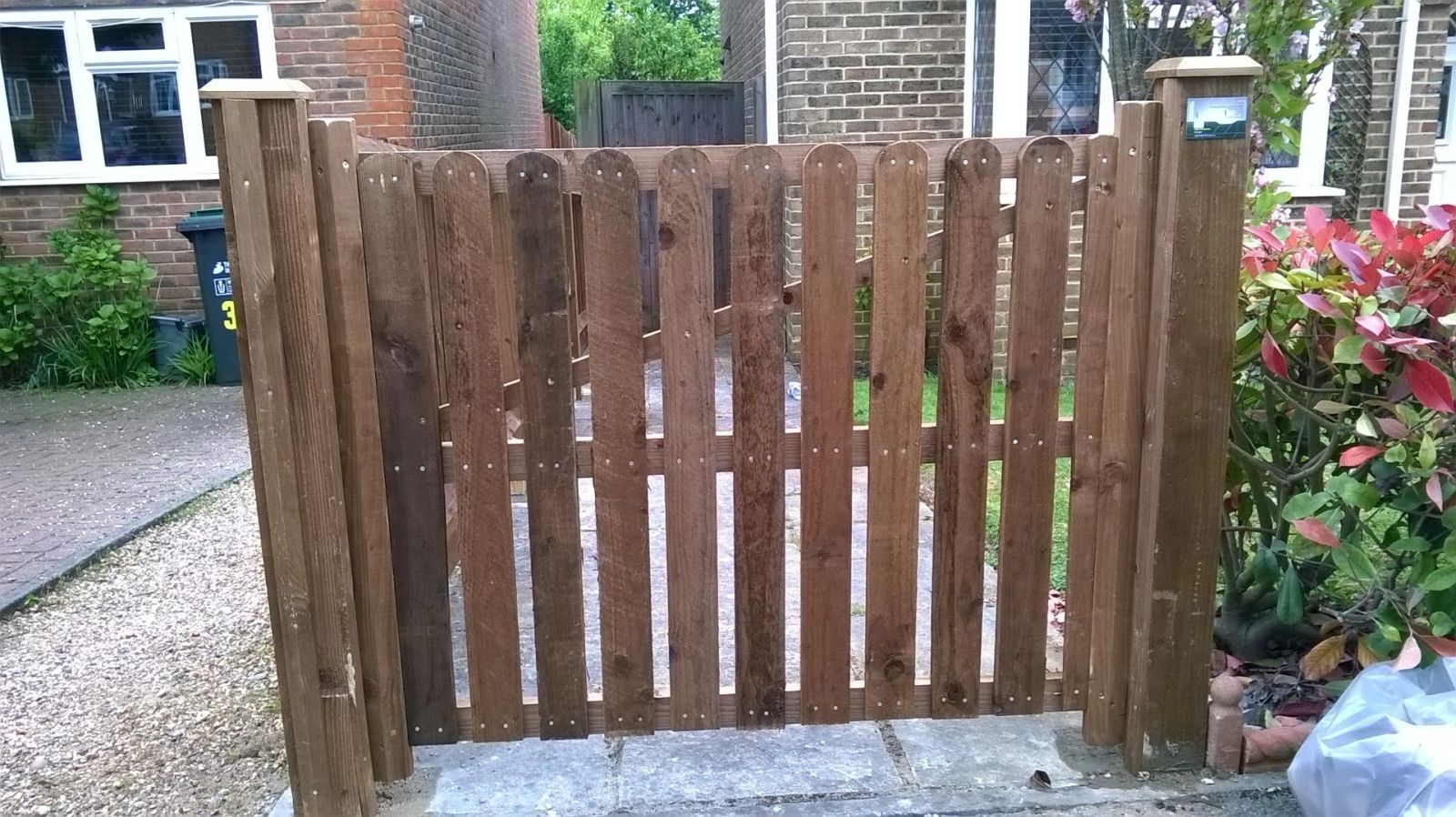
Picket fencing is defined as much by the top profile of each paling — pointed, rounded, flat or 'gothic' — as by the gap between them, and both are usually specified rather than left to whatever the yard has in stock.
A tighter spacing, close to the paling's own width, gives a more solid boundary marker and better contains small pets; a wider spacing is more open and traditionally cottage-garden in character but does less to define a boundary.
Picket is a low-privacy, low-height fence by design, generally under a metre, and isn't a substitute for a taller closeboard or panel run where genuine screening is the aim.
Composite versus timber
Composite decking and fencing boards trade a higher upfront cost for lower ongoing maintenance — no annual staining or oiling, and better resistance to rot in permanently damp or shaded spots where timber struggles.
The trade-off is that composite doesn't weather the way timber does; it stays close to its original colour rather than silvering or taking on the character some clients want, and off-cuts and end sections need cutting and capping carefully to stop moisture getting into the core.
For a boundary fence that's mostly out of sight, timber with a reapplied treatment every few years is often the more economical long-term choice; for a heavily-used deck, composite's lower maintenance burden usually wins out.
Clearing storm and repair debris
Broken panels, snapped posts and old concrete are cleared and taken off site as standard on any repair, rather than left in the garden for the client to deal with separately.
Where a repair follows a storm, we also check for and clear any debris that's blown into the garden from elsewhere, not just the fence materials themselves.
Concreted posts against bolted baseplates for a semi-permanent compound
A concreted post gives a stronger, more permanent fixing appropriate to a fence expected to stay in place indefinitely, but it's disruptive and costly to remove if the boundary line needs to move later, such as when a leased yard's layout changes.
A bolted baseplate fixed to an existing hardstanding trades some ultimate strength for the ability to relocate or remove the fence relatively cleanly, which suits a semi-permanent compound on a leased site better than a fully concreted installation.
Testing timber moisture content before deciding on a repair
A moisture meter reading on a post or board gives a more reliable picture of remaining life than appearance alone, since timber can look weathered but still be structurally sound, or look reasonably clean-faced while being saturated and soft just beneath the surface.
This is particularly useful where a client is unsure whether a section needs full replacement or can be left, since a moisture reading gives a specific figure to base that decision on rather than a subjective visual judgement.
Land registered as a town or village green
Land formally registered as a town or village green carries strong legal protection against enclosure or obstruction, including from fencing, under the Commons Act 2006.
This status can sometimes apply to open spaces that don't look obviously like a traditional village green, following a successful community application to register them.
Checking the relevant register before fencing land bordering an open green space avoids inadvertently obstructing protected land.
Lichen colonising capping and post tops
Lichen tends to establish on horizontal or gently sloped timber surfaces that stay damp longest, which makes flat-topped capping and post caps more susceptible than the vertical panel faces below them.
Unlike algae, lichen grows slowly and bonds tightly to the timber surface, so a stiff brush rather than a pressure washer is usually needed to remove it without damaging the wood fibres underneath.
Once removed, a capping profile with a fall to shed water reduces how quickly lichen re-establishes compared with a flat top that holds a film of moisture after every rain.